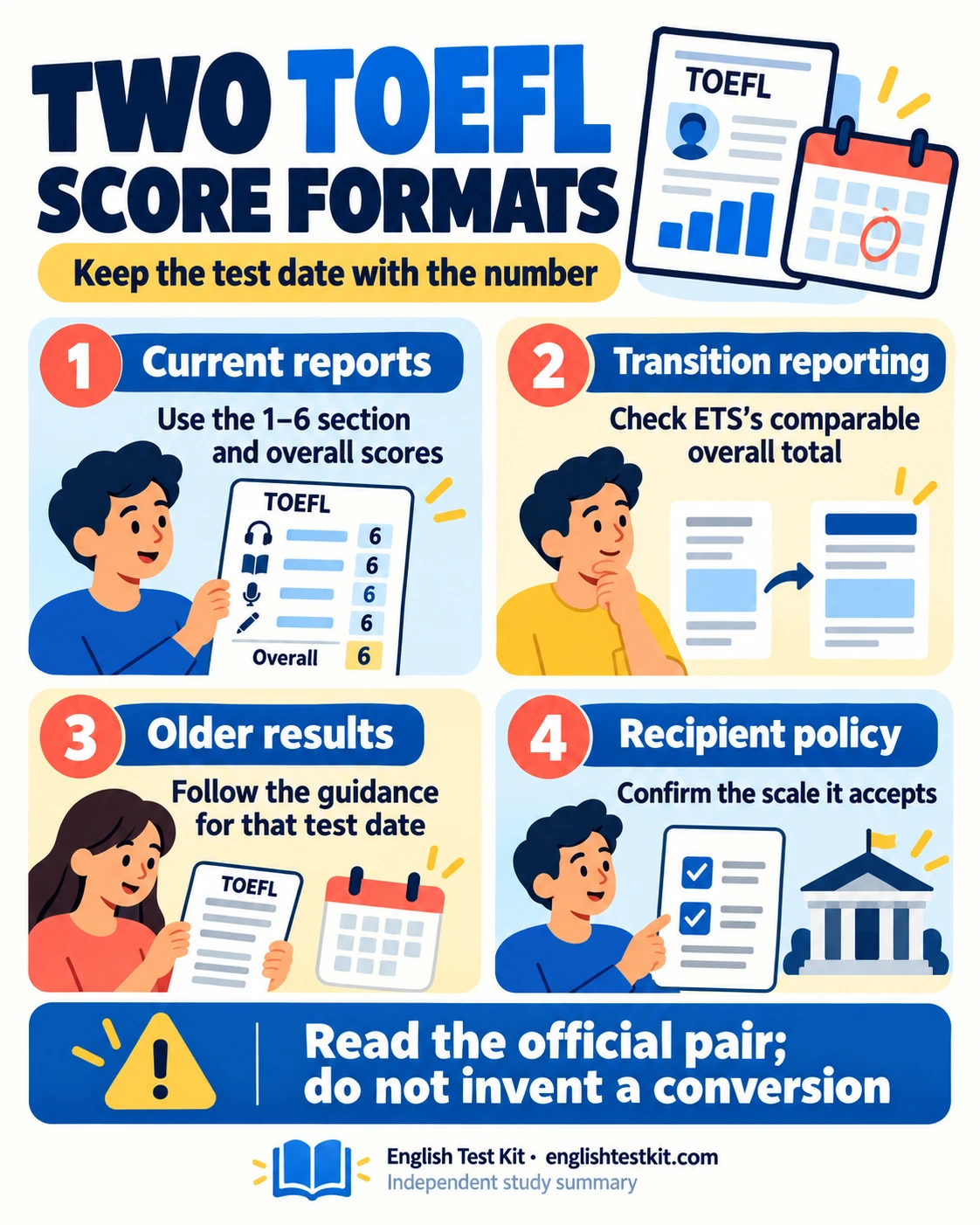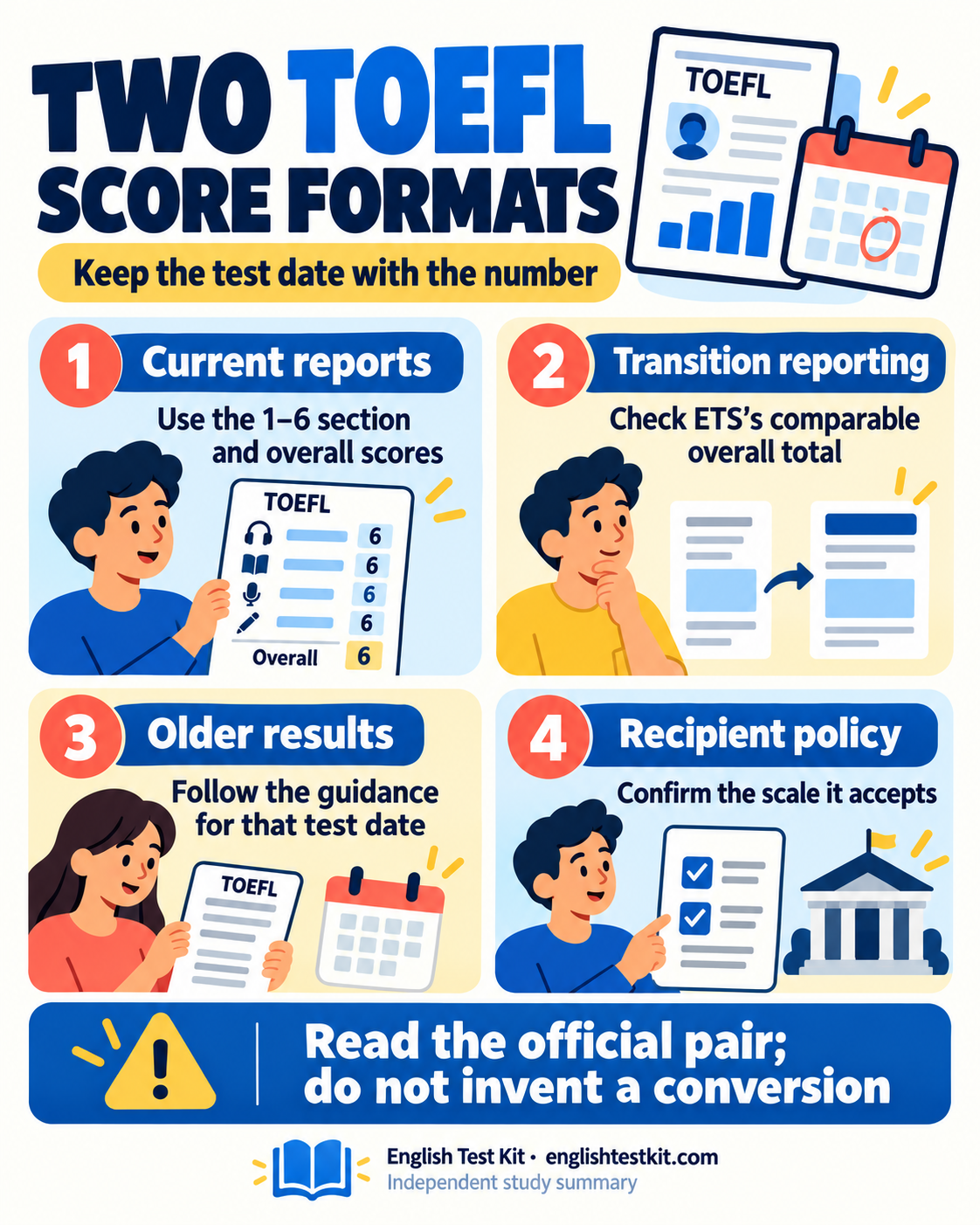
Comparing TOEFL score formats requires attention to the test date and the purpose of the comparison. A current report with a comparable overall total is not the same document as a legacy report or an unofficial conversion chart. Use the official values and ask the recipient how it applies a requirement that still uses older terminology.
The new report can bridge the two formats
ETS introduced the 1–6 banded scale on January 21, 2026. During a two-year transition period, the official report also includes a comparable overall score on the familiar 0–120 scale. ETS’s June 2026 explanation says the dual-format report is provided through January 2028. If an institution still lists a 0–120 requirement, read the comparable total on your official report and confirm how that program handles the change.
For a current test, use the score pair printed by ETS rather than calculating your own conversion.
The 0–120 figure is a comparable estimate for the overall total; keep the four new section scores with it.
Institutions update their rules at different times, so ask about the score scale, section minimums and test options if the policy is unclear.
Do not mix up test dates and comparison tables
ETS also publishes comparison tables for scores from tests taken before January 21, 2026. Those tables help interpret legacy results; they are not a substitute for the comparable 0–120 estimate printed on a current test report. For example, ETS describes 4.5 as accompanied by a comparable 90 estimate, based on the midpoint of the corresponding old-scale range. The estimate is a reference point, not a personal score conversion. TOEFL scores are valid for two years, so applicants may encounter both formats while older results remain valid.
A simple check before you submit
Open the receiving school’s official English-language requirement page. Note the minimum total, any minimum score for an individual skill, accepted test setting, MyBest policy if relevant, and score validity date. If the page uses only the old scale or is ambiguous, contact the program and ask which value on the ETS report it wants.
The receiving institution decides which tests and scores it accepts. ETS provides score reporting; it does not decide an applicant’s admission outcome.
Identify the document before comparing numbers
Start with the report's test date and scale. Then identify whether the recipient asks for an overall result, section minimums or both. A legacy section score and a current band are not interchangeable units that can simply be added or averaged together. Keep each report's own labels intact.
A comparison table can help explain a broad relationship between scales, but it should not replace the values printed on an individual's official report. The distinction matters when a table describes a range while a report gives a particular comparable estimate. Do not select whichever interpretation looks most favourable for an application.
A fictional recipient-enquiry example
Imagine a programme's page still lists a minimum on the 0–120 scale, while your current official report uses the 1–6 section and overall bands and includes the provider's comparable overall figure. A useful enquiry would say which test date and report format you have and ask which reported value the programme uses for its requirement.
Also ask about any section minimums. An overall comparison does not automatically settle a requirement about Writing or Speaking. This is an administrative clarification, not a request for the programme to invent a new score. Keep its response with the requirement page and your report.
Avoid misleading arithmetic
Do not add a current band from one attempt to an old-scale section score from another. Do not convert each practice question into a fraction of an old total or assume that a midpoint in a comparison range predicts your own performance. The official reporting process and any valid combined-score feature should be used as described by the provider.
For learning, the more useful question is often which skill is below the recipient's requirement and what the task evidence shows. A conversion exercise can consume time without identifying a single change to your preparation.
Review older materials for the right purpose
An older book can still help vocabulary, reading or listening, but it may describe different task formats and report scales. Mark it as general skill practice where appropriate and add current official familiarisation for the booked test. Avoid using the presence of useful English exercises as proof that the book is a complete current-format mock test.
Keep a clear submission record
Save the official report, test date, recipient's requirement, clarification about scale and any section conditions. Check validity and delivery arrangements separately. A correct comparison is useful only when the accepted report reaches the right recipient in time. If a policy changes, repeat the check with the current official guidance rather than relying on a previous applicant's experience.
Save your one-page study summary