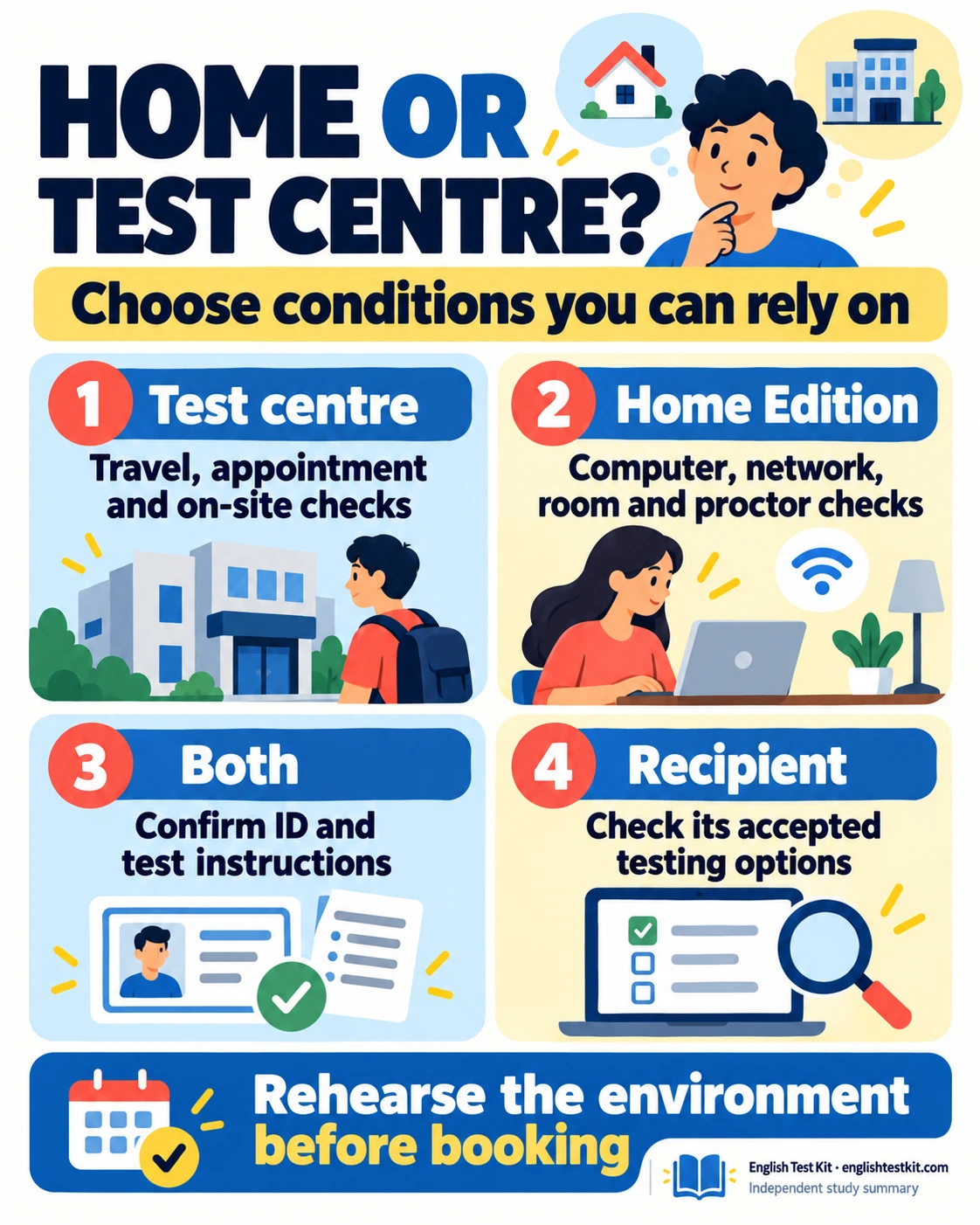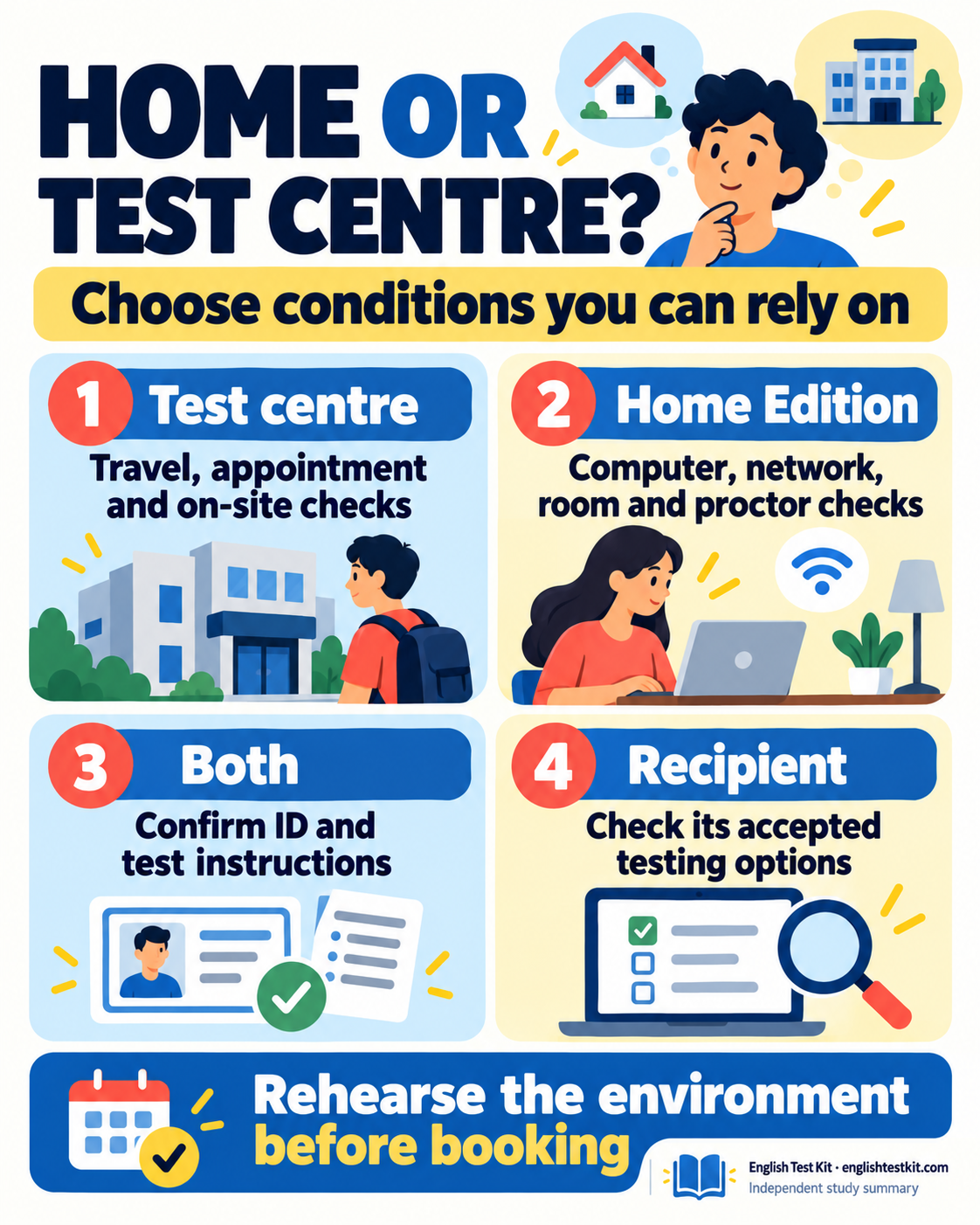
Choosing a TOEFL setting is partly a question of concentration and reliability. The test-centre and Home Edition options have different practical demands, so compare the conditions you can actually provide. Confirm the receiving institution's policy and the current provider requirements before treating convenience as the deciding factor.
Two ways to take the TOEFL iBT
ETS offers the TOEFL iBT at an authorized test center or as the Home Edition. At a test center, you take the computer-based exam at the selected location. For the Home Edition, you take the test on a computer at home and are monitored online by a human proctor. ETS describes the Home Edition as the same TOEFL iBT test; the setting and logistics differ.
A practical comparison based on ETS testing-option guidance.
Consideration | Test center | Home Edition |
|---|---|---|
Where | Authorized test center. | A private location that meets ETS requirements. |
Supervision | On-site test-center procedures. | Online human proctor. |
Before booking | Check location, available date and identification rules. | Check computer, internet, room and environment requirements. |
Institution policy | Confirm the program accepts the test and your score. | Confirm the program accepts this setting and your score. |
Choose based on your real testing conditions
A test center can provide a dedicated testing environment but requires travel and a suitable appointment. The Home Edition avoids travel, but the room, computer and network need to meet ETS requirements and remain suitable for online proctoring. Choose the environment in which you can follow the rules and concentrate reliably.
Check these details before registering
Confirm current availability for your country and preferred test date in the ETS registration system.
Review identification requirements and test-day rules for your chosen setting.
For Home Edition, run the required equipment checks and read the current room rules before booking.
Ask your receiving institution whether it accepts the test setting and any MyBest scores you plan to send.
Availability, appointment terms and technical requirements can change. ETS’s current registration and testing-option pages take precedence over this overview.
Work through two realistic scenarios
Imagine a learner with a quiet private room, a suitable computer and a stable connection, but a long journey to the nearest available centre. Home testing may be worth investigating, provided every current equipment, room and proctoring requirement can be met and the recipient accepts that option. Convenience alone does not establish compliance or acceptance.
Another learner shares a room, has unpredictable interruptions and cannot guarantee a suitable testing environment. A test centre may offer a more dependable arrangement, even with travel. These fictional examples show how to compare conditions; they are not a universal recommendation that one setting produces a better score.
Evaluate the full environment
For Home Edition, review the provider's current equipment and room guidance, complete the required checks and rehearse the actual arrangement in advance. Consider access to power, connection reliability, visibility and the ability to remain uninterrupted. Use official support if a compatibility or setup question is unclear rather than relying on a workaround described for another candidate.
For a test centre, check the location, arrival instructions, identification, journey and any accessibility arrangements you need. Plan enough travel margin to avoid beginning the test distracted by a preventable delay. An authorised centre still has specific check-in procedures that should be read before the appointment.
Keep task preparation and setting preparation separate
A reliable room does not replace knowing the current tasks, and strong English does not remove technical or administrative requirements. Use one checklist for reading, listening, writing and speaking readiness and another for the appointment environment. This makes it easier to see what remains unresolved.
For example, an interview-style speaking answer should be rehearsed with actual spoken delivery, not only a written plan. A home setup check should test the required equipment and conditions, not simply whether a video call worked once. Each rehearsal needs evidence relevant to its purpose.
Ask the recipient precise questions
Confirm whether the institution accepts the testing option you intend to use and which score and date conditions apply. If you plan to use MyBest, check that policy separately. A general statement that TOEFL is accepted may not answer every programme-specific condition, especially when a page is unclear or uses older wording.
Keep the requirement and any clarification with your booking details. If your application or testing plan changes, revisit the comparison rather than assuming that a previous answer still settles the new situation.
Before committing to an appointment
Identify the accepted setting, verify the requirements you must meet, test the practical arrangement and resolve questions through the official provider or recipient. Then make the decision using the conditions available to you, not an online claim that a particular setting is inherently easier. The most useful choice is the one that is accepted, compliant and predictable enough for you to concentrate on the assessment.
Save your one-page study summary