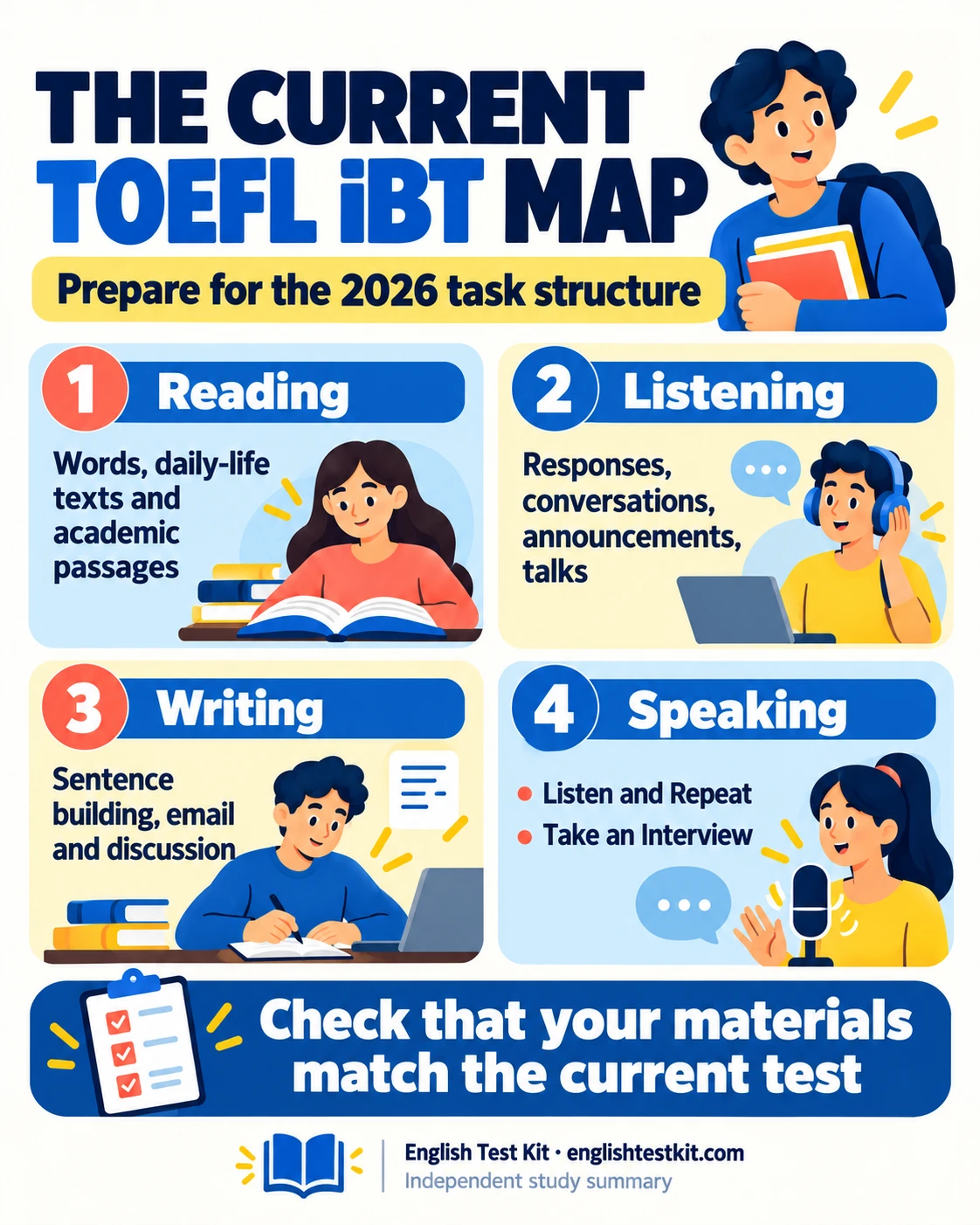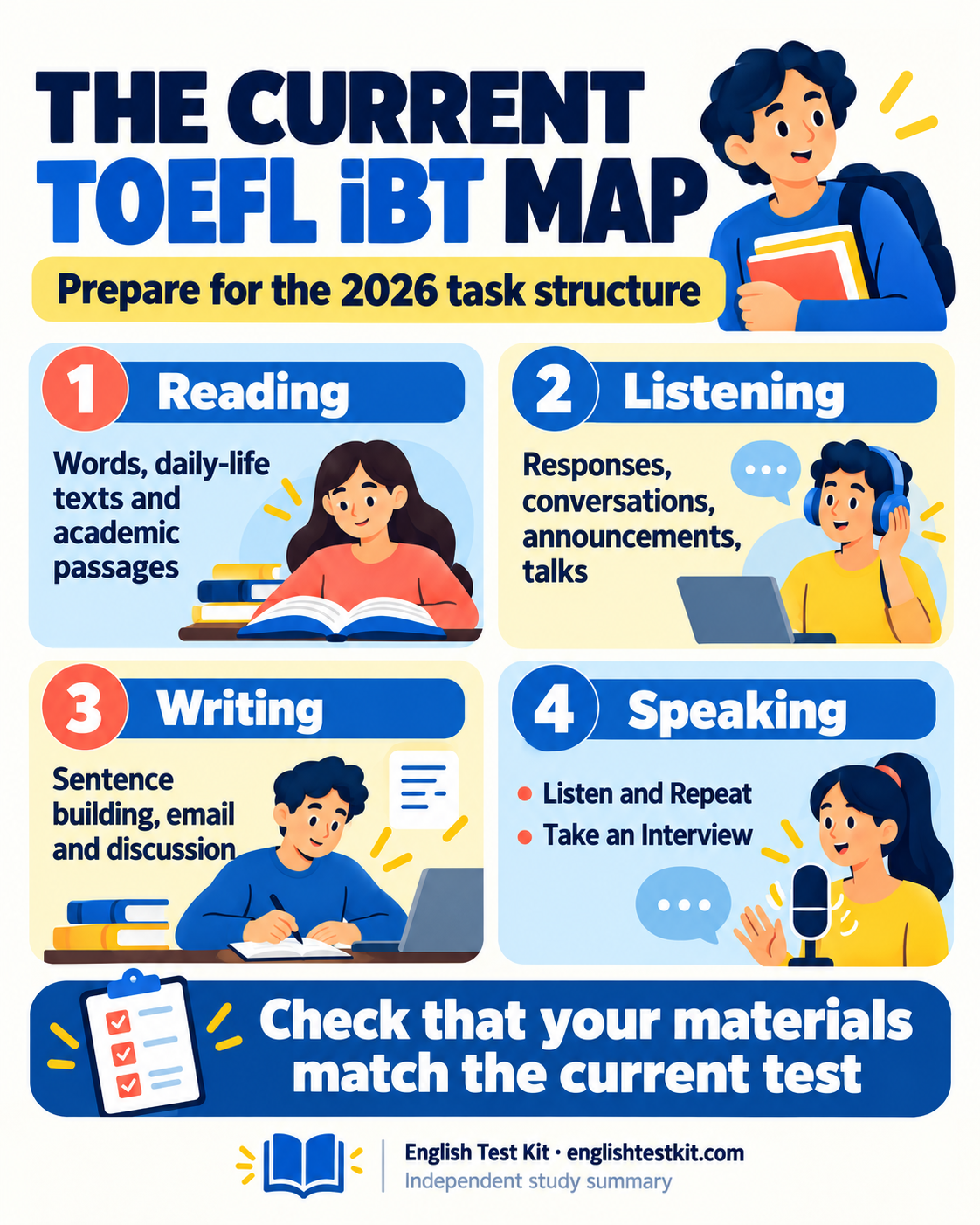
The current TOEFL iBT requires preparation for a refreshed mix of reading, listening, writing and speaking tasks. Use the section map as a starting point, then practise the different response actions. A resource that develops general English can still be useful while failing to rehearse the current test, so label its purpose carefully.
The section order is Reading, Listening, Writing, Speaking
The TOEFL iBT assesses four English skills used in academic and campus settings. Since January 21, 2026, the test has a refreshed structure and task types. If a practice book or video describes long reading passages, integrated speaking tasks, or the old 0–30 section scales, check its publication date before using it as a guide to the current test.
ETS describes the complete test as approximately two hours. Its published section figures are base estimates: as the test adapts, the number of items and the time can vary. Use the table as an orientation, not a promise of an identical timer for every test taker.
Current TOEFL iBT section overview from ETS; item counts and base times may vary as the test adapts.
Section | Current task types | Items | Approx. base time |
|---|---|---|---|
Reading | Complete the Words; Read in Daily Life; Read an Academic Passage | 50 | 30 min |
Listening | Choose a Response; Conversation; Announcement; Academic Talk | 47 | 29 min |
Writing | Build a Sentence; Write an Email; Academic Discussion | 12 | 23 min |
Speaking | Listen and Repeat; Take an Interview | 11 | 8 min |
What changed in the current version?
The current format uses short, focused tasks across the four skills and adaptive delivery. Reading and Listening include a broader mix of everyday campus and academic material. Writing now includes sentence building and email writing alongside an academic discussion. Speaking centers on repeating short spoken sentences and answering interview-style questions.
The names of the tasks are useful preparation landmarks. Learn what each task asks you to do, then practise the underlying skill instead of memorizing a single response template.
Reading: complete words in context, understand practical short texts, and read an academic passage.
Listening: respond to a prompt and understand conversations, announcements, and academic talks.
Writing: construct a sentence, write an email for a situation, and contribute to a classroom discussion.
Speaking: repeat sentences accurately and respond clearly to interview questions.
ETS advises allowing about two hours. The approximate section times above exclude directions, and adaptive delivery can change item counts and time.
Choose a test setting that fits your circumstances
ETS offers the TOEFL iBT at authorized test centers and as the Home Edition, taken on a computer with an online human proctor. Before you register, check current local availability, the technical and room requirements for home testing, and the receiving institution’s rules. A test option being offered by ETS does not automatically mean every school or program has identical policies for it.
Test center: choose an available authorized location and review its check-in instructions.
Home Edition: confirm that your computer, internet connection, room, and test environment meet ETS requirements before booking.
A practical starting point
Begin with a timed diagnostic using material that follows the 2026 task types. Record how you perform in each skill, identify the tasks that slow you down, and build practice around those gaps. The section guides in this atlas explain what each task measures and offer study approaches; ETS remains the authority for official test rules and updates.
Check a resource before making it your main course
Look at the task list, score scale and update information. Current-format preparation should recognise sentence building, email writing, academic discussion, Listen and Repeat, and Take an Interview alongside the current comprehension tasks. Material centred on older integrated Speaking tasks may develop useful skills, but it should not be presented as a complete simulation of the current section.
Keep a small materials list with a purpose beside each resource: official familiarisation, task practice, vocabulary development or general academic listening. This prevents an older book from becoming the accidental authority for present-day directions. Use the live provider pages and your appointment instructions when details differ.
Try a diagnostic that samples different processes
Begin with a word-completion activity, a practical campus text and an academic passage. Follow with a short response-selection task and a longer listening situation. For productive skills, try sentence building, a short purposeful email, a discussion contribution, repetition and an interview answer. This is an independent diagnostic menu, not an official miniature test or a scaled-score estimator.
After each activity, record one observation. “I completed the word but chose the wrong grammatical form” differs from “I did not know the word”. “My email omitted the request” differs from “I answered the request but used unclear sentences”. These distinctions help you choose a task-specific correction.
A worked example of linking diagnosis to practice
Imagine a learner who understands the general topic of a campus notice but repeatedly misses conditions such as “only after approval”. Another learner reads the conditions accurately but struggles to explain an opinion in a spoken answer. More complete tests alone would not tell either learner what to change.
The first learner could practise identifying restrictions, dates and required actions in short texts. The second could plan a direct answer, a reason and a relevant example, then record a fresh response. Both should return to mixed practice after the targeted habit improves. A format map becomes valuable when it leads to this kind of decision.
Rehearse transitions and the testing environment
The response method changes across the test. Before each new task, identify whether you must complete, select, arrange, write or speak. Check the instructions and time available, then reset attention. Do not carry an essay structure into an email task or an interview strategy into exact repetition.
Once the tasks are familiar, practise longer sequences so you can observe concentration and pacing. Separately confirm test-centre or Home Edition requirements, identification, permitted materials and reporting arrangements. A predictable environment lets you focus on the language rather than preventable setup uncertainty.
Review the complete profile
Use official practice and informed feedback where available, while keeping practice estimates separate from certified results. Compare your progress with the actual overall and section requirements of the recipient. The goal is current-format readiness across all four skills, supported by evidence of what you can do consistently on unfamiliar material.
Save your one-page study summary