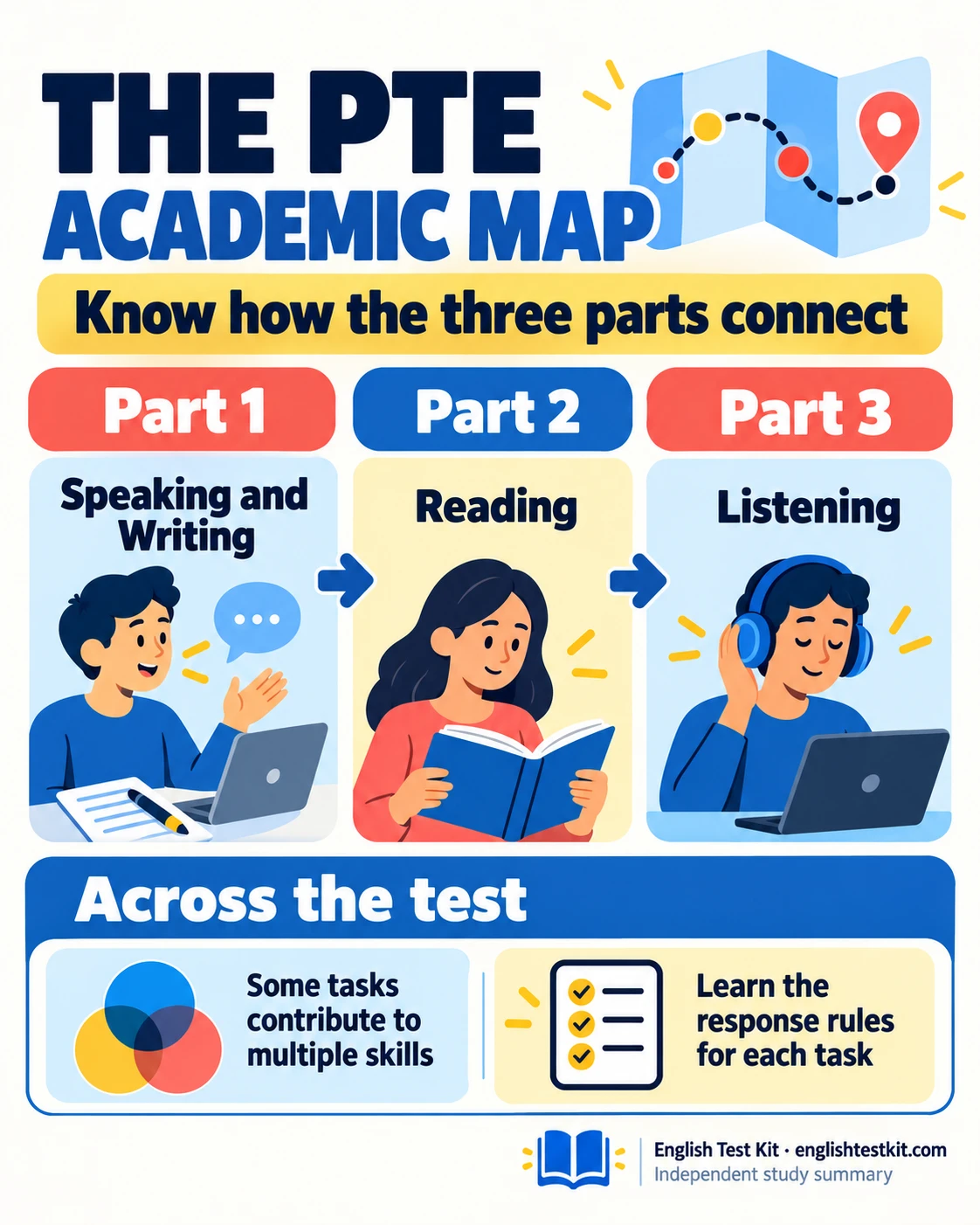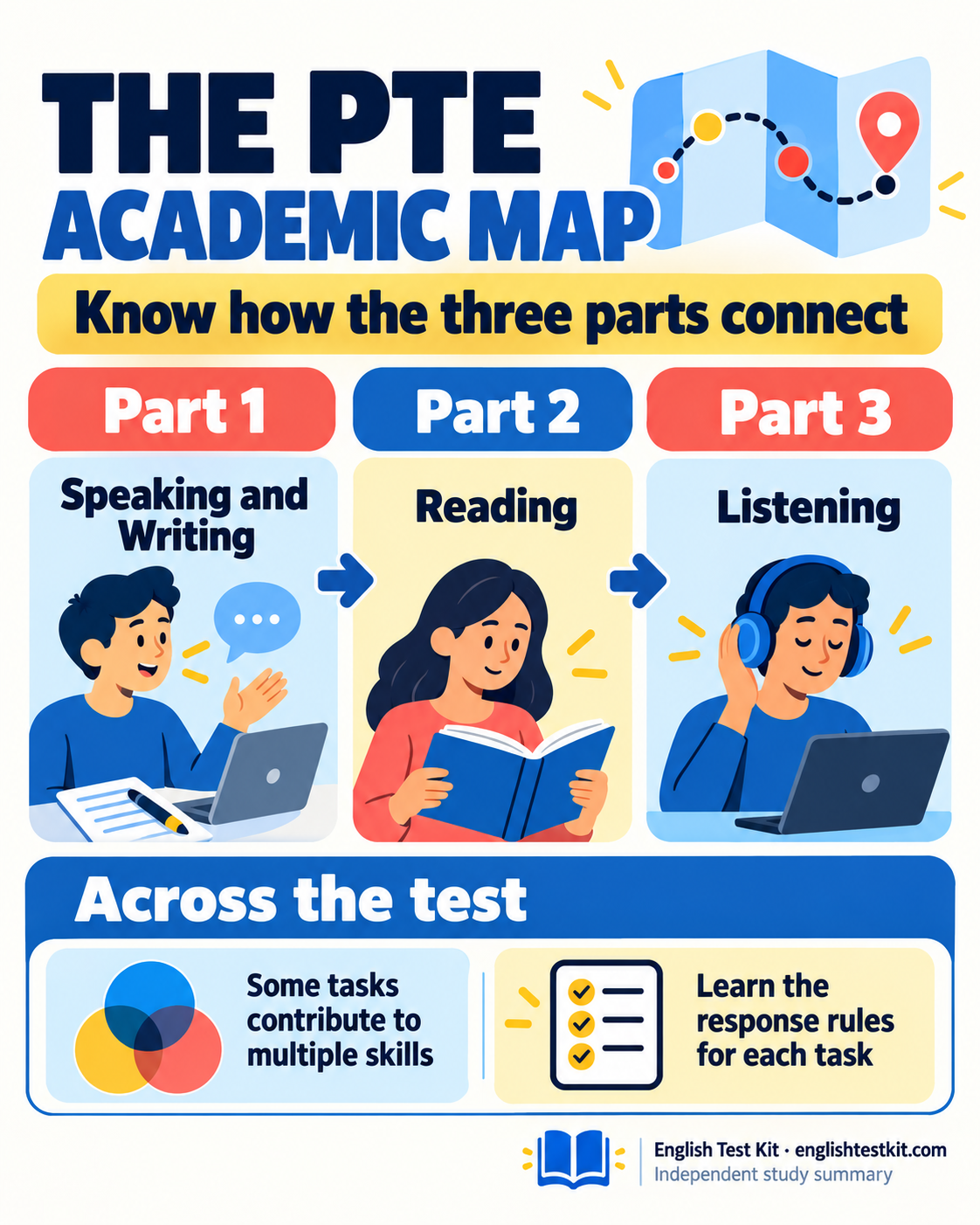
PTE Academic's three parts organise the session, but they do not all demand the same response strategy. You may speak, type, select, complete or reorder information. Learning those actions in advance helps you spend the working time on language rather than repeatedly figuring out how to respond.
One computer-based session, three parts
Pearson describes PTE Academic as an approximately two-hour test. It is taken at a test centre on a computer, with a headset for listening and speaking responses. The test is organised as Speaking & Writing, Reading, and Listening.
Current format shown on Pearson’s PTE Academic overview; individual test forms vary.
Part | Pearson timing range | Question types |
|---|---|---|
Speaking & Writing | 76–84 minutes | 9 scored types |
Reading | 23–30 minutes | 5 types |
Listening | 31–39 minutes | 8 types |
The section ranges do not add up to a fixed appointment length. Pearson describes the whole test as approximately two hours; use your booking confirmation for the session details that apply to you.
Why a section is not always one skill
PTE Academic uses integrated tasks. For example, Reading and Writing: Fill in the Blanks tests reading and word choice in a written passage, while Summarize Spoken Text requires listening and writing. A task’s home section therefore does not always tell the whole story about how it contributes to a score.
Question counts can vary
A test form can contain a different number of prompts within the published structure. Learn the task instructions and response format rather than memorising a fixed item count or assuming every test will have exactly the same sequence.
The best first practice step
Take a short diagnostic across all four skills. Mark which tasks cost you time, which errors repeat, and whether the issue is English ability, understanding instructions, or pacing. Then practise one task family at a time before completing a full timed test.
Map the response action before the content
For each task family, record the input, required output and main constraint. A short audio prompt followed by repetition needs accurate listening and spoken reproduction. A written summary needs selection, sentence control and the required form. A reading gap needs meaning and grammar, while a paragraph-order task needs connections across the text.
This map is more useful than memorising a list of names without trying the tasks. During a diagnostic, mark whether an error came from the language or from misunderstanding an instruction. A technically complete response can still miss the task if it uses the wrong form, omits required content or answers something different from the prompt.
Understand timing without inventing an exact session
Published section ranges describe the provider's format, while your appointment instructions and the on-screen timer guide the actual session. Do not add a few example task times and treat the result as a universal booking length. Different tasks have different timing arrangements, and the time you spend on one kind of work affects the rhythm of the rest.
For practice, use the official task conditions when the aim is rehearsal. Use a slower pace when learning a new method, then add time pressure once you understand the response. Mixing those purposes can make practice frustrating: an unfamiliar task attempted at full speed may reveal confusion without giving you a chance to learn how to fix it.
A sample diagnostic sequence
Try a short repetition task, a source-based spoken response and a written response. Follow with a reading gap, a text-order activity and a listening comprehension or dictation activity. These are independent practice choices, not an official miniature PTE test. Their purpose is to sample different language processes and response actions.
After each activity, note one observable issue. For example, “understood the source but included an irrelevant detail” differs from “could not recognise the key phrase”. A reordering error caused by an unclear pronoun relationship needs a different correction from a dictation error caused by a missing plural ending.
Rehearse switching between task families
Once the basic method is familiar, combine short activities so you practise resetting attention. After speaking, pause mentally to identify what the next prompt requires rather than carrying the same response structure into a different task. Before typing, check the requested form. Before selecting multiple options, confirm how many answers are supported and how the task is scored.
Keep the transition routine brief: identify the task, read the constraint, plan the response action and begin. Rehearsal should make these decisions more reliable, not create a long checklist that consumes the task's working time.
Common format mistakes
Treating every task in a section as if it tested only the section's name.
Practising outdated material without checking the current task list.
Ignoring the difference between a one-sentence summary and a longer essay.
Using repeated listening during a first attempt intended to rehearse one-play conditions.
Confusing a provider's timing overview with the instructions for a particular appointment.
Finish preparation with current official familiarisation material and a realistic rehearsal. Then review task understanding, language performance and pacing separately so the next study decision is specific.
Save your one-page study summary