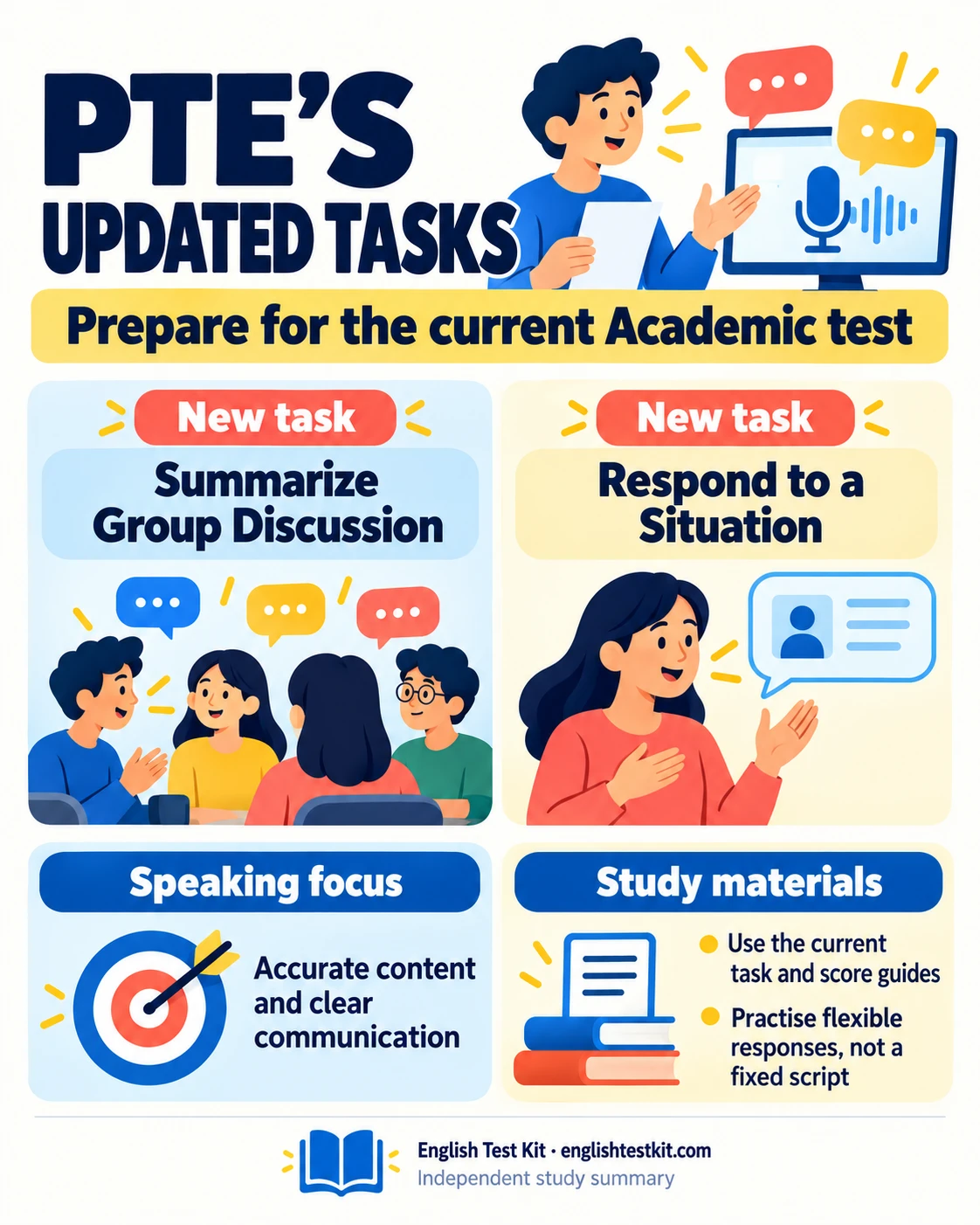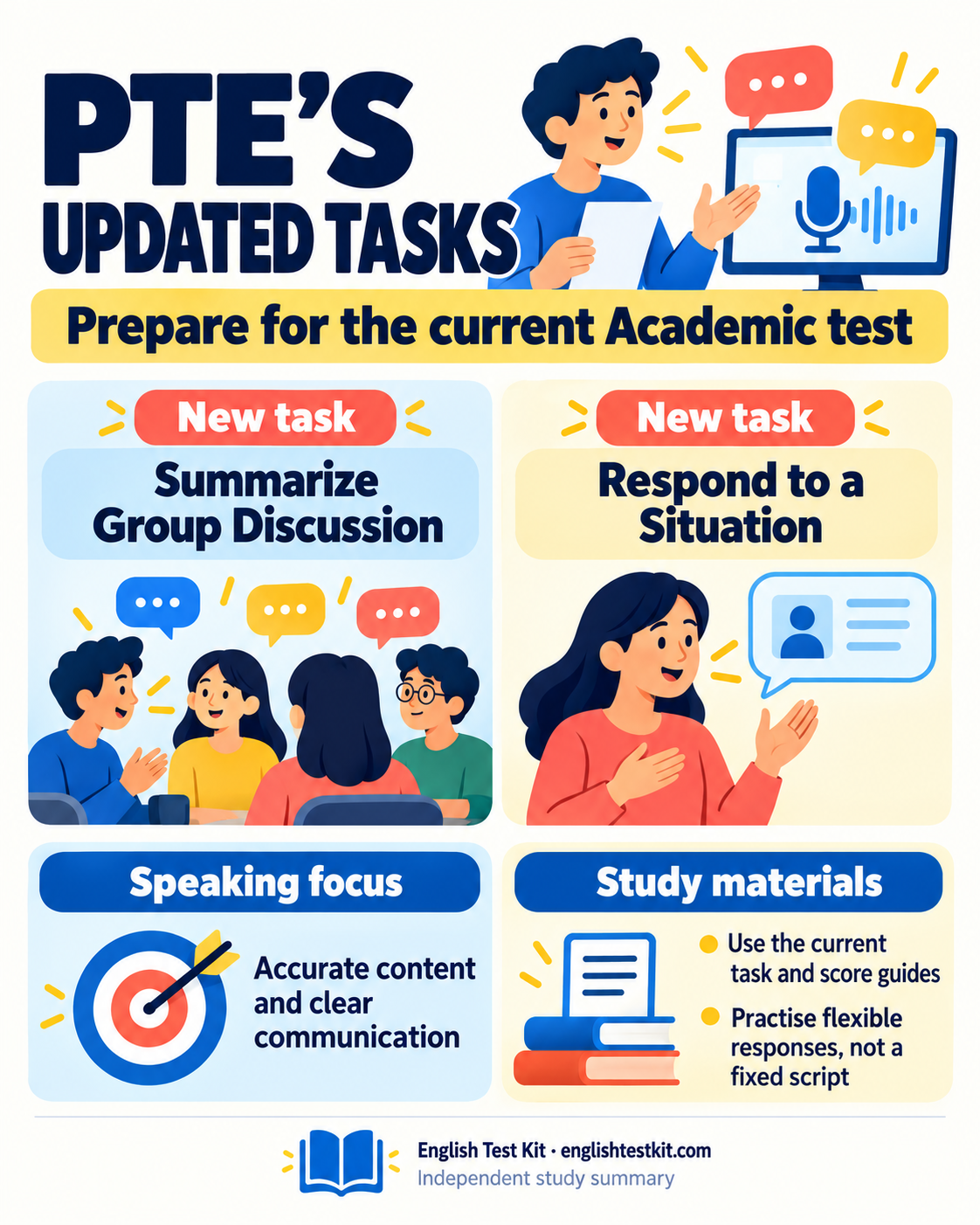
The PTE Academic update matters because useful preparation must include the tasks that now appear, not only the ones in an older book. The two added speaking activities ask you to understand a situation or discussion and produce a relevant response. Build flexible selection, organisation and delivery habits rather than learning one answer that assumes every prompt is alike.
Two tasks were added to Speaking & Writing
For tests taken after 7 August 2025, Pearson added two question types to PTE Academic and PTE Academic UKVI. The three-part structure remains, the test is still approximately two hours, and the updated test keeps its alignment with the Common European Framework of Reference (CEFR).
Summarize Group Discussion: listen to a discussion among three people, then explain the main points in your own words. Pearson allows up to three minutes for the recording and two minutes for the spoken response.
Respond to a Situation: listen to and read a short situation, then give an extended spoken response. The current instructions allow ten seconds to prepare and forty seconds to speak.
Scoring also received updates
Pearson says it enhanced scoring criteria for some tasks and that some response traits can receive a human expert review alongside AI scoring. The Score Report remains on the 10–90 scale with an overall score and four communicative-skill scores. Human review does not assess pronunciation or oral fluency, according to Pearson.
What did not change
The Reading and Listening parts remain in the same three-part test structure. The changes described on Pearson’s update page apply to PTE Academic and PTE Academic UKVI; Pearson says PTE Core and PTE Home were not changed by this update.
Old PTE Academic score reports remain valid for two years under Pearson’s general policy, but receiving institutions may set a different expiry rule. Check directly before relying on an older result.
How to prepare for the current version
Use practice materials that include both new task types. For Summarize Group Discussion, practise tracking each speaker’s view and the connection between ideas. For Respond to a Situation, identify what the listener needs, choose an appropriate tone, and answer the prompt directly. Build adaptable speaking skills rather than memorising a fixed script.
Summarize Group Discussion: connect the viewpoints
Imagine an original practice discussion about extending a university café's opening hours. One speaker supports later opening for evening students; another worries about staffing costs; a third suggests a short trial. A useful summary should preserve the shared topic, the differing considerations and the proposed way forward.
“People talked about a café” identifies the topic but loses the substance. A more developed practice summary could explain that later opening would improve access, staffing costs are a concern, and a trial could test demand before a permanent change. Do not invent an agreement if the speakers only proposed an option. The summary's job is accurate representation, not deciding the discussion for them.
Respond to a Situation: choose a purpose and tone
Consider an original situation in which you must ask a course organiser to change a workshop booking because it overlaps with a required lecture. A useful response identifies the problem, makes a clear request and supplies a relevant detail: “My workshop booking overlaps with a compulsory lecture. Could I move to the Friday session if there is a place available?”
The situation determines the relationship and level of formality. A message to a friend may sound different from a request to a staff member, but both need to achieve the stated purpose. A fluent description of an unrelated experience would not satisfy the task simply because the English sounded confident.
Review content and delivery separately
For discussion summaries, compare your response with a simple source map: each speaker's main point, important support and the relationship between views. For situation responses, check the requested action and the information the listener needs. Only then focus on pace, intelligibility, grammar and vocabulary.
This order helps you diagnose a smooth answer that omits the central issue, or an accurate answer whose delivery makes the meaning difficult to follow. Change one weakness in the next attempt. A new prompt is important because it shows whether the habit transfers beyond a recording you now remember.
Check old materials before using them
Look for the task list, publication or update information and references to the current Score Guide. Material can still help general English even if it does not rehearse the complete current test. Label that purpose clearly. An older task book that excludes the added activities should not be your only source of format preparation.
Also distinguish changes to PTE Academic and Academic UKVI from other PTE tests. Similar branding does not mean every task or update applies to Core or Home. Use the official page for the exact assessment you plan to take.
An update-focused practice week
Start by learning both task instructions and trying one example of each. Spend another session on selecting discussion points, then one on responding appropriately to situations. Record fresh attempts, review content and delivery, and finish by mixing these activities with established tasks. The aim is a complete current-format routine, not a prediction that mastering two tasks guarantees a score increase.
Save your one-page study summary