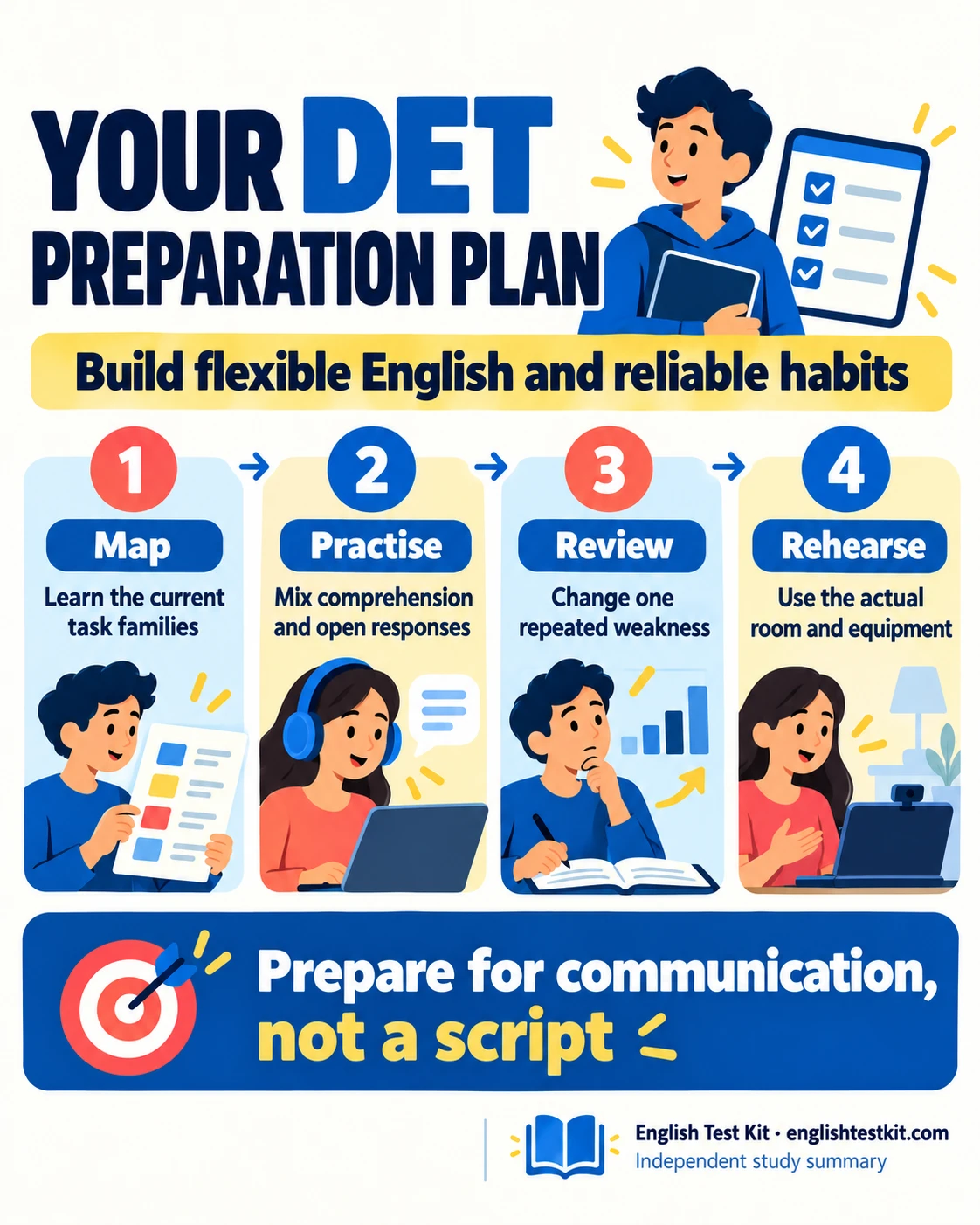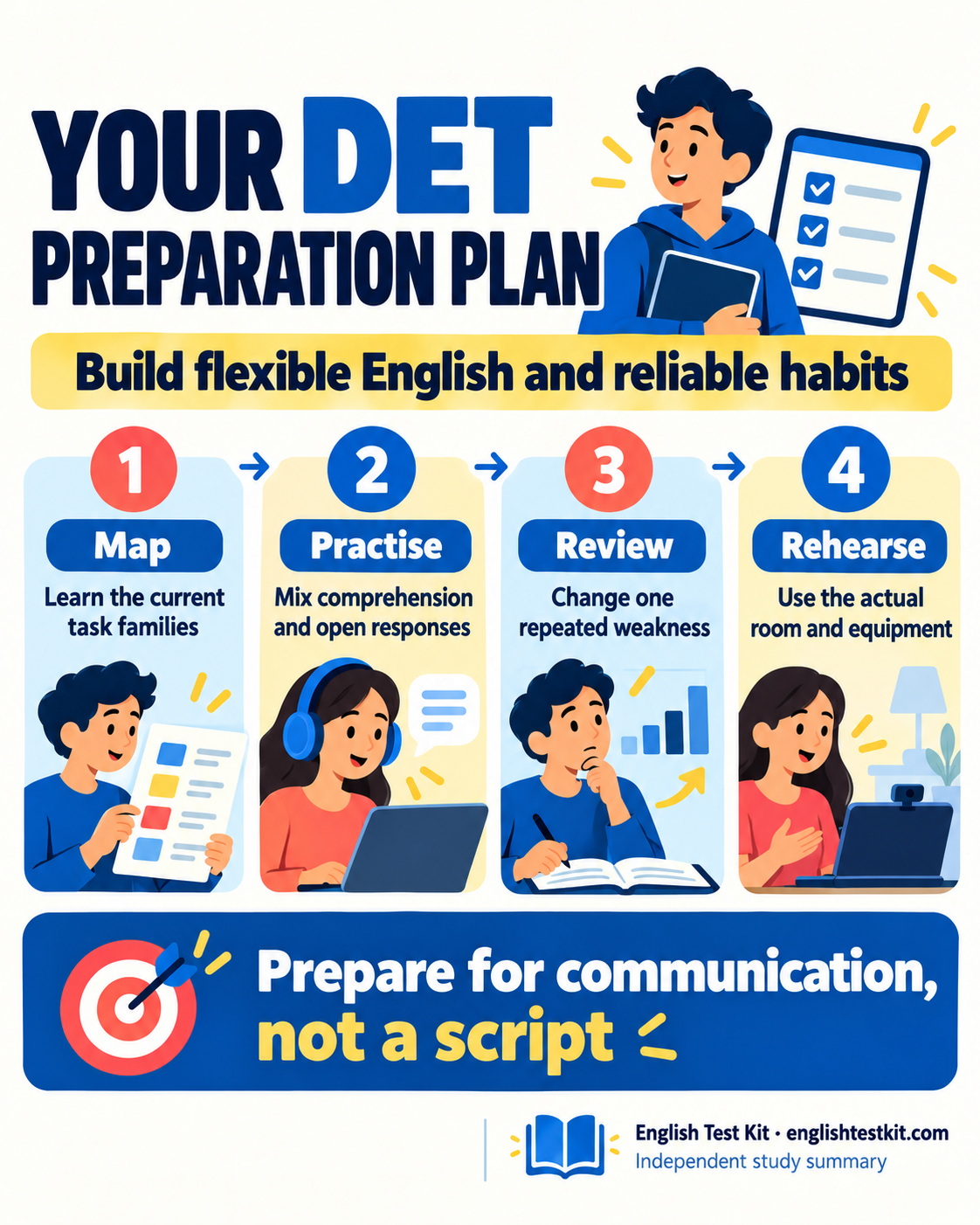
Effective Duolingo English Test preparation combines language development, familiarity with current tasks, and a reliable testing setup. Start from your application requirement and available study time, then work on the errors that repeatedly limit your responses. Completing more practice tests is useful only when the results change what you practise next.
Prepare for the task, not a script
Duolingo’s readiness guidance emphasises understanding the format, using English regularly, trying the free practice test, and preparing the equipment and room. The adaptive test rewards flexible language control, so memorised answers are a poor substitute for real practice.
A four-week routine
Week 1: map the current question types and take a low-pressure practice test to find your starting point.
Week 2: alternate reading and listening tasks with short photo descriptions, summaries, and opinion responses.
Week 3: record timed speaking answers and write several responses; review clarity, grammar, vocabulary, and organisation.
Week 4: repeat the setup check, practise in the same room, and taper the workload so you arrive rested.
On the final day
Keep your government ID and both charged devices nearby.
Close every unrelated programme and remove notes, headphones, extra screens, and reference materials.
Allow about an hour without interruption, plus enough time for the complete camera setup.
Check the receiving institution’s score deadline before choosing a test date.
Use official Test Center pages for format and policy updates. A practice score is a useful progress signal, but only a certified result can be sent as an official score report.
Establish a baseline you can explain
Begin with the current official format and a low-pressure practice attempt. Record which task families feel difficult and why: missing a corrected detail in a conversation, choosing a word without checking grammar, giving a thin photo description, or struggling to develop an opinion aloud.
Keep the practice estimate in perspective. It is an indicator of readiness, not a certified result or a promise of the score you will receive. Save examples of your own work as well as the estimate. Those responses give you evidence for choosing useful exercises and checking whether your habits improve.
Turn the four-week outline into a personal schedule
In the first week, map the task types and identify two recurring weaknesses. In the second, alternate targeted comprehension work with short spoken and written responses. In the third, combine unfamiliar prompts under realistic timing and review whether the targeted errors recur. In the fourth, complete the equipment rehearsal, check application logistics and reduce last-minute overload.
Four weeks is an example structure, not a guaranteed preparation period. A learner with a strong baseline may need a different schedule from someone still developing everyday comprehension. Adjust the time available to the work required, and include regular reading, listening and conversation rather than limiting all English exposure to test items.
Use an error log that changes the next attempt
A useful log records the task, the actual mistake, its likely cause and a specific correction. For example: “Photo response: I listed objects but explained no actions. Next time I will describe the central action and two relationships.” This gives the next response a clear purpose.
For listening, a useful entry might be: “I remembered the original appointment time and missed ‘instead’. Next time I will update the plan when the speaker corrects it.” Repeating a recording without identifying that cause may reinforce the same error. Complete the exercise without notes, then write the review afterwards so that certified-test habits remain realistic.
Develop open responses without memorising them
Practise a direct answer, one relevant reason and a concrete detail. Then change the prompt and use the same planning habit with new language. For photo tasks, distinguish visible evidence from speculation. For interactive tasks, respond to the latest question rather than returning to a prepared topic.
Review recordings for complete ideas, intelligibility and pace. Review writing for relevance, development, sentence boundaries and recurring grammar problems. Choose one improvement for the next attempt. Current guidance assesses the speaking and writing samples, so include them in practice rather than treating them as optional introductions for admissions staff.
Finish with a complete rehearsal and delivery plan
Use the actual computer, secondary-camera device, room and network for an official setup check. Confirm identity requirements, camera views, audio, power and an uninterrupted session. Practise under the note-free and independent-response rules; do not rely on tools that cannot be used during certification.
Finally, work backwards from the institution’s deadline. Allow for testing, review, certified result sharing and the recipient’s processing instructions. Check both overall and any required individual skill scores before applying. A useful study plan ends with a ready learner and a workable reporting schedule, rather than only a growing total of practice attempts.
Save your one-page study summary