One Chesapeake resident is helping rebuild the oyster reefs that once shaped the bay
 By Emma Carter
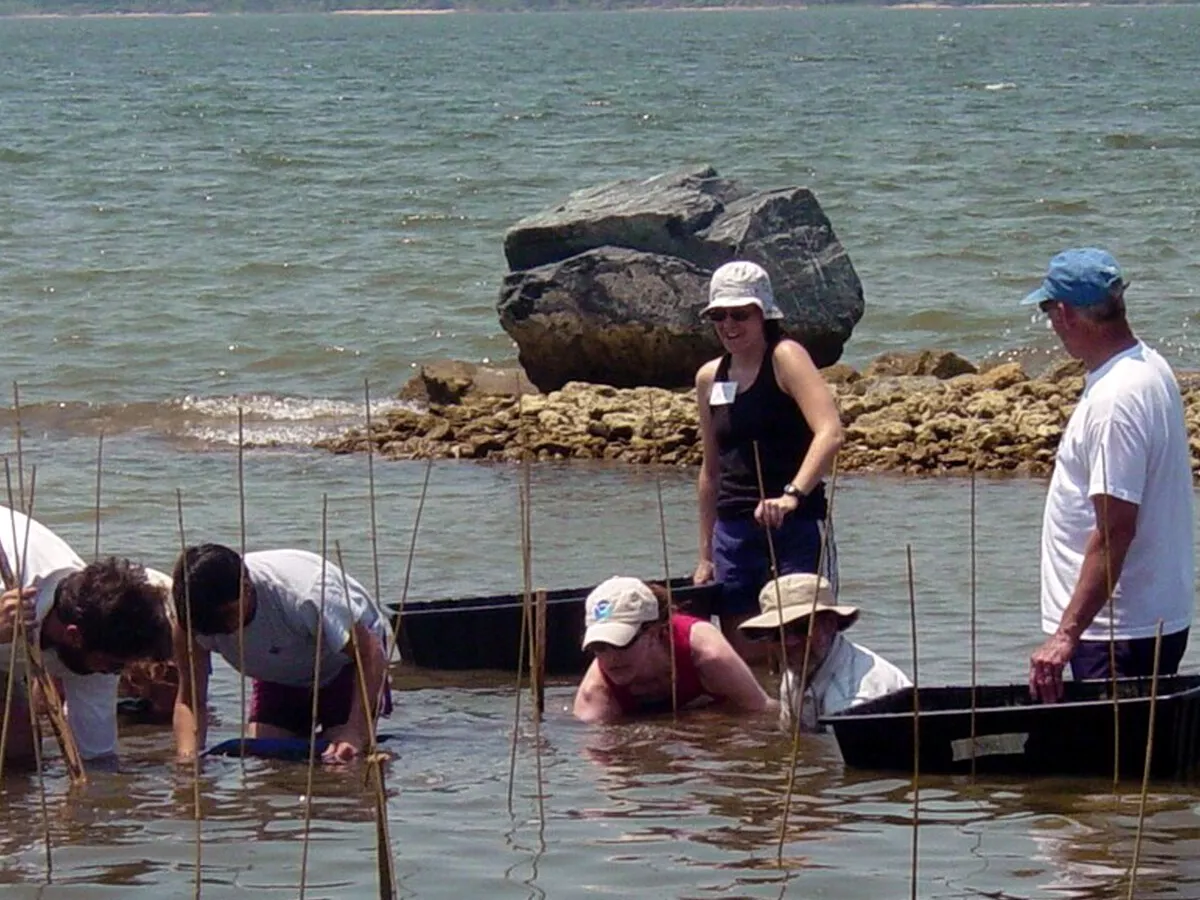
Image information
This is a representative image for this Daily News lesson.
Intro
A Maryland resident is cultivating oysters in the Chesapeake Bay as part of a broader effort to restore a species whose decline has affected the bay’s water quality and habitat.
Vocabulary
| Word | Part of speech | Meaning | Example |
|---|---|---|---|
| suspended adjective | adjective | Meaning: held in position above or within something, rather than resting on a surface | Example: The sensors remained suspended beneath the research vessel throughout the survey. |
| densely adverb | adverb | Meaning: in a manner involving a large amount or number within a limited space | Example: The archive is densely packed with correspondence from the period. |
| clarity noun | noun | Meaning: the quality of being transparent, intelligible, or free from obscurity | Example: The report’s clarity allowed readers to evaluate the competing claims. |
| crevices noun | noun | Meaning: narrow cracks or openings, especially in a solid structure | Example: The insects retreat into crevices in the bark during the coldest months. |
| substantial adjective | adjective | Meaning: considerable in importance, extent, amount, or effect | Example: The institution made a substantial contribution to the regional study. |
| overharvesting noun | noun | Meaning: the excessive removal of a natural resource beyond its capacity to recover | Example: Overharvesting has depleted several fish stocks despite recent restrictions. |
| caretaker noun | noun | Meaning: a person who assumes responsibility for protecting, maintaining, or tending something | Example: As caretaker of the historic site, she balances preservation with public access. |
| principle noun | noun | Meaning: a fundamental idea or rule that guides reasoning, conduct, or interpretation | Example: The principle of proportionality should guide any response to the dispute. |
The story
At the southern tip of Maryland’s Kent Island, John Consoli tends oysters growing in mesh bags suspended from a pier that extends into the Chesapeake Bay. When he lifts one bag from the water, it is densely filled with oysters that, he says, had been nearly weightless when he received them three months earlier.
For Consoli, the project is both practical and deeply personal. He regards oysters as unusually valuable organisms because they contribute to the health of the bay in several ways. An adult oyster can filter as much as 50 gallons of water a day, a process that can improve water clarity and support the growth of sea grass. Healthier sea grass, in turn, provides better conditions for crabs and other organisms.
Oyster shells also create physical structure in an otherwise shifting underwater environment. Their irregular surfaces form crevices where small fish and crabs can live, feed, and shelter. Consoli says he even discovered a seahorse among the habitat formed by the oysters.
The need for restoration is substantial. Oyster reefs once covered much of the Chesapeake, but overharvesting reduced their numbers by more than 99 percent by 2011, according to one estimate. That transformation was associated with poorer water quality and the loss of habitat for other species.
Oyster farming in the Chesapeake has expanded in recent years despite environmental and disease-related difficulties, according to Ryan Carnegie, a biologist at the Virginia Institute of Marine Science. Wild oysters have also made a partial comeback, aided by improved management and investment in restoration.
Still, Elizabeth North, a fisheries oceanographer at the University of Maryland Center for Environmental Science, says current oyster populations are probably only a fraction of their historic levels. Consoli’s aim is therefore not simply to grow oysters for their own sake. He wants to act as a caretaker, adding more oysters to the bay while monitoring their condition. His work reflects a broader ecological principle: restoring a species can also mean rebuilding the network of habitats and natural processes that depend on it.
Warm-up questions
- What ecological functions might a single sedentary species perform within a complex estuary?
- When restoration projects involve living organisms, what responsibilities should human caretakers assume?
Comprehension questions
- Why does Consoli consider oysters unusually valuable organisms?
- How do oyster shells benefit aquatic life?
- What caused the dramatic historical decline in oyster numbers?
- What developments have aided the partial comeback of wild oysters?
- How does Consoli’s objective extend beyond oyster cultivation itself?
Opinion questions
- Should restoration funding prioritize species with broad ecosystem effects over species with narrower ecological roles?
- Does describing Consoli as a caretaker imply a more responsible relationship with nature than describing him as a farmer?
Further discussion
- How might oyster restoration alter the relationship between private cultivation and public ecological stewardship?
- What evidence would justify claiming that a restoration project has rebuilt an ecosystem rather than merely increased one species’ abundance?
Writing prompt
- Write a discursive essay assessing whether restoring a keystone species can realistically repair wider ecological networks. Use the article’s evidence, acknowledge limitations, and propose criteria for evaluating success.