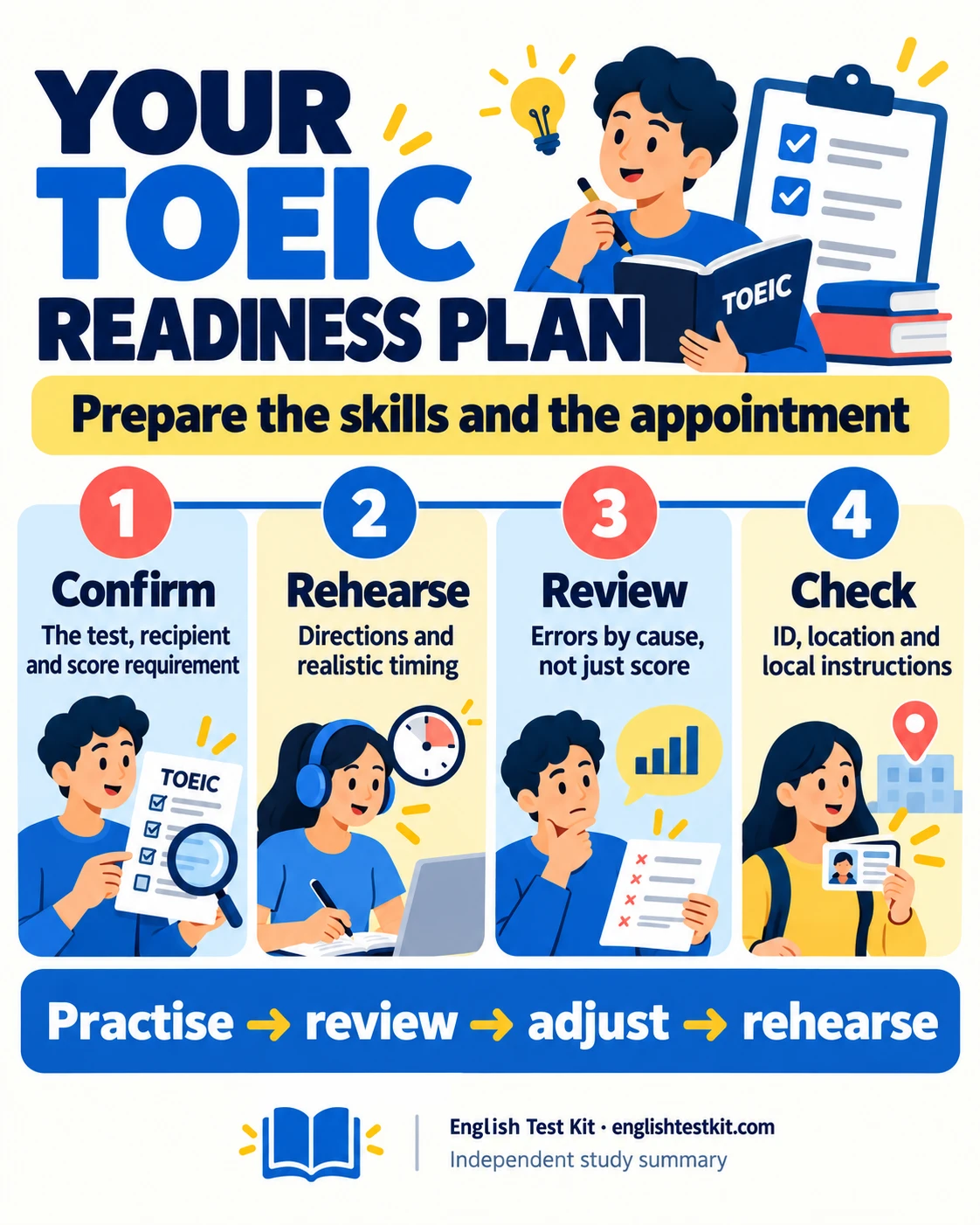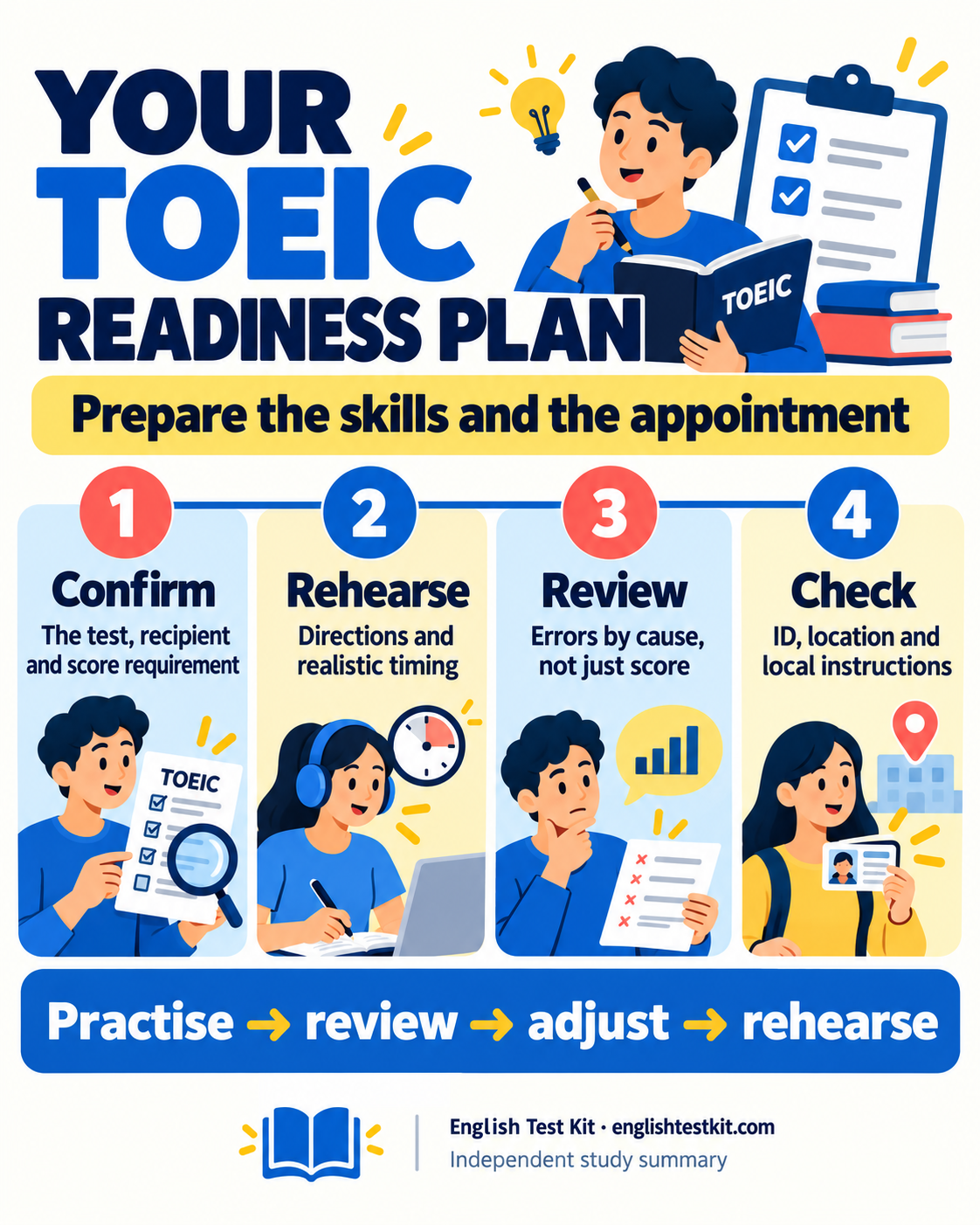
A useful TOEIC plan connects practice with the test you need and the conditions of your appointment. Completing many questions can expose weaknesses, but improvement depends on what you do with those observations. Keep a learning checklist and an appointment checklist so language preparation and registration logistics both receive attention.
1. Confirm the exact test and score requirement
Check the test name, skills, section minimums, session type, report recipient, and any deadline with the organisation asking for your result. Listening and Reading, Speaking and Writing, and Bridge have different tasks and scales.
2. Use the official handbook and samples
ETS provides handbooks and sample tests for its main TOEIC and Bridge formats. Read the handbook for directions, timing, scoring policies, test-day rules, and identification requirements. Then practise sample tasks before adding a timer.
For Listening and Reading, practise all seven parts. For Speaking and Writing, rehearse concise responses under the task’s actual preparation and response windows. Familiarity with directions is part of readiness.
3. Turn practice into feedback
Keep a simple record of missed question types and the reason for each miss: vocabulary, grammar, missed evidence, misunderstood instructions, or time. Review those patterns before adding more full-length practice.
In a timed Reading set, practise moving on when a single item is consuming too much time. In Speaking, record yourself and check whether the response answers the prompt clearly. In Writing, use the final moments to check required content and basic accuracy.
4. Follow your test location’s instructions
Registration, session formats, arrival times, permitted items, and identification rules can vary by region and test centre. Read your confirmation carefully and contact the local ETS Preferred Network office if an instruction is unclear.
Do not assume that a format or online option available in another country is available for your session. Use the directions attached to your own appointment.
An adaptable two-week example
This is an independent study example, not an official schedule or a score guarantee. During the first few sessions, sample the relevant parts and identify recurring difficulties. Spend the remaining first-week sessions on two priorities, such as indirect listening responses and word-form choices. Keep a short amount of mixed practice so other skills remain active.
In the second week, combine focused work with realistic timed sets. Review the errors before choosing the next activity. Use a longer rehearsal when the directions and task methods are familiar, then finish with lighter review and the appointment checks. A learner with less time can reduce the number of sessions; someone with larger language gaps may need a longer preparation period.
Make an error log that changes the next session
A useful entry contains the task, the mistake, its cause and an adjustment. For example: “Part 7 schedule question — chose the earlier date — missed the phrase ‘after registration closes’ — underline time conditions before comparing options.” The next session should test that adjustment on a fresh question, not only repeat the original passage.
For Listening, separate not hearing a phrase from hearing it but misunderstanding its purpose. For sentence questions, distinguish a grammar-position problem from unknown vocabulary. For Speaking and Writing, identify whether the main weakness is task coverage, development, organisation or language control. These categories help you select a relevant activity instead of prescribing the same revision to every error.
Rehearse response conditions honestly
Use one-play listening for a first attempt, then replay during review. Complete reading sets with a timer when pacing is the skill you are testing. For recorded speech, practise producing the answer aloud within the relevant window. For writing, include planning and checking rather than spending all the practice time on an unreviewed draft.
Avoid confusing a familiar question with a transferable skill. If you remember an answer, use the item to practise explanation or pronunciation, then try new material to check understanding. Progress should appear across unfamiliar examples and task situations.
Prepare the appointment separately
Check the exact test, date, location or approved delivery arrangement, arrival instructions, identification, permitted belongings and reporting route. Confirm that the receiver accepts the session and result you are booking. Use the current local official instructions; another candidate's experience in a different country may not describe your appointment.
If an instruction is unclear, contact the appropriate official support before test day and retain the response. Plan travel or access arrangements with enough margin to avoid starting the assessment distracted. Preparation includes removing preventable uncertainty, not trying to memorise every possible administrative detail from a general article.
Review readiness before the final rehearsal
Ask whether you understand the directions, can sustain attention through the relevant sections, have tested a workable reading pace, and know what to do after an uncertain response. For productive tasks, check that you can answer the requested purpose clearly. Use the last review to reinforce a small number of reliable habits rather than introducing an entirely new strategy immediately before the appointment.
Save your one-page study summary