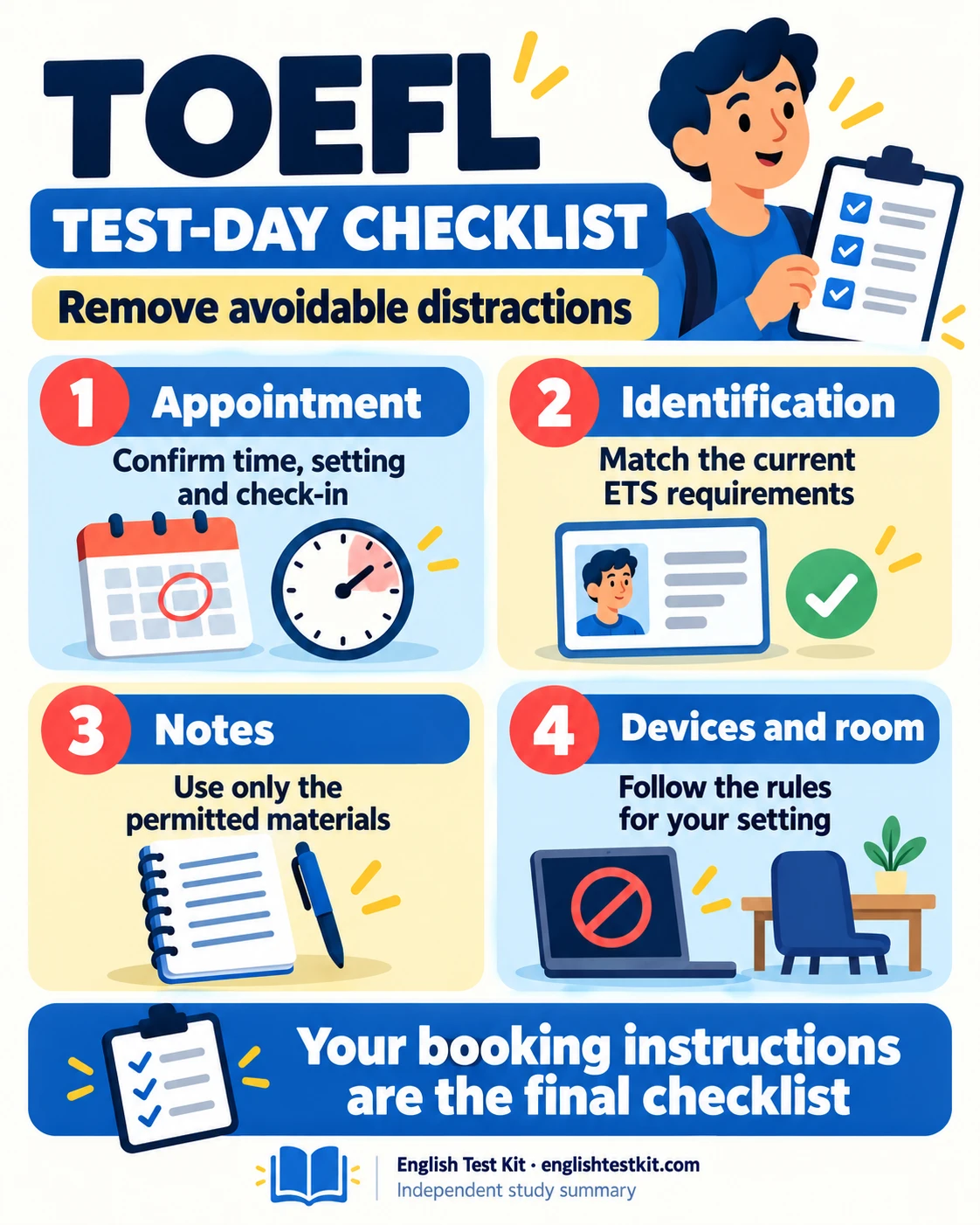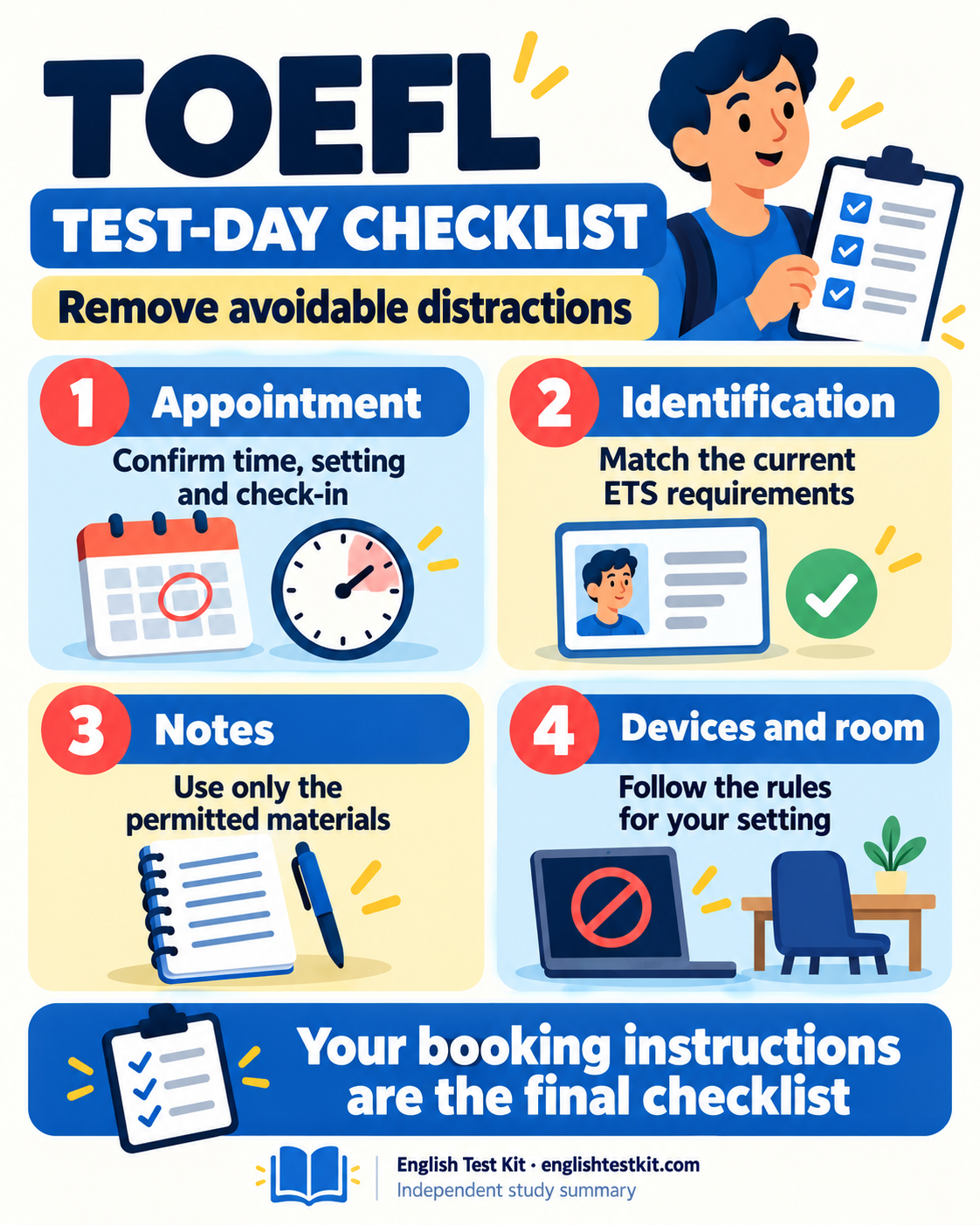
TOEFL test-day preparation should remove avoidable uncertainty about the appointment, equipment and rules. The current test format matters, but so do the instructions for the setting you booked. Read those directions early enough to resolve a problem rather than discovering it when the assessment is about to begin.
Know the rules for your test setting
TOEFL iBT is delivered on a computer at an authorized test center or through the Home Edition with an online human proctor. Test-day logistics differ, so read the current instructions for the option you booked. Confirm identification, arrival or check-in steps, room requirements and any allowed note-taking materials before the appointment.
Note-taking, breaks and devices
ETS says test takers may take notes. At a test center, scratch paper and pencils are provided. For Home Edition, ETS specifies a small whiteboard or a blank sheet inside a transparent sheet protector with an erasable marker. ETS also says there are no scheduled breaks and mobile devices are not permitted during the test. Review the latest instructions in case procedures change.
Do not assume ordinary paper or a personal phone can stay with you during the exam.
Writing assistance software is not permitted during the TOEFL iBT test.
Plan water, meals and other needs before you begin because no scheduled break is listed.
A short checklist
Recheck the appointment time, location or Home Edition check-in instructions.
Confirm your identification matches ETS requirements for your registration.
For home testing, complete equipment and environment checks in advance.
Use only the note-taking materials allowed for the selected setting.
Check that the receiving institution accepts your test setting and result format.
Keep the official instructions nearby
Policies can be updated and may depend on location or test setting. Review ETS’s current test-content and testing-option pages shortly before your appointment. If an instruction here and ETS’s live direction differ, follow the direction issued by ETS for your booking.
ETS says a test must include at least one completed question or task in every section to be scored. Do not skip a section.
Make a checklist for your actual setting
For a test centre, confirm the address, arrival instructions, accepted identification, permitted belongings and any agreed accessibility arrangements. Plan the journey with a reasonable margin and keep the confirmation available through the permitted check-in process. Use the instructions for that centre and booking rather than a general account from another candidate.
For Home Edition, review the current equipment, room, identification and proctoring requirements. Complete the provider's required checks and rehearse the actual setup. A successful call on a different device or in another room does not establish that the booked arrangement meets every test requirement.
Rehearse note-taking within the rules
The permitted materials differ by setting. Use the provider's current directions for the exact type of notes you may take and the materials allowed. Do not assume that an ordinary notebook, personal phone or the same stationery arrangement is acceptable everywhere.
During legitimate practice, learn to record useful relationships rather than every word: the problem, change, reason or conclusion. For an original listening example about a cancelled lab session and a replacement meeting, “lab cancelled → attend Friday briefing” may preserve the practical outcome better than a page of disconnected nouns. Note-taking should support comprehension without making you miss the next idea.
Prepare for a manageable unexpected problem
Imagine noticing a setup issue before a Home Edition appointment. The useful action is to use the official support or appointment process and explain the problem, not improvise an unauthorised device or room change. At a centre, follow staff instructions if there is an administrative or technical question. Keep the rules and the authorised support route as the basis for decisions.
This is a reason to finish checks early, not a suggestion that you can predict every interruption. Your preparation should make the normal process familiar and make it clear who to ask when something falls outside it.
Use a day-before and arrival routine
The day before, confirm the appointment, identification, required environment and current instructions. Avoid introducing a completely new response strategy at the last moment. Review a few reliable habits, such as answering the exact question, checking a writing task's required points and recovering after an uncertain comprehension item.
On the day, follow the arrival or online check-in procedure and keep attention on the directions given. Plan ordinary needs around the provider's current break policy; do not assume that a break or device use allowed in another exam is permitted in TOEFL. Follow instructions for completing every section so the attempt can be scored under the current rules.
Keep language readiness and rule readiness distinct
Strong practice performance does not settle an identification or equipment issue, and a compliant room does not prove task readiness. Check both. Use current official pages shortly before the appointment, especially if you prepared with older materials. The aim is to arrive with predictable procedures, permitted materials and enough familiarity to concentrate on using English.
Save your one-page study summary