
The Hidden Dependencies in a Modular Water System
About this practice test
An advanced explanation of a modular water-treatment plant asks learners to identify components by their positions, functions, and dependencies within the system.
What you’ll practice
Finding detail
Locate specific information and evidence.
Interpreting ideas
Connect main points and inferences.
Evaluating arguments
Assess claims, evidence, and limitations.
What to expect:
1 question with explanations to review after submission.
Study the questions and tasks
Work through the material below, or start the interactive practice above to complete an attempt. Try the exercises before opening any answer or transcript sections, then use them to review your work.
- Practice level
- C2. Try this level if you can follow the instructions and understand most of the language; choose an earlier level if you need more support.
- Question formats
- Label the image
How to approach this practice
Read the passage for its main idea, then return to the relevant sentence or paragraph for each question. Base answers on the passage.
The Hidden Dependencies in a Modular Water System
 region-1
region-2
region-3
region-4
region-5
region-6
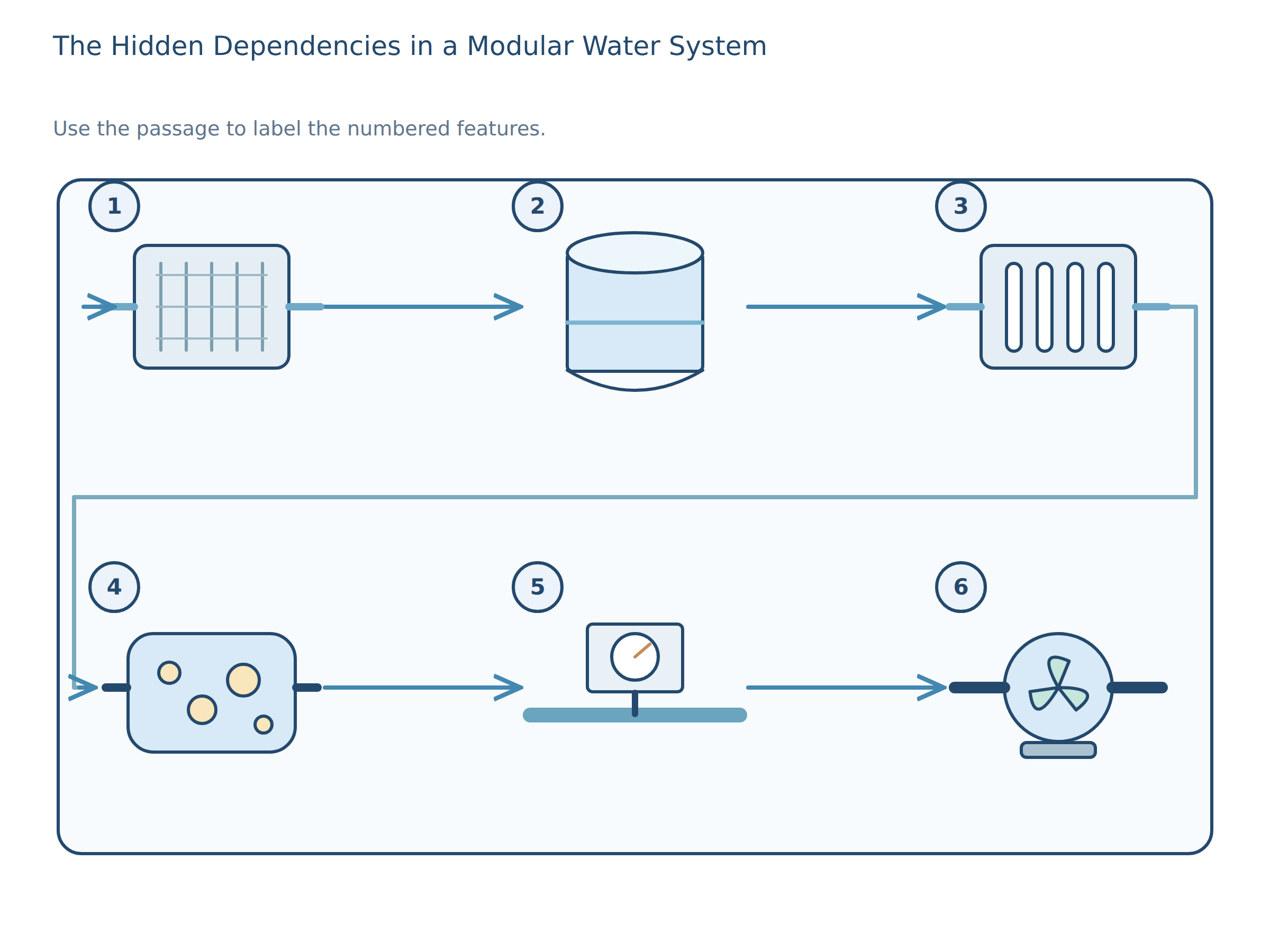
When the town council approved the new water plant, the brochure sold it with a simple promise: the system would be broken into modules that could be lifted out, replaced, or upgraded without disturbing the rest. Mara, the engineer responsible for making that promise work, never objected to the word modular itself. What she rejected was the fantasy that a plant could be reduced to a row of self-sufficient boxes. Water treatment can be divided into visible units, but those units do not behave independently. Each one borrows conditions from the stage before it and passes obligations to the stage after it. Modularity is real, but it is not the same as isolation. The training schematic encouraged neat thinking, though Mara used it to teach the opposite lesson. On that diagram, the upper left was reserved for the point where raw canal water was first made mechanically tolerable: leaves, grit, and stray plastic had to be stripped out there before the rest of the line could operate safely. The upper centre held the vessel whose main task was not cleaning but absorbing irregularity, turning violent swings in level and silt into a slower feed the controllers could live with. The upper right showed the stage that did most of the actual purification, though only on the condition that what reached it had already been calmed. On the lower row, the left-hand unit existed to put back a little of what successful treatment had removed, the centre unit watched pressure, conductivity, and temperature closely enough to guide the software, and the lower right sent finished water out to the clinic while simultaneously transmitting demand shocks backward through the plant. Visitors often lingered over the polished steel farther down the line and dismissed the first barrier as almost trivial. Mara resisted calling it "just a screen." Its full name, the coarse intake screen, mattered because its job was preparatory rather than purifying. If the mesh was too fine, it clogged and reduced intake; if it was too open, small stones reached later stages and forced maintenance crews to stop the system. The screen did not make the water safe to drink. It prepared the water to be handled without damaging everything else. The vessel in the middle of the top row was the equalization tank. Farmers upstream sometimes cleaned their channels, and after rain the canal could carry a sudden brown surge of silt. Without some buffer, the control software would have had to chase every fluctuation in supply. The tank absorbed that irregularity and turned it into a slower, more predictable feed. What looked like a passive container was really the plant's memory of recent instability. The stage that visitors found most persuasive was the membrane rack, because it appeared to be where purification visibly became serious. It contained several identical membrane skids, which made outsiders assume one skid could simply replace another. During the first commissioning week, a contractor briefly swapped one skid for another, assuming that identical and interchangeable meant the same thing. The replacement fit, but its pressure curve was different enough to unsettle the controller until Mara retuned the surrounding settings. To her, the episode proved that modularity did not erase context; it only made context easier to ignore. The rack did the hardest work in the system, but only because earlier stages had already protected it from shock and sudden pressure changes. The most counterintuitive correction came later, after the water had been cleaned. Mara often had to explain that purification was not simply subtraction. The unit on the lower left was the remineralization chamber, and its task was to put back a measured trace of calcium and bicarbonate so the water would not taste hollow or attack the pipes. Water stripped too thoroughly becomes chemically restless: it can taste flat and may pull minerals from pipe walls in storage. The chamber repaired an absence created upstream and prevented a new problem downstream. A system can be technically pure and still be operationally wrong. The least visually dramatic device was the sensor manifold. It occupied only a modest cluster of instruments, yet it governed the logic of the whole installation by watching pressure, conductivity, and temperature while the plant was running. If conductivity rose, the manifold warned the controller that the membranes were letting through more dissolved material than expected. If pressure fell, it suggested clogging or a tiring pump. The software then chose whether to recirculate, bypass, or continue. Even so, Mara reminded the night shift that readings were not a replacement for judgment. A stable pressure line could still conceal gradual clogging, and a modest rise in conductivity could matter more when demand was climbing. The final unit in the diagram was the distribution pump, which pushed the finished water to the clinic taps. Because it was last in sequence, some visitors imagined it was also the least consequential. Mara thought this was the most misleading assumption of all. The pump determined the pressure available to users, but it also fed back into the earlier stages, because a sharp change in demand could alter the conditions seen by the membrane rack. After a long power cut, demand spiked, the pump worked harder, and the whole line had to settle again before quality readings returned to normal. The end of the process, in other words, could still rewrite the middle. That was why Mara resisted the council's favourite phrase, plug-and-play. A better description was plug-and-negotiate. Every module could, in principle, be lifted out, but only if the surrounding modules were retuned to accept the replacement. The intake screen mattered because it spared the equalization tank. The tank mattered because it shielded the membrane rack. The rack mattered because it shaped the chemistry that the remineralization chamber had to repair. The sensor manifold mattered because it interpreted those changes before the distribution pump turned them into public water. Remove the dependencies, and the plant would become easy to imagine but hard to run. By the end of the pilot month, the clinic had reliable water, and the brochure's neat boxes no longer offended Mara as much. They were not lies. They were abbreviations. A modular system does divide work into visible units, but its real intelligence lies in the hidden agreements between them: pressure must be steady, chemistry must be balanced, and control must be continuous enough to notice when either begins to drift. The plant succeeded not because each part was independent, but because each part knew how dependent it was on the others.
-
Question 1 · Label the image
Match the labels to the marked regions of the image.
Read the passage and choose the best labels for the six numbered parts of the diagram.
Return to the passage, recording or visualImage labels
equalization tank · membrane rack · remineralization chamber · sensor manifold · distribution pump · chlorine injector · sludge hopper · coarse intake screen
Label regions region-1, region-2, region-3, region-4, region-5, region-6 marked on the image above.
Check answers and explanations
- Region region-1
- coarse intake screen
- Region region-2
- equalization tank
- Region region-3
- membrane rack
- Region region-4
- remineralization chamber
- Region region-5
- sensor manifold
- Region region-6
- distribution pump
Label 1: The upper-left position removes leaves, grit, and plastic before later stages, so it is the coarse intake screen. Label 2: The upper-centre vessel absorbs changes in level and silt and creates a slower feed, so it is the equalization tank. Label 3: The upper-right stage performs most of the purification after the water has been stabilized, so it is the membrane rack. Label 4: The lower-left unit replaces calcium and bicarbonate removed during treatment, so it is the remineralization chamber. Label 5: The lower-centre unit monitors pressure, conductivity, and temperature to guide the software, so it is the sensor manifold. Label 6: The lower-right unit sends finished water to the clinic and transmits demand effects backward through the system, so it is the distribution pump. The chlorine injector and sludge hopper are plausible technical distractors, but the passage does not assign them to any diagram position.
On that diagram, the upper left was reserved for the point where raw canal water was first made mechanically tolerable: leaves, grit, and stray plastic had to be stripped out there before the rest of the line could operate safely. The upper centre held the vessel whose main task was not cleaning but absorbing irregularity, turning violent swings in level and silt into a slower feed the controllers could live with. The upper right showed the stage that did most of the actual purification, though only on the condition that what reached it had already been calmed. On the lower row, the left-hand unit existed to put back a little of what successful treatment had removed, the centre unit watched pressure, conductivity, and temperature closely enough to guide the software, and the lower right sent finished water out to the clinic while simultaneously transmitting demand shocks backward through the plant
Its full name, the coarse intake screen, mattered because its job was preparatory rather than purifying
The intake screen mattered because it spared the equalization tank. The tank mattered because it shielded the membrane rack. The rack mattered because it shaped the chemistry that the remineralization chamber had to repair. The sensor manifold mattered because it interpreted those changes before the distribution pump turned them into public water
What to review next
Find the words that support each answer. For a mistake, compare the question with the evidence and identify the detail or inference you missed.
A focused practice result shows how you did on these tasks. Use several activities across skills to decide what to study next; one practice score does not certify an overall CEFR level.
Before you practise: a worked example
Look for evidence in the text. Separate what the writer says from what you already know about the topic.
The library normally closes at six, but on Fridays it stays open until eight. When does it close on Friday?
The answer is eight. But introduces an exception to the normal closing time, so the first time mentioned is not the answer.
This teaching example is separate from the scored questions. After your test, compare any mistakes with the explanation and revisit the topic before trying again.