
Designing for Uncertainty in a Shared Landscape
About this practice test
Practise reading three advanced texts about adaptive floodplain design, reversible interventions, shared landscapes, and evidence-based responses to environmental uncertainty.
What you’ll practice
Finding detail
Locate specific information and evidence.
Interpreting ideas
Connect main points and inferences.
Evaluating arguments
Assess claims, evidence, and limitations.
What to expect:
24 questions with explanations to review after submission.
Study the questions and tasks
Work through the material below, or start the interactive practice above to complete an attempt. Try the exercises before opening any answer or transcript sections, then use them to review your work.
- Practice level
- C2. Try this level if you can follow the instructions and understand most of the language; choose an earlier level if you need more support.
- Question formats
- Yes / No / Not Given, Single choice, Fill in the blank (text), Fill in the blank (dropdown), Label the image
How to approach this practice
Read the passage for its main idea, then return to the relevant sentence or paragraph for each question. Base answers on the passage.
Working with the Tide: Reversible Planning in a Shared Marsh
The first time I walked the lower marsh at dawn, the footpath was already half water and half mud. Dairy farmers, schoolchildren, reed-cutters, dog walkers, and birdwatchers all used the same narrow strip of ground, but they used it for different reasons and on different timetables. That is what makes a shared landscape difficult: everyone depends on it, yet no one controls all of it. Floods may come earlier than expected, summers may dry faster than the models predict, and the people who defend the place today may be arguing over a different boundary next year. I have stopped treating uncertainty as a defect in the brief. It is the brief. For decades, our profession behaved as if the future could be compacted into a single forecast. We drew clean lines on maps, then built as though the map were stronger than wind, water, or public disagreement. Higher banks, straighter edges, heavier structures: each seemed to promise control, and each often shifted trouble downstream, uphill, or into someone else’s season. That habit still has its admirers, because permanence looks reassuring in a presentation room. On the ground, however, it can become a tidy form of denial. A design that cannot acknowledge its own limits is not necessarily bold; sometimes it is merely overconfident. I prefer interventions that can be lifted, shifted, widened, or retired without leaving the site maimed. That may mean timber boardwalks on screw piles, seasonal fencing, stone baskets that can be relaid, or planting schemes designed to fail in stages rather than all at once. Reversible does not mean timid, and it does not mean provisional in the lazy sense. It means that a decision can be tested against the living site, then adjusted when the site answers back. The best temporary work is not a compromise between thought and action; it is a disciplined way of allowing action to learn. A hydrological model may tell us where water is likely to travel, but the marsh will also answer with sediment, birds, repairs, and complaint. Those responses are not distractions from the “real” project; they are part of what the project becomes. I have seen a nursery path alter drainage in a way no spreadsheet had predicted, and I have watched a small viewing platform reveal how much pressure visitors place on an informal bank. In both cases, the first intervention was valuable not because it solved everything, but because it made the next decision more intelligent. Temporary work is often dismissed as an expensive way of hesitating. I think it is often the opposite: a way of preventing one mistaken certainty from hardening into a costly landscape. When residents disagree, the temptation is to freeze the conversation until everyone agrees. In practice, that often means preserving the loudest existing arrangement. A small, reversible step can do something politically useful as well as technically useful: it turns abstract conflict into something that can be observed, discussed, and revised. People who cannot agree on a theory may still agree on what a path does after a winter flood. That is one reason I distrust grand consultations that produce grand certainty. Consensus is not the same as clarity, and neither is silence the same as consent. Not every intervention deserves to announce itself. In a fragile place, modest works can be more respectful than grand gestures because they concede that the land is not a blank stage but a collaborator. There is also an ethical reason for favouring modesty under uncertainty. The more difficult the future is to read, the more dangerous it becomes to hide ambition inside the language of necessity. We should be wary of projects that call themselves inevitable simply because they are expensive, visible, or impressive. A design can be beautiful and still be too sure of itself. None of this is an argument against permanence as such. There are places where a fixed wall, a raised route, or a rebuilt culvert is plainly the least bad option. The test is whether a permanent decision is justified by durable need, not by our impatience for closure. What deserves permanence should earn it. In a shared landscape, that is a higher standard than the one usually set by routine procurement or political deadlines, but it is also a fairer one. Design under uncertainty is therefore not design without conviction. It is conviction disciplined by the possibility of error. We should make room for revision because landscapes outlast plans, and because shared places deserve more than one person's confidence disguised as certainty. A reversible intervention is not an admission that nothing can be known; it is a refusal to pretend that what we know today should govern every season that follows.
The North Fen Floodplain Trial
At the lower edge of the Kestrel Plain, North Fen was a shallow floodplain shared in ordinary times by farmers, cyclists, birdwatchers, and the county drainage board. On maps it appeared almost empty, yet on the ground it was threaded with ditches, access tracks, hedge banks, and informal rights of passage. When a wet winter threatened the nearby village, the board did not immediately choose a wall or another hard engineering cure. Instead, hydrologist Mara Ellison and site manager Jae Verma agreed to a three-winter pilot that would let winter water enter selected strips of land, slow down, and leave again without forcing the river into one hardened channel. The arrangement looked modest, but it was complicated in practice. Landowners stayed on site and kept their access roads, while temporary fences and low earth ridges altered the field pattern. A resilience fund paid for sensor towers, staff time, and compensation for crop loss beyond what the agreed flooding caused. Rather than treating the floodplain as one continuous surface, the team divided it into linked units with different thresholds for opening. That administrative decision mattered as much as the earthworks, because one reach could fill while another remained closed. The first storm arrived in December. Rain fell for thirty hours, the river rose, and the upstream gate opened later than planned because reed mats had jammed the small culvert on the western track. Water backed up, spread across the first shallow basin, and then ran into a wider swale cut slightly lower than the rest. The delay seemed minor, but it changed the flow enough to shave eight centimetres from the peak measured at North Fen bridge. Sensors also showed that the water lingered longest where cattle had recently grazed the grass down. That was useful and awkward at once: short grass slowed erosion, yet hoofprints made the edge less tidy. After that first season, the team altered the monitoring rather than the design. They added two pressure sensors, shifted one telemetry mast, and asked farmers to note when soil at the margin stopped sticking to a boot. Mara was careful not to call the trial a success too quickly. At a public meeting, she said the point was not to make flooding disappear. It was to keep the river from arriving all at once. That distinction mattered because some residents wanted higher levees after road closures, while others feared that harder defences would push the problem downstream. The experiment was therefore both practical and political. The second winter turned out to be unusually dry. For three months the river never reached the level that would have triggered the main inlet, and a local paper printed a brisk headline about a project that had allegedly failed to deliver. Yet the quiet season gave the team information they could not have obtained in a dramatic flood. Groundwater stayed close to the root zone for days after light rain, and the shallow basins kept moisture longer than their computer model had predicted. Residents who walked the site noticed fewer gulls and more worm casts, which did not fit either the celebratory or the sceptical version of the story. In that year, the absence of overtopping became data in its own right. The team did not learn less just because the water stayed low; they learned something different about retention, timing, and the slow movement of moisture through the soil profile. That was awkward for anyone hoping for a dramatic ribbon-cutting, but useful for the people who had to manage the land after the reporters went home. During the third winter, a shorter but sharper storm tested the most exposed sector of the plain. To protect the highest-value hay plots, the operators opened the eastern channel first and let the lower western fields act as sacrificial swales. The phrase made some people uncomfortable, because it sounded as if certain farmers had been asked to accept damage for everyone else. In practice, the arrangement was less brutal than that: compensation had been fixed in advance, water depth had been capped, and the worst deposits were trapped in a sediment pocket before they could bury the gate machinery. Still, the experiment made plain that equitable planning was not the same thing as equal treatment. By spring, the shared record of water levels, soil wetness, and bird counts had become hard to dismiss. The board could see that no single setting worked everywhere. What protected the road most effectively in one reach caused nuisance in another, and what suited the lapwings was not always ideal for the barley. Mara therefore began to speak less about flood control than about flood accommodation: a system should be able to open, delay, or narrow according to conditions, rather than trying to impose one fixed answer on a changing landscape. The final report did not claim victory. It argued instead that the most durable outcome was a method for negotiating uncertainty: measure closely, share the inconvenience, and keep the river’s options visible instead of pretending they could be abolished.
A Map That Accepts the River
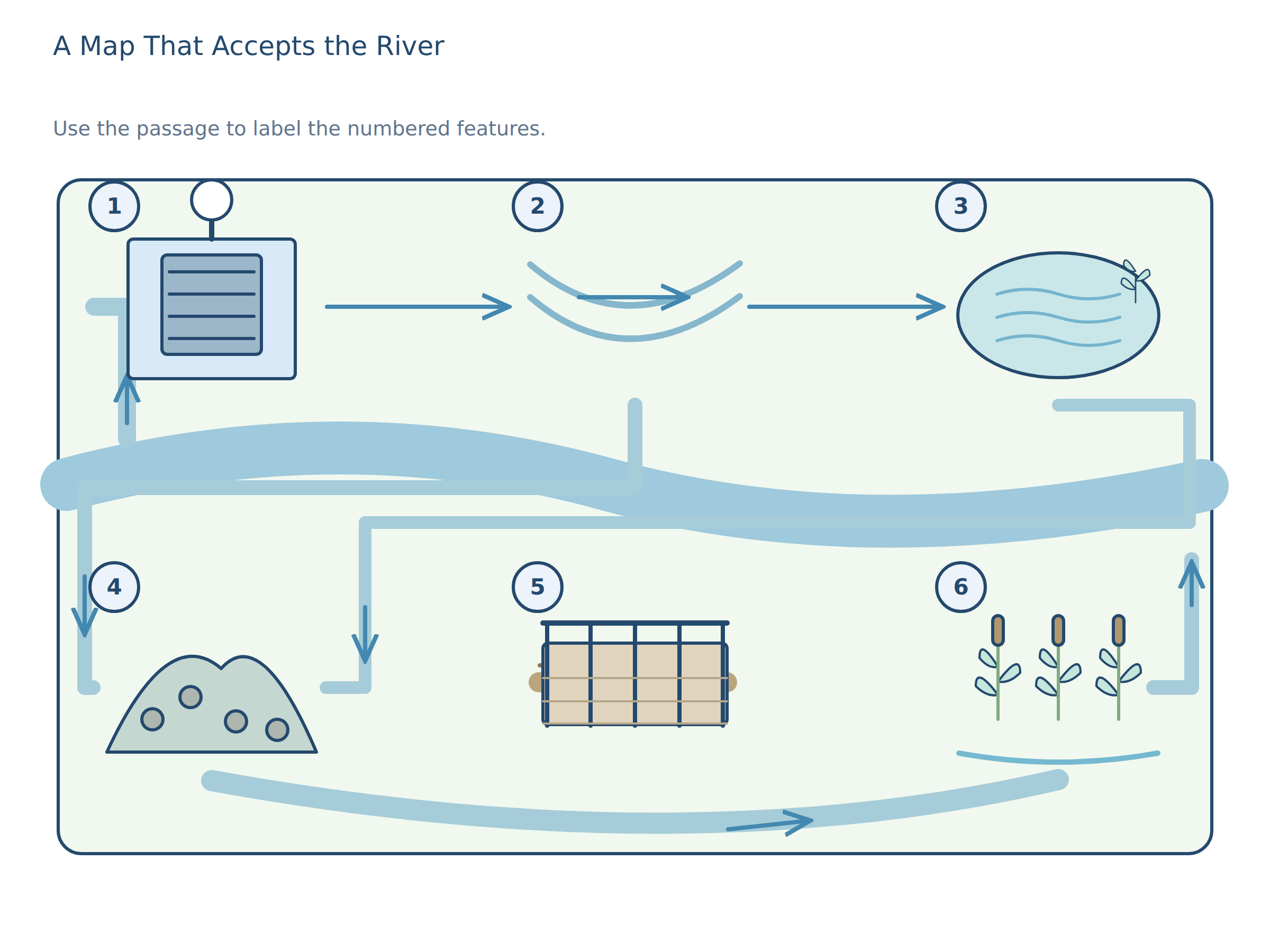 region-1
region-2
region-3
region-4
region-5
region-6
Mara Venn had spent so many years discussing flood permits that she had begun to distrust any sentence built on certainty. The floodplain she worked on was not a blank site to be protected from water; it was a shared corridor of soil, reeds, cattle paths, nesting sites, drains, and old disagreements. Every change in one place moved risk somewhere else. When the council asked for a design, she told them that the real question was not how to make the river harmless, but how to keep its changes legible and bearable. The older plan for the district had been simple in theory and expensive in practice: raise the banks, tighten the channels, and assume that a higher wall was the same thing as security. Mara had watched that logic fail in small ways before it failed in a large one. A wall could hold for years and then break the district’s confidence in a single night. The result was not only physical damage but a brittle politics in which everyone expected someone else to have promised too much. For that reason she preferred to say that the floodplain should be designed for uncertainty, not against it. In her notes she wrote, almost as a warning to herself, that it did not promise to stop floods; it promised to spread them, delay them, and read them. On the wall of the field office, the scheme was drawn as six boxes around a blue curve. The upper left box was the inlet sluice, a narrow opening that admits river water only when the level rises past a marked stone. The upper centre box was the bypass channel, which carries surplus water around the pasture instead of across it. The upper right box was the temporary basin, a shallow depression reserved for water that can remain for days without harming crops. The lower left box was the silt trap, placed there to catch sand and gravel before they move farther downstream. The lower centre box was the observation terrace, a raised strip where walkers can check the gauges and the banks without sinking into soft ground. The lower right box was the reed marsh, a planted fringe that slows the last flow, filters it, and gives cover to birds. The sequence mattered more than the labels. In a hard rain, water first met the inlet sluice, then either slipped through the bypass channel or spilled into the temporary basin if the river kept rising. Heavier material dropped into the silt trap, while the reed marsh softened the return flow before it rejoined the main channel. In a dry week the same objects still had jobs, but quieter ones: the basin remained open for inspection, the marsh held moisture, and the terrace let volunteers read the marks without trampling the verge. Nothing in the plan was decorative; every part was asked to do more than one kind of work. That was why the observation terrace mattered so much to the people who used the landscape. Children from the nearby school counted beetles there after storms; farmers used it to judge whether a tractor could cross without rutting the edge; birdwatchers stood there in spring and still felt that they had not entered private ground. The design worked because it did not separate function from permission. It gave people a place to look before they acted, which is another way of saying that it made restraint visible. Mara liked that phrase because it sounded moral without pretending to be sentimental. Still, she did not pretend that the arrangement was neutral. A temporary basin means that one patch of land must be willing to be wet when another patch stays usable, and no map can fully remove the awkwardness of that bargain. Yet the alternative was worse. If every hectare were protected as if it were priceless, then one exceptional surge would do disproportionate damage everywhere. The plan spread inconvenience so that catastrophe would have fewer places to gather. That was the difference between a compromise and a fantasy. Monitoring was supposed to protect that difference from fading. The figures were not treated as an oracle, because no graph could tell the team what a river would do after a winter of unusual thaw or a summer of compacted soil. Instead, the readings were compared from season to season to see whether the river was beginning to answer differently. A gate opened a little earlier; a bank was regraded a little later; the marsh was allowed to spread another metre. Adaptive management, as Mara used the phrase, was less a blueprint than a disciplined habit of revision. By the time the meeting ended, no one in the room believed the scheme had solved flood risk. That would have been a childish promise. What it offered was something stricter and, to Mara, more honest: a way to share a landscape with a river that remained free to surprise them. The landscape would never become safe in the absolute sense. It could, however, become more intelligible, and therefore more just.
-
Question 1 · Yes / No / Not Given
Decide whether the statement agrees with the writer’s or speaker’s view. Choose Not Given when the view is not stated.
The writer believes reversible design usually saves money in the long term.
Return to the passage, recording or visual- Yes
- No
- Not Given
Check answers and explanations
- Answer
- Not Given
Not Given. The passage mentions that temporary work is often seen as expensive and that reversible action can prevent a "costly landscape," but it does not state a general belief that reversible design usually saves money over time. The writer’s main emphasis is on learning and avoiding mistaken certainty, not on a definite long-term cost claim.
Temporary work is often dismissed as an expensive way of hesitating
I think it is often the opposite: a way of preventing one mistaken certainty from hardening into a costly landscape
-
Question 2 · Yes / No / Not Given
Decide whether the statement agrees with the writer’s or speaker’s view. Choose Not Given when the view is not stated.
The writer believes temporary measures can reveal things that plans and models may miss.
Return to the passage, recording or visual- Yes
- No
- Not Given
Check answers and explanations
- Answer
- Yes
Yes. The writer says the site answers back in ways a model cannot fully predict, and gives examples where temporary work changed what planners understood. This supports the view that temporary measures can reveal new information.
A hydrological model may tell us where water is likely to travel, but the marsh will also answer with sediment, birds, repairs, and complaint
I have seen a nursery path alter drainage in a way no spreadsheet had predicted
-
Question 3 · Yes / No / Not Given
Decide whether the statement agrees with the writer’s or speaker’s view. Choose Not Given when the view is not stated.
The writer believes uncertainty should be treated as part of the brief rather than as a problem to eliminate first.
Return to the passage, recording or visual- Yes
- No
- Not Given
Check answers and explanations
- Answer
- Yes
Yes. The writer says exactly that uncertainty is not a defect in the brief, but the brief itself. This shows approval of designing with uncertainty instead of trying to remove it completely before acting.
I have stopped treating uncertainty as a defect in the brief. It is the brief
Design under uncertainty is therefore not design without conviction
-
Question 4 · Yes / No / Not Given
Decide whether the statement agrees with the writer’s or speaker’s view. Choose Not Given when the view is not stated.
The writer thinks reversible interventions are simply a sign that the planner lacks conviction.
Return to the passage, recording or visual- Yes
- No
- Not Given
Check answers and explanations
- Answer
- No
No. The writer explicitly separates reversibility from weakness: "Reversible does not mean timid" and later "Design under uncertainty is therefore not design without conviction." The passage presents reversibility as a disciplined choice, not a sign of hesitation.
Reversible does not mean timid, and it does not mean provisional in the lazy sense
Design under uncertainty is therefore not design without conviction
-
Question 5 · Yes / No / Not Given
Decide whether the statement agrees with the writer’s or speaker’s view. Choose Not Given when the view is not stated.
The writer believes planners should choose permanent interventions only when there is a durable need for them.
Return to the passage, recording or visual- Yes
- No
- Not Given
Check answers and explanations
- Answer
- Yes
Yes. This is the writer’s explicit recommendation. The passage says permanence is not rejected in principle, but it should be justified by lasting need rather than by impatience or a desire for closure.
None of this is an argument against permanence as such
The test is whether a permanent decision is justified by durable need, not by our impatience for closure
What deserves permanence should earn it
-
Question 6 · Yes / No / Not Given
Decide whether the statement agrees with the writer’s or speaker’s view. Choose Not Given when the view is not stated.
The writer believes modest works are less respectful than grand gestures in fragile places.
Return to the passage, recording or visual- Yes
- No
- Not Given
Check answers and explanations
- Answer
- No
No. The writer says that, in a fragile place, modest works can be more respectful than grand gestures. This directly contradicts the statement.
In a fragile place, modest works can be more respectful than grand gestures because they concede that the land is not a blank stage but a collaborator
-
Question 7 · Yes / No / Not Given
Decide whether the statement agrees with the writer’s or speaker’s view. Choose Not Given when the view is not stated.
The writer believes national planning rules are usually more useful than local discussion when a shared landscape is contested.
Return to the passage, recording or visual- Yes
- No
- Not Given
Check answers and explanations
- Answer
- Not Given
Not Given. The writer discusses residents’ disagreement, consultations, procurement, and political deadlines, but does not compare national planning rules with local discussion or say which is usually more useful. The passage gives no clear opinion on that comparison.
When residents disagree, the temptation is to freeze the conversation until everyone agrees
In a shared landscape, that is a higher standard than the one usually set by routine procurement or political deadlines, but it is also a fairer one
-
Question 8 · Single choice
Choose one answer.
Which statement best summarises the writer’s overall argument?
Return to the passage, recording or visual- Reversible interventions are useful because they let planners learn from the site while keeping future choices open.
- Landscape planning should avoid action until floods, droughts, and public opinion can be predicted with high confidence.
- Permanent structures are always preferable because they give communities a clearer and more stable answer.
- The central benefit of reversible design is that it shields planners from criticism when conditions change.
Check answers and explanations
- Answer
- Reversible interventions are useful because they let planners learn from the site while keeping future choices open.
The best summary is that reversible interventions help planners learn from the site while keeping future choices open. The passage repeatedly stresses testing, revision, and avoiding foreclosed futures. The other options misread the argument: the writer does not recommend delay until perfect knowledge, does not claim permanence is always best, and does not present reversible design as a way to protect planners personally.
It means that a decision can be tested against the living site, then adjusted when the site answers back
A reversible intervention is not an admission that nothing can be known; it is a refusal to pretend that what we know today should govern every season that follows
-
Question 9 · Fill in the blank (text)
Complete each blank with the missing word or phrase.
Write NO MORE THAN THREE WORDS AND/OR A NUMBER from the passage. The project began as a ___ rather than a permanent barrier scheme.
Return to the passage, recording or visualCheck answers and explanations
- Blank 1
- three-winter pilot / pilot
The passage says the team agreed to a three-winter pilot, showing the scheme was temporary and experimental rather than a permanent barrier project. Both "pilot" and "three-winter pilot" are valid extracted phrases that fit the gap.
agreed to a three-winter pilot that would let winter water enter selected strips of land
-
Question 10 · Fill in the blank (text)
Complete each blank with the missing word or phrase.
Write NO MORE THAN THREE WORDS AND/OR A NUMBER from the passage. The landowners remained on site and kept their ___.
Return to the passage, recording or visualCheck answers and explanations
- Blank 1
- access roads
The text states directly that the landowners stayed on site and retained their access roads, so that exact phrase completes the sentence.
Landowners stayed on site and kept their access roads
-
Question 11 · Fill in the blank (text)
Complete each blank with the missing word or phrase.
Write NO MORE THAN THREE WORDS AND/OR A NUMBER from the passage. During the first storm, reed mats jammed the ___.
Return to the passage, recording or visualCheck answers and explanations
- Blank 1
- small culvert / culvert
The passage states that reed mats jammed the small culvert on the western track. Both “small culvert” and “culvert” are precise source-based answers that fit the sentence.
reed mats had jammed the small culvert on the western track
-
Question 12 · Fill in the blank (text)
Complete each blank with the missing word or phrase.
Write NO MORE THAN THREE WORDS AND/OR A NUMBER from the passage. The managed flood lowered the peak at North Fen bridge by ___.
Return to the passage, recording or visualCheck answers and explanations
- Blank 1
- eight centimetres
The source gives the reduction precisely as eight centimetres, so that measurement is the only answer that fits.
shave eight centimetres from the peak measured at North Fen bridge
-
Question 13 · Fill in the blank (dropdown)
Choose the correct option for each blank.
Some reporters called the project a failure in the dry second season because ___.
Return to the passage, recording or visualChoices for blank 1
- the main inlet was never triggered by high water
- the resilience fund was withdrawn before the season ended
- the farmers stopped maintaining their access roads
- the main gate was opened before the river rose
Check answers and explanations
- Blank 1
- the main inlet was never triggered by high water
The project was called a failure because the river never reached the level needed to trigger the main inlet. The other choices describe events that the passage does not report.
the river never reached the level that would have triggered the main inlet
-
Question 14 · Fill in the blank (dropdown)
Choose the correct option for each blank.
Mara later said the key was not total exclusion of water but ___.
Return to the passage, recording or visualChoices for blank 1
- making every field equally dry
- raising the whole floodplain above river level
- keeping the river from arriving all at once
- stopping cattle from grazing altogether
Check answers and explanations
- Blank 1
- keeping the river from arriving all at once
Mara explicitly contrasts eliminating flooding with managing its timing. The correct choice repeats her point that the river should not arrive all at once.
It was to keep the river from arriving all at once
-
Question 15 · Fill in the blank (dropdown)
Choose the correct option for each blank.
In the third winter, the lower western fields were left as ___.
Return to the passage, recording or visualChoices for blank 1
- sacrificial swales
- access roads
- dry storage pits
- permanent reservoirs
Check answers and explanations
- Blank 1
- sacrificial swales
The passage states that the operators used those fields as sacrificial swales. The other options may sound plausible in a flood project, but they do not match the text.
let the lower western fields act as sacrificial swales
-
Question 16 · Fill in the blank (dropdown)
Choose the correct option for each blank.
The final report recommended a plan that could be ___ as conditions changed.
Return to the passage, recording or visualChoices for blank 1
- replaced only after failure
- sealed, hidden, and forgotten
- held open in every season
- opened, delayed, or narrowed
Check answers and explanations
- Blank 1
- opened, delayed, or narrowed
The report supports a flexible system that changes with conditions. The correct option reflects the exact range of adjustments named in the passage, while the others imply rigidity or neglect.
a system should be able to open, delay, or narrow according to conditions
-
Question 17 · Label the image
Match the labels to the marked regions of the image.
Read the passage and choose the correct labels for the six parts of the diagram.
Return to the passage, recording or visualImage labels
fish ladder · inlet sluice · bypass channel · temporary basin · silt trap · observation terrace · reed marsh · pump station
Label regions region-1, region-2, region-3, region-4, region-5, region-6 marked on the image above.
Check answers and explanations
- Region region-1
- inlet sluice
- Region region-2
- bypass channel
- Region region-3
- temporary basin
- Region region-4
- silt trap
- Region region-5
- observation terrace
- Region region-6
- reed marsh
Label 1: The upper-left region is the inlet sluice, which admits river water when the level rises past a marked stone. Label 2: The upper-centre region is the bypass channel, which carries surplus water around the pasture. Label 3: The upper-right region is the temporary basin, where water can remain without harming crops. Label 4: The lower-left region is the silt trap, which catches sand and gravel. Label 5: The lower-centre region is the observation terrace, where people can check gauges and banks without sinking into soft ground. Label 6: The lower-right region is the reed marsh, which slows and filters the returning flow and provides cover for birds.
The upper left box was the inlet sluice, a narrow opening that admits river water only when the level rises past a marked stone
The lower centre box was the observation terrace, a raised strip where walkers can check the gauges and the banks without sinking into soft ground
The lower right box was the reed marsh, a planted fringe that slows the last flow, filters it, and gives cover to birds
-
Question 18 · Single choice
Choose one answer.
What is the passage mainly arguing about floodplain design?
Return to the passage, recording or visual- It should adapt to changing conditions, not promise total control.
- It works best when the river is forced into a single fixed route.
- It is most successful when every flood is kept outside the landscape.
- It matters mainly because it creates new land for building.
Check answers and explanations
- Answer
- It should adapt to changing conditions, not promise total control.
The passage argues for a design that adjusts to changing conditions rather than pretending the river can be fully controlled. The text explicitly says the floodplain should be designed for uncertainty, not against it. The other options conflict with that stance by claiming total control, fixed routes, or simple expansion.
she preferred to say that the floodplain should be designed for uncertainty, not against it
it did not promise to stop floods; it promised to spread them, delay them, and read them
-
Question 19 · Single choice
Choose one answer.
What does the author mean when she says the figures were not treated as an oracle?
Return to the passage, recording or visual- The figures were ignored because only field impressions mattered.
- They supported revisions, not complete prediction.
- The figures were collected only to prove that the plan was already perfect.
- The figures replaced the need for any human judgment about the river.
Check answers and explanations
- Answer
- They supported revisions, not complete prediction.
The phrase means the monitoring data guided discussion and small adjustments, but it was not considered a perfect predictor. The passage says the readings were compared from season to season, which shows ongoing judgment rather than blind trust. The other options overstate what the figures can do or ignore their use altogether.
The figures were not treated as an oracle
the readings were compared from season to season to see whether the river was beginning to answer differently
-
Question 20 · Single choice
Choose one answer.
Why is the silt trap placed before the reed marsh?
Return to the passage, recording or visual- To store water for several dry months after a flood.
- To give birds cover while filtering the last flow of water.
- To raise the walking surface above the soft ground.
- To catch sand and gravel before they move downstream.
Check answers and explanations
- Answer
- To catch sand and gravel before they move downstream.
The silt trap catches coarse material before it can move farther downstream and interfere with the rest of the system. That is why it comes earlier in the sequence than the reed marsh. The other options describe functions the passage does not assign to it.
The lower left box was the silt trap, placed there to catch sand and gravel before they move farther downstream
Heavier material dropped into the silt trap
-
Question 21 · Single choice
Choose one answer.
What does the phrase 'it did not separate function from permission' suggest about the observation terrace and the people using it?
Return to the passage, recording or visual- It existed mostly as storage space for tools and equipment.
- It was mainly built to stop people from entering the floodplain at all.
- It let people inspect the floodplain without damaging it.
- It replaced the need for any observation or judgement.
Check answers and explanations
- Answer
- It let people inspect the floodplain without damaging it.
The terrace is not just a structure for measurement; it also gives people an acceptable place to inspect the floodplain without damaging it. That is why the passage links function with permission and says it made restraint visible. The other options miss this social and practical dimension.
The design worked because it did not separate function from permission
It gave people a place to look before they acted, which is another way of saying that it made restraint visible
-
Question 22 · Single choice
Choose one answer.
Why does the author say the floodplain should be designed for uncertainty rather than against it?
Return to the passage, recording or visual- Because fixed walls are cheaper than any other approach.
- Because total-control confidence can fail abruptly.
- Because the river can be made harmless with enough engineering.
- Because floods always improve farmland if they are left alone.
Check answers and explanations
- Answer
- Because total-control confidence can fail abruptly.
The passage rejects the fantasy of total control because older wall-based schemes created brittle confidence and then failed abruptly. Designing for uncertainty means spreading, delaying, and reading floods instead of pretending they can be abolished. The incorrect options all revive the idea of complete exclusion or fixed security.
she preferred to say that the floodplain should be designed for uncertainty, not against it
A wall could hold for years and then break the district’s confidence in a single night
-
Question 23 · Single choice
Choose one answer.
What limitation of the plan does the passage openly accept?
Return to the passage, recording or visual- The temporary basin is only needed because the river is no longer natural.
- Every part of the floodplain can stay dry if monitoring is good enough.
- Some land must accept water so other land stays usable.
- The scheme removes all awkward trade-offs between users of the land.
Check answers and explanations
- Answer
- Some land must accept water so other land stays usable.
The plan accepts that one area must sometimes be wet so another area can stay usable, and that this bargain cannot be made perfectly neat. The text says no map can fully remove that awkwardness. The other options deny the need for compromise or claim the plan eliminates risk entirely, which the passage rejects.
A temporary basin means that one patch of land must be willing to be wet when another patch stays usable
no map can fully remove the awkwardness of that bargain
-
Question 24 · Single choice
Choose one answer.
Why does the author conclude that the landscape can become 'more just'?
Return to the passage, recording or visual- Because the river is turned into a profitable transport route.
- Because the floodplain becomes completely safe for everyone.
- Because the design makes the landscape look more modern.
- Because it spreads risk and limits catastrophic harm.
Check answers and explanations
- Answer
- Because it spreads risk and limits catastrophic harm.
The concluding idea is that spreading inconvenience and making restraint visible reduces the chance that one group bears all the damage from a rare surge. That shared burden is what allows the landscape to be called more just, even though it is not absolutely safe. The incorrect options introduce ideas such as profit, beauty, or total safety that the passage does not support.
The plan spread inconvenience so that catastrophe would have fewer places to gather
It could, however, become more intelligible, and therefore more just
What to review next
Find the words that support each answer. For a mistake, compare the question with the evidence and identify the detail or inference you missed.
A focused practice result shows how you did on these tasks. Use several activities across skills to decide what to study next; one practice score does not certify an overall CEFR level.
Before you practise: a worked example
Look for evidence in the text. Separate what the writer says from what you already know about the topic.
The library normally closes at six, but on Fridays it stays open until eight. When does it close on Friday?
The answer is eight. But introduces an exception to the normal closing time, so the first time mentioned is not the answer.
This teaching example is separate from the scored questions. After your test, compare any mistakes with the explanation and revisit the topic before trying again.