
A Closed-Loop Materials System and Its Exceptions
About this practice test
Read an explanation of a seaside town’s materials-recovery system and assign its collection, sorting, repair, reprocessing, composting, and exception-handling stages to a diagram.
What you’ll practice
Finding detail
Locate specific information and evidence.
Interpreting ideas
Connect main points and inferences.
Evaluating arguments
Assess claims, evidence, and limitations.
What to expect:
1 question with explanations to review after submission.
Study the questions and tasks
Work through the material below, or start the interactive practice above to complete an attempt. Try the exercises before opening any answer or transcript sections, then use them to review your work.
- Practice level
- C2. Try this level if you can follow the instructions and understand most of the language; choose an earlier level if you need more support.
- Question formats
- Label the image
How to approach this practice
Read the passage for its main idea, then return to the relevant sentence or paragraph for each question. Base answers on the passage.
A Closed-Loop Materials System and Its Exceptions
 region-1
region-2
region-3
region-4
region-5
region-6
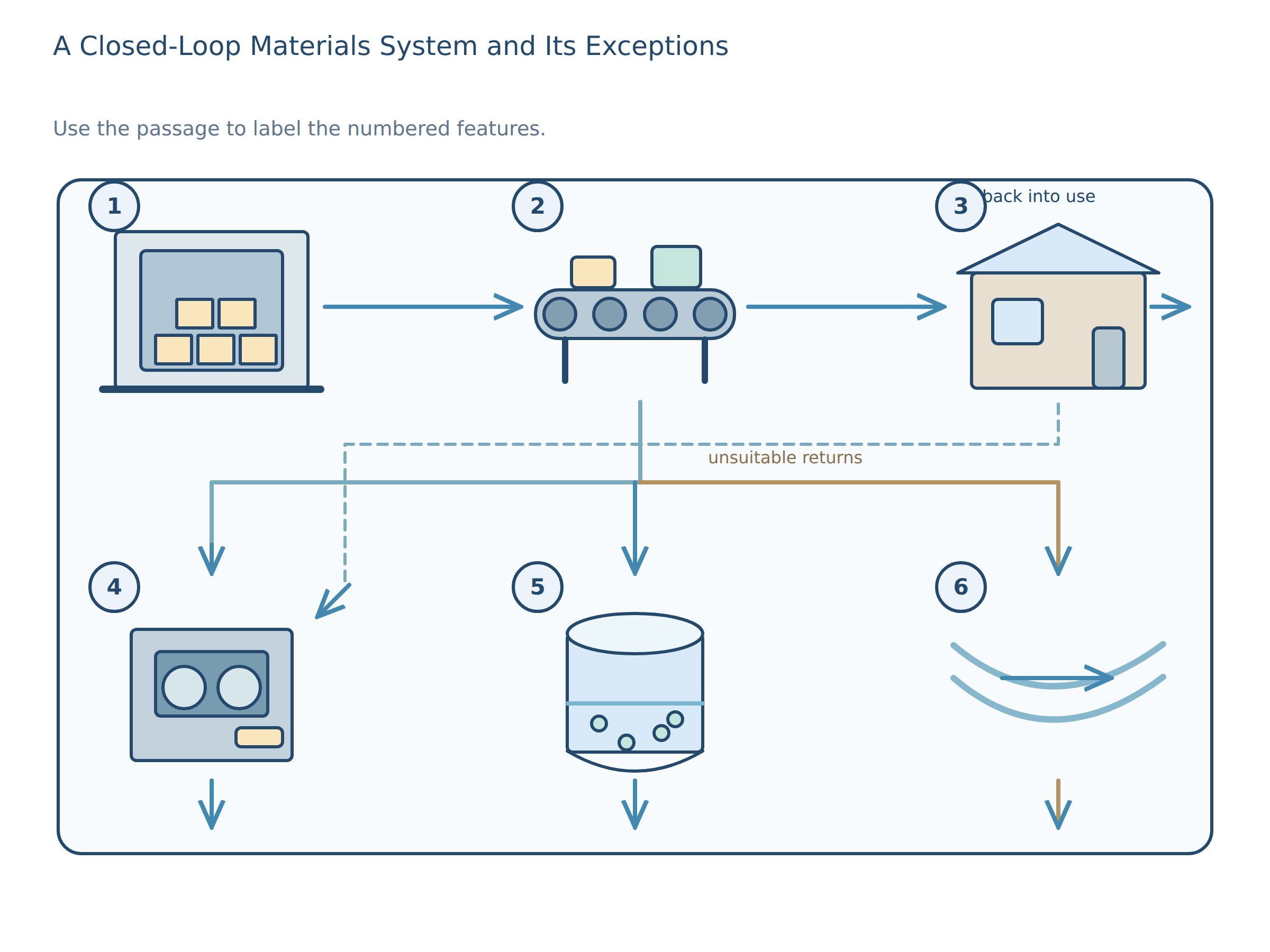
People often speak about circular economy as if the world could be persuaded into perfect closure by diagrams alone. In practice, a closed-loop materials system is less a circle than a disciplined conversation between design and refusal. It asks a plain question of every object: can it be kept in use with modest effort, can its material be safely recovered, or does it belong, for reasons that are not sentimental, elsewhere? The system described here was built for a seaside town that wanted to cut its landfill load without pretending that all materials behave alike. Its virtue is not magic. It is triage. In the upper left, the collection dock is the first public face of the system. Residents, shops, and repair cafés deliver sorted returns there in crates and bins. The staff do not yet decide what something is worth; they merely check whether it has arrived intact enough to justify examination. The dock therefore acts like a breathing point, slowing the pace just enough for the next stage to work. In the upper centre, the sorting belt runs beneath cameras, magnets, and air jets. This stage is more discriminating than dramatic. Paper that is dry and clean can remain in the loop; metal is pulled aside; glass is separated by colour; and anything oily, frayed, or composite is sent out of the main stream. The upper right holds the repair room, which is less visible but often more valuable than the machinery that follows. Here technicians test kettles, lamps, stools, and small electronics to see whether failure is local rather than total. A broken hinge, a worn seal, or a dead switch may be enough to send an item back into circulation. Once an item cannot be repaired, clean material may still be retained, and in the lower left the reprocessing mill performs that task. Shredders, washers, and presses reduce rigid leftovers to a form that can be re-entered into manufacture as pellets, flakes, or fibre. The word mill is useful because it suggests both force and restraint. The lower centre is occupied by the biological tank, where food scraps, yard waste, and certified compostable packaging are broken down by heat, moisture, and microbes. Unlike the reprocessing mill, which treats material as a physical substance to be reshaped, the tank treats it as food for other life. The result is soil amendment, biogas, or both, depending on the design. The lower right is the exception channel, and its presence is the clearest sign that the system has thought about its own limits. Batteries with damaged casings, medicine containers bearing residue, and composite laminates that cannot be separated without waste all pass this way. This is where people sometimes misread the idea of circularity. They imagine that the best system is the one that keeps everything circulating forever. But a perfect circle is not always a responsible shape. Materials age, laws change, additives migrate, and some products are assembled from layers that can barely be separated without worse damage than disposal would cause. A laminated packet may look thin and innocent; chemically, it can be stubborn. A battery may be compact; if crushed in the wrong place, it can become a fire. The system therefore measures success not by the fantasy of total recovery, but by how intelligently it preserves what is recoverable and isolates what is not. The town that built this system also learned that closure depends on trust. Shops had to label returns honestly. Designers had to reduce unnecessary mixtures. Collectors had to resist the temptation to treat speed as a synonym for efficiency. Even the best machinery cannot compensate for vague habits upstream. That is why the architecture matters: each stage teaches the next stage what kind of material is arriving, and each exception teaches the public that responsible sorting includes the courage to say no. In this sense, the loop is closed not because nothing leaves it, but because every departure is deliberate. Between those stages, the town also created a small audit office. Its job was not to congratulate the system, but to record where material was lost, where contamination entered, and which categories were beginning to arrive in forms that no machine could comfortably handle. Those records prevented the loop from becoming a ritual. If a stream improved, the figures had to show it; if a stream worsened, the reason had to be named rather than hidden behind a cheerful average. The office had no moving belts and no dramatic machinery, yet it helped keep the whole arrangement honest. The distinction between repair, reprocessing, composting, and exception handling also changes how the town talks about waste. A broken chair is not automatically a loss, and a food container is not automatically a candidate for the same treatment as a sandwich wrapper. The labels matter because they prevent the comforting simplification that all discards are equivalent. Once that simplification is abandoned, the system becomes easier to defend and harder to romanticise. It is not a cathedral of sustainability. It is an arrangement of practical allowances. That arrangement has consequences beyond the plant fence. Schools visit it to see that material value is a property of condition, not of slogan. Shopkeepers see that packaging choices can either widen or narrow the path back into use. Engineers learn that purity is expensive but not optional when recovery is the goal. Citizens, for their part, discover that convenience is not the same thing as care. The most revealing feature of the system may therefore be its refusal to flatter anyone. It rewards attention, not virtue-signalling. Seen from a distance, the diagram looks neat, almost self-contained. Seen closely, it looks more interesting than neat: a sequence of promises, corrections, and carefully placed exits. The system holds only because it distinguishes between what can be repaired, what can be reprocessed, what can be composted, and what must be handed off. That distinction is not a compromise of the circular idea. It is the idea, made honest.
-
Question 1 · Label the image
Match the labels to the marked regions of the image.
Read the passage, trace how materials move through the system, and assign the most precise label to each numbered region. Use both the region’s position and its function; distinguish repair, reprocessing, biological treatment, and deliberate removal from the loop.
Return to the passage, recording or visualImage labels
collection dock · sorting belt · repair room · reprocessing mill · biological tank · exception channel · landfill mound · smelter furnace
Label regions region-1, region-2, region-3, region-4, region-5, region-6 marked on the image above.
Check answers and explanations
- Region region-1
- collection dock
- Region region-2
- sorting belt
- Region region-3
- repair room
- Region region-4
- reprocessing mill
- Region region-5
- biological tank
- Region region-6
- exception channel
Label 1: collection dock — the upper-left starting point receives sorted returns for initial inspection. Label 2: sorting belt — the upper-centre stage uses mechanical and optical separation to direct materials into different routes. Label 3: repair room — the upper-right stage tests whether an item can return to use after a local failure. Label 4: reprocessing mill — the lower-left stage reshapes clean unrepaired material into pellets, flakes, or fibre. Label 5: biological tank — the lower-centre stage uses heat, moisture, and microbes to transform organic material into soil amendment or biogas. Label 6: exception channel — the lower-right route deliberately removes unsafe or inseparable materials from the main loop. The landfill mound and smelter furnace are not described as stages in this system.
each stage teaches the next stage what kind of material is arriving
Once an item cannot be repaired, clean material may still be retained, and in the lower left the reprocessing mill performs that task
The lower right is the exception channel, and its presence is the clearest sign that the system has thought about its own limits
What to review next
Find the words that support each answer. For a mistake, compare the question with the evidence and identify the detail or inference you missed.
A focused practice result shows how you did on these tasks. Use several activities across skills to decide what to study next; one practice score does not certify an overall CEFR level.
Before you practise: a worked example
Look for evidence in the text. Separate what the writer says from what you already know about the topic.
The library normally closes at six, but on Fridays it stays open until eight. When does it close on Friday?
The answer is eight. But introduces an exception to the normal closing time, so the first time mentioned is not the answer.
This teaching example is separate from the scored questions. After your test, compare any mistakes with the explanation and revisit the topic before trying again.