
Tracing Material Flows in a Repair Cooperative
About this practice test
A reading task tracing how a repair cooperative receives, sorts, cleans, repairs, reuses, and dispatches damaged items while acknowledging the limits of its process.
What you’ll practice
Finding detail
Locate specific information and evidence.
Interpreting ideas
Connect main points and inferences.
Evaluating arguments
Assess claims, evidence, and limitations.
What to expect:
1 question with explanations to review after submission.
Study the questions and tasks
Work through the material below, or start the interactive practice above to complete an attempt. Try the exercises before opening any answer or transcript sections, then use them to review your work.
- Practice level
- C1. Try this level if you can follow the instructions and understand most of the language; choose an earlier level if you need more support.
- Question formats
- Label the image
How to approach this practice
Read the passage for its main idea, then return to the relevant sentence or paragraph for each question. Base answers on the passage.
Tracing Material Flows in a Repair Cooperative
 region-1
region-2
region-3
region-4
region-5
region-6
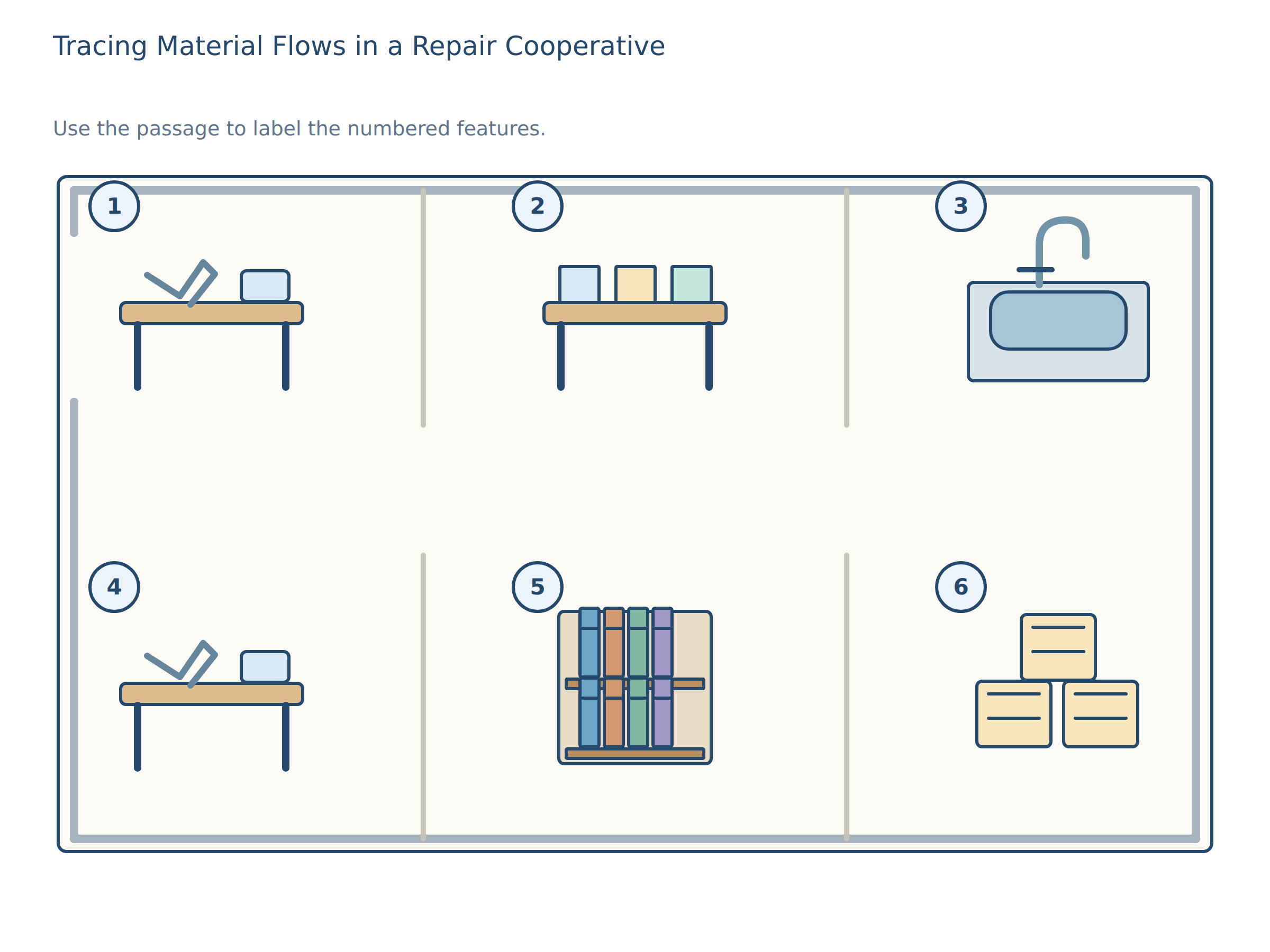
The repair cooperative occupies a converted print shop on a side street, and its members are careful about how they describe their work. They do not promise to turn every broken thing into a success story. What they promise is a traceable route for material: each item is logged, moved, handled, and either returned to use or passed on with its condition openly recorded. That modest language matters, because the cooperative wants to avoid the neat but false idea that all waste can simply be rescued if people are enthusiastic enough. At the upper left, just inside the door, stands a covered intake bench. This is where customers leave kettles, chairs, lamps, or bags of torn clothing. A volunteer weighs the object, takes one photograph, and fastens a paper tag to the handle or seam. The bench is narrow on purpose, because nothing is meant to stay there long. It is a stopping point, not a storage area, and the tag number follows the item through every later decision. The upper centre is a long sorting table with a washable surface. Here, two people split the incoming stream into practical categories: electrical goods, textiles, rigid plastic, and metal frames. They also decide whether an item is worth repair, worth harvesting for parts, or too damaged for either route. The table is the cooperative's honest bottleneck. A cracked radio may look hopeful at first glance, but if the casing has warped or the wiring is brittle, the item is sent onward without sentimental delay. On the upper right, behind a splash screen, is the wash station. Only the objects that can safely meet water come here, and even then the cleaning is measured rather than decorative. Grease is lifted from hinges, dust is brushed from fan guards, and textile pieces are pre-soaked before they are checked for hidden tears. Anything with delicate paper labels, rusty batteries, or swollen wood is cleaned in other ways, or not at all. The point is not to make everything shine; it is to reduce contamination so the next judgement is fair. The lower left holds three repair benches, each marked by a small lamp and a tray for screws. This is where the cooperative's claim becomes visible in hand movements. One volunteer resolders a kettle switch, another replaces a zipper slider, while a third straightens a chair leg with clamps and patience. The work is deliberately limited: if a repair would swallow half a day and still leave the item unreliable, the bench does not force heroics. A repair is useful only when it can be trusted. In the lower centre sits the parts library, a bank of shallow drawers made from salvaged cabinets. It is not a museum of interesting leftovers. It is a working archive of screws, switches, knobs, zips, springs, and fabric patches, each taken from items that could not be kept whole. Volunteers borrow from the drawers and return the unused pieces at the end of the shift, which keeps the supply visible and stops small components from vanishing into pockets. The library also reduces purchases, but it does so quietly, one replacement at a time. The lower right contains the dispatch crates. These are labelled for three streams: local repair, school donation, and recycling partner. Items that have been restored enough to sell or return go into the first stream; sturdy but outgrown goods go into the second; and the rest, once stripped for anything useful, go to the third. The crates are placed near the exit so that decisions do not have to be reversed later. A crate closed too early can hide a mistake, but an open crate can create confusion, so the volunteers check the tag against the route before sealing it. Because the cooperative records counts by category rather than by object, it can say that most of what leaves the building goes back into use, yet it cannot honestly promise the same ratio every month. Winter brings damp tools and more failed appliances; school holidays bring more damaged toys and fewer hands. The manager prefers this qualified account to a glossy one. If the public can see where material enters, pauses, and exits, they are more likely to trust the process even when some pieces are finally lost. In that sense, the map of the workshop is also an argument about restraint.
-
Question 1 · Label the image
Match the labels to the marked regions of the image.
Read the passage and choose labels for the numbered diagram.
Return to the passage, recording or visualImage labels
sorting table · wash station · repair benches · parts library · dispatch crates · tool lockers · donation shelf · intake bench
Label regions region-1, region-2, region-3, region-4, region-5, region-6 marked on the image above.
Check answers and explanations
- Region region-1
- intake bench
- Region region-2
- sorting table
- Region region-3
- wash station
- Region region-4
- repair benches
- Region region-5
- parts library
- Region region-6
- dispatch crates
Label 1: intake bench — the upper-left station is where customers leave items and volunteers tag them. Label 2: sorting table — the upper-centre station divides items into practical categories and assesses their possible routes. Label 3: wash station — the upper-right station cleans objects that can safely meet water. Label 4: repair benches — the lower-left station is where volunteers carry out limited, reliable repairs. Label 5: parts library — the lower-centre drawers store reusable components from items that could not be kept whole. Label 6: dispatch crates — the lower-right crates separate items for local repair, school donation, or recycling. The other labels are not assigned to any described position.
At the upper left, just inside the door, stands a covered intake bench
The upper centre is a long sorting table with a washable surface
The lower right contains the dispatch crates
What to review next
Find the words that support each answer. For a mistake, compare the question with the evidence and identify the detail or inference you missed.
A focused practice result shows how you did on these tasks. Use several activities across skills to decide what to study next; one practice score does not certify an overall CEFR level.
Before you practise: a worked example
Look for evidence in the text. Separate what the writer says from what you already know about the topic.
The library normally closes at six, but on Fridays it stays open until eight. When does it close on Friday?
The answer is eight. But introduces an exception to the normal closing time, so the first time mentioned is not the answer.
This teaching example is separate from the scored questions. After your test, compare any mistakes with the explanation and revisit the topic before trying again.