
Preserving Heritage while Changing Its Purpose
About this practice test
Read three connected texts about adapting historic industrial and civic buildings for contemporary use while retaining visible evidence of their past. Tasks assess detail, reference, inference, stance, limitations, synthesis, cloze completion, and diagram-based retrieval.
What you’ll practice
Finding detail
Locate specific information and evidence.
Interpreting ideas
Connect main points and inferences.
Evaluating arguments
Assess claims, evidence, and limitations.
What to expect:
21 questions with explanations to review after submission.
Study the questions and tasks
Work through the material below, or start the interactive practice above to complete an attempt. Try the exercises before opening any answer or transcript sections, then use them to review your work.
- Practice level
- C1. Try this level if you can follow the instructions and understand most of the language; choose an earlier level if you need more support.
- Question formats
- Yes / No / Not Given, Single choice, Fill in the blank (text), Fill in the blank (dropdown), Label the image
How to approach this practice
Read the passage for its main idea, then return to the relevant sentence or paragraph for each question. Base answers on the passage.
North Quay Reimagined
Elin Morley stood in the south bay of North Quay Foundry, looking along the rail tracks set into the floor. The building had been redundant for years, but she refused to describe it as finished simply because its machines had stopped. As a curator, she argued for a position that many people still found uncomfortable: the foundry should be adapted, not embalmed. In public meetings she kept returning to two neat but misleading ideas. One was that preservation means freezing a place in the form people remember. The other was that any new use must necessarily erase the past. Elin believed both assumptions were too simple. A heritage building, she thought, should remain legible in the present without pretending that time has left no mark. The foundry’s red brick walls were darkened with soot, repaired in patches, and widened at old openings where carts had once moved in and out. Elin saw these details as evidence rather than damage. She resisted the wish to polish industrial interiors until they appeared untouched by work. Once that happens, she said, the site begins to tell a false story. The scratches on the floor, the uneven wear near the loading bay, and the crane beam above the eastern arch all belonged to the building’s meaning. In her view, an over-restored shell can mislead more than a weathered one. Repair was necessary, but erasure was not. At the same time, Elin was not defending neglect. She pointed out that abandoned buildings deteriorate quickly, and deterioration is expensive. A roof that leaks for another winter may cause more loss than a modest intervention that allows a building to be heated, inspected, insured, and used. Yet this did not mean that any proposal would do. Some new uses would demand too much of the structure, especially those needing deep partitions or heavy services. She wanted the right use, not merely a use, because a poor conversion can damage both fabric and meaning at once. During public consultations, some residents asked whether a café and rehearsal room would make the site less authentic. Elin replied that authenticity is not the same as stillness. If a new tenant hides the structure behind plasterboard and branded signs, the building becomes a container rather than a witness. But if the new activity follows the existing rhythm of the place, visitors can read the old story through the new one. She often repeated that the aim is not to preserve every bolt. It is to preserve the logic of labour, circulation, and scale that once shaped the site. In her view, the best adaptation lets people feel that logic without forcing the building to perform as a museum exhibit. Her position also made room for compromise, which some campaigners found hard to accept. She did not believe every redundant mill should become a museum, because not every site can carry the burden of memory alone. Nor did she think commercial rent is automatically suspect; a sustainable income can protect a site far better than a short-lived campaign poster. What she resisted was the idea that money and meaning must be enemies. A project might pay its way and still leave space for local schools, oral-history displays, and occasional public access to the old gantry. The point, she suggested, was not to choose between use and remembrance, but to arrange them so that each strengthened the other. Still, Elin was careful about what she promised. She knew that adapting heritage is slower and messier than slogans suggest. Surveys uncover hidden damage, planning rules change, and the first proposal is rarely the best one. She would rather the town have a difficult conversation than a polished lie. If North Quay is reused well, people will not mistake it for a theme park or a sealed relic; they will see a working building whose present purpose does not cancel its former life. That, she said, is the nearest thing to respect the site can have.
The Bramley Shed Trial
A report on Bramley’s conservation trial drew on three documents from different stages of the project. The first was a briefing note prepared after the council invited proposals for the Old Ferry Shed, an industrial building at the edge of town. Built in 1912, the shed had once housed steam locomotives. After the rail line closed, it was used for storage and later left empty. Rain had entered through the roof, ivy had reached the loading doors, and the brickwork was flaking away. Even so, local historian Mira Donne argued that the structure still retained its long roof, its iron frame, and the memory of working life in the town. For her, the aim was not to freeze the building in time, but to preserve enough of it for people to recognise what it had once been. The same briefing note recorded the winning proposal, submitted by a group led by café owner Tariq Benson and conservator Lena Holt. They suggested a one-year trial in which the shed would be part rehearsal space for a youth theatre, part weekend market, with a reading room at the rear. The plan was deliberately modest. Rather than rebuilding the shed as a polished attraction, the team wanted to test whether a lighter use could pay for basic repairs. They believed the building could survive public use only if its old form stayed legible and the changes remained limited. The council agreed on the condition that the external shell remained visible and that all changes could, if necessary, be reversed. A second document, written as a site memorandum during the building work, showed how that condition shaped each intervention. The stone floor in the western bay was lifted only where it had already failed, leaving patches of the old brick surface exposed. Insulation was inserted between the steel ribs, and new fire exits were cut through later additions rather than through the original wall. Old paint lines, once used to guide wagons, were cleaned rather than erased. Holt wrote that these choices were less about museum purity than about making the shed legible, so visitors could still read what had happened there. The same memorandum also noted the dispute that followed. The heritage group feared that music, stalls, and people carrying coffee cups would make the place feel like an ordinary event hall. Benson replied that an empty building did not preserve itself; a roof left unused, he said, decays faster than one that is watched daily. The council settled the disagreement by requiring a maintenance log, a public notice explaining the former railway use, and quarterly inspections. The compromise did not remove disagreement, but it made responsibility visible, and it gave the trial a paper trail as well as a physical one. The third source in the report was a winter review prepared after several months of use. It offered mixed evidence. Energy use was lower than consultants had predicted, partly because the shed was only partially heated and partly because the busiest periods were short. Attendance at theatre rehearsals was steady, and the Saturday market drew enough visitors to keep the nearby bakery busy. At the same time, revenues fluctuated from month to month, and two stallholders left after finding the evening hours too quiet. Noise complaints were few, but they rose on nights when the hall was booked for amplified music. The pattern suggested that the shed could support light activity, though not every kind of event with equal ease. In its final section, the council avoided claiming that the Bramley trial offered a universal model. The outcome, it said, depended on a favourable set of conditions: small grants, volunteer labour, and a structure that could accept new services without losing its frame. The authors concluded that changing a heritage building's purpose can save fabric when the new use is light, regular, and carefully monitored. They also warned that the same method would be less successful in a site needing heavy commercial alterations, because some forms of adaptation leave too little of the original building to justify the effort. The document treated the shed as a useful test case, not as a simple success story.
The Quay House Retrofit
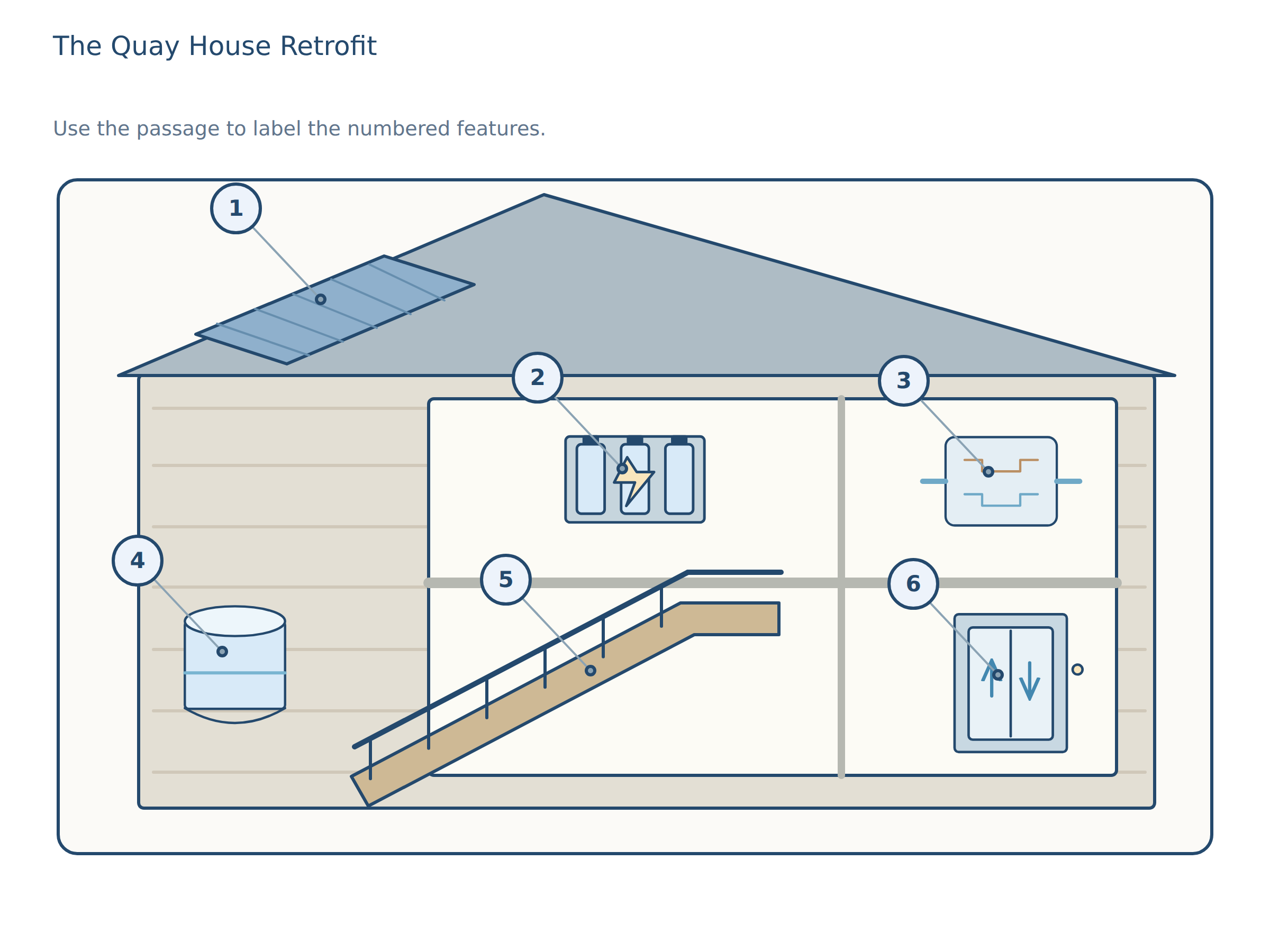 region-1
region-2
region-3
region-4
region-5
region-6
The old stone customs house on Alder Quay had spent decades as a warehouse, then almost ten years empty. When Mara first brought visitors inside, she did not talk about making it look new. She talked about keeping the building readable: the heavy arches, the worn floor, the line where a later wall had once split the hall. The new use would be a local history centre with classrooms and a small archive, so the shell had to welcome more people without pretending that nothing had changed. In the upper left of the schematic sits a slim photovoltaic strip tucked along the less visible roof slope. It is not large enough to power the whole building, and nobody on the team pretended otherwise, but it covers the busiest daytime demand and keeps the lights, ticket desk, and computers running when the weather cooperates. Opposite it, in the upper centre, is a cupboard-sized battery bank beside the old service stair. Its job is not to make the building independent; it simply stores surplus electricity so the evening programme can start without drawing immediately from the grid. The upper right shows the heat-recovery ventilator, hidden where a blocked chimney once stood. That choice saved an awkward cut through the main rooms, and it also let the system borrow warmth from stale outgoing air instead of throwing it away. Dev was careful to say that this does not make the building “green” on its own. The thick walls still need sensible use, the windows still leak a little heat, and the most efficient machine cannot compensate for careless opening of doors during winter tours. At the lower left, a rainwater cistern collects run-off from the roof and feeds the toilets and cleaning taps. Mara liked it because it made one old habit useful again: the building has always shed rain into the yard, but now some of that water returns inside. The lower centre marks the access ramp, a shallow route that follows the footprint of an earlier loading path. It is longer than a straight concrete shortcut would have been, yet the gentle slope allowed wheelchair users and delivery trolleys to enter without forcing a new scar through the front steps. The lower right contains the lift core, a compact shaft tucked behind a repaired brick pier. This was the hardest compromise, because a heritage façade can tolerate pipes and cables more easily than a visible box inserted into its front. The team therefore placed the lift where a later partition had already damaged the plan, then wrapped the opening in timber of a tone close to the surrounding floors. It is not invisible; Mara said that would have been dishonest. Instead, it is legible as a later layer, and that honesty matters when a building must keep its history while earning its keep. By the time the work was finished, the project had become less a rescue than a negotiation. Some visitors will notice the systems immediately; others will only feel that the rooms are warmer, easier to reach, and less dependent on fossil fuel. Mara preferred that balance. If a renovation erases every trace of intervention, it risks turning heritage into scenery. If it leaves the building too fragile to use, it merely preserves inconvenience. The point, she argued, is to let the past remain visible while making present use possible.
-
Question 1 · Yes / No / Not Given
Decide whether the statement agrees with the writer’s or speaker’s view. Choose Not Given when the view is not stated.
Elin Morley believes that traces of past labour should remain visible after the site is adapted.
Return to the passage, recording or visual- Yes
- No
- Not Given
Check answers and explanations
- Answer
- Yes
Yes. She explicitly argues that the marks of use should stay visible, not be polished away. The passage says those features are part of the building’s meaning, and she rejects repair that erases evidence of work.
The scratches on the floor, the uneven wear near the loading bay, and the crane beam above the eastern arch all belonged to the building’s meaning
Repair was necessary, but erasure was not
Yes: Correct. The passage supports keeping visible evidence of former labour.
No: Incorrect. Elin says the opposite: visible traces help the building tell the truth about its past.
Not Given: Incorrect. The passage clearly states Elin's view on this point.
-
Question 2 · Yes / No / Not Given
Decide whether the statement agrees with the writer’s or speaker’s view. Choose Not Given when the view is not stated.
Elin Morley believes the first phase should rely on council funding rather than outside help.
Return to the passage, recording or visual- Yes
- No
- Not Given
Check answers and explanations
- Answer
- Not Given
Not Given. The passage discusses sustainability, planning, and income, but it never says the first phase should depend on council funding, nor does it compare council money with outside help in that way.
a sustainable income can protect a site far better than a short-lived campaign poster
planning rules change, and the first proposal is rarely the best one
Yes: Incorrect. The passage never states that council funding should be the main source for the first phase.
No: Incorrect. The text does not contradict this specific funding claim; it simply does not make it.
Not Given: Correct. The passage gives no clear information about council funding versus outside help for the first phase.
-
Question 3 · Yes / No / Not Given
Decide whether the statement agrees with the writer’s or speaker’s view. Choose Not Given when the view is not stated.
Elin Morley believes that visitor numbers should be the main measure of success.
Return to the passage, recording or visual- Yes
- No
- Not Given
Check answers and explanations
- Answer
- Not Given
Not Given. The passage mentions public access, schools, oral-history displays, and income, but it never says visitor numbers should be the main measure of success. That criterion is not stated or implied as her standard.
local schools, oral-history displays, and occasional public access to the old gantry
What she resisted was the idea that money and meaning must be enemies
Yes: Incorrect. The passage does not present visitor numbers as Elin's main standard.
No: Incorrect. The passage does not directly contradict the idea; it simply does not say it.
Not Given: Correct. No statement is made about visitor numbers as the main measure of success.
-
Question 4 · Yes / No / Not Given
Decide whether the statement agrees with the writer’s or speaker’s view. Choose Not Given when the view is not stated.
Elin Morley believes that a building can remain authentic even when its function changes.
Return to the passage, recording or visual- Yes
- No
- Not Given
Check answers and explanations
- Answer
- Yes
Yes. She states that authenticity is not the same as stillness and ends by saying the building's present purpose does not cancel its former life. That shows she thinks change of use and authenticity can coexist.
authenticity is not the same as stillness
they will see a working building whose present purpose does not cancel its former life
Yes: Correct. Elin clearly separates authenticity from keeping the building frozen in one function.
No: Incorrect. She explicitly rejects the idea that a changed function destroys authenticity.
Not Given: Incorrect. The passage states her view directly.
-
Question 5 · Yes / No / Not Given
Decide whether the statement agrees with the writer’s or speaker’s view. Choose Not Given when the view is not stated.
Elin Morley believes commercial rent is automatically suspect.
Return to the passage, recording or visual- Yes
- No
- Not Given
Check answers and explanations
- Answer
- No
No. She says the opposite: commercial rent is not automatically suspect, because a sustainable income can protect the site. Her argument is that money and meaning need not be enemies.
Nor did she think commercial rent is automatically suspect
a sustainable income can protect a site far better than a short-lived campaign poster
Yes: Incorrect. The passage explicitly rejects this view.
No: Correct. Elin accepts commercial rent if it helps protect the site.
Not Given: Incorrect. The passage directly discusses her view on commercial rent.
-
Question 6 · Yes / No / Not Given
Decide whether the statement agrees with the writer’s or speaker’s view. Choose Not Given when the view is not stated.
She believes that the safest way to protect the site is to leave it empty and wait for a perfect museum project.
Return to the passage, recording or visual- Yes
- No
- Not Given
Check answers and explanations
- Answer
- No
No. Elin says abandoned buildings deteriorate quickly and that use helps them survive. She does not argue for leaving the place empty; she argues for finding a suitable new use instead of waiting for a perfect museum plan.
abandoned buildings deteriorate quickly
A roof that leaks for another winter may cause more loss than a modest intervention that allows a building to be heated, inspected, insured, and used
Yes: Incorrect. The passage argues against leaving the site unused.
No: Correct. Elin sees occupation and maintenance as safer than waiting for a perfect project.
Not Given: Incorrect. The passage gives her view on this issue directly.
-
Question 7 · Single choice
Choose one answer.
What does Elin Morley say is the main test of a successful adaptation of the site?
Return to the passage, recording or visual- It should make the building look as untouched as possible.
- It should maximise visitor numbers, whatever the cost.
- It should avoid all commercial activity.
- It should give the site a new use while keeping its former life readable.
Check answers and explanations
- Answer
- It should give the site a new use while keeping its former life readable.
The correct answer is that the building should gain a new use while keeping its former life readable. The passage rejects both freezing the site and erasing its past, and it says the aim is to preserve the logic of labour while letting the building work again. The other options are too extreme or directly contradicted.
the aim is not to preserve every bolt. It is to preserve the logic of labour, circulation, and scale that once shaped the site
they will see a working building whose present purpose does not cancel its former life
It should make the building look as untouched as possible.: Incorrect. Elin rejects over-restoration and says a weathered building can be more honest.
It should maximise visitor numbers, whatever the cost.: Incorrect. Visitor numbers are not presented as the key test, and cost matters in her reasoning.
It should avoid all commercial activity.: Incorrect. She explicitly says commercial rent is not automatically suspect.
It should give the site a new use while keeping its former life readable.: Correct. This matches her argument about preserving meaning without freezing the building.
-
Question 8 · Fill in the blank (text)
Complete each blank with the missing word or phrase.
Write NO MORE THAN THREE WORDS AND/OR A NUMBER from the passage. According to Mira Donne, the shed still mattered because it kept the town's memory of ___.
Return to the passage, recording or visualCheck answers and explanations
- Blank 1
- working life
Mira Donne says the shed preserved "the memory of working life in the town". The correct completion is "working life". Answers such as "steam locomotives" refer to the shed's past use, but not to the broader memory she says the building still carried.
the memory of working life in the town
-
Question 9 · Fill in the blank (text)
Complete each blank with the missing word or phrase.
Write NO MORE THAN THREE WORDS AND/OR A NUMBER from the passage. The team wanted to test whether a lighter use could pay for ___.
Return to the passage, recording or visualCheck answers and explanations
- Blank 1
- basic repairs
The briefing note says the group wanted to test whether “a lighter use could pay for basic repairs”. The correct completion is “basic repairs”. Shorter answers such as “repairs” omit the source’s necessary qualification.
the team wanted to test whether a lighter use could pay for basic repairs
-
Question 10 · Fill in the blank (text)
Complete each blank with the missing word or phrase.
Write NO MORE THAN TWO WORDS AND/OR A NUMBER from the passage. The council's compromise gave the trial a ___ as well as a physical one.
Return to the passage, recording or visualCheck answers and explanations
- Blank 1
- paper trail
The memorandum says the compromise "gave the trial a paper trail as well as a physical one". The answer is "paper trail". Close alternatives such as "maintenance log" name one requirement, but the question asks for the broader result of the compromise, not one specific measure.
it gave the trial a paper trail as well as a physical one
-
Question 11 · Fill in the blank (dropdown)
Choose the correct option for each blank.
The council approved the trial only if the shed's historic exterior remained ___.
Return to the passage, recording or visualChoices for blank 1
- logged
- reversed
- inspected
- visible
Check answers and explanations
- Blank 1
- visible
The approval condition was that "the external shell remained visible". That means the outside of the building had to stay recognisable. "Inspected" and "logged" refer to later monitoring requirements, and "reversed" describes the changes, not the exterior itself.
The council agreed on the condition that the external shell remained visible and that all changes could, if necessary, be reversed
logged: Incorrect. A maintenance log was part of the later compromise, not the approval condition for the exterior.
reversed: Incorrect. Reversibility applied to the changes, not to the shed's exterior.
inspected: Incorrect. Quarterly inspections were required later, but they were not the approval condition about the exterior.
visible: Correct. The council required the external shell to remain visible.
-
Question 12 · Fill in the blank (dropdown)
Choose the correct option for each blank.
To preserve the option of reversing the work, the new fire exits were cut through ___ rather than the original wall.
Return to the passage, recording or visualChoices for blank 1
- the reading room
- the stone floor
- the loading doors
- later additions
Check answers and explanations
- Blank 1
- later additions
The site memorandum says the exits were cut through "later additions rather than through the original wall". This protected the older fabric and supported reversibility. The other options are mentioned elsewhere in the passage, but not as the location of the new exits.
new fire exits were cut through later additions rather than through the original wall
the reading room: Incorrect. The reading room was part of the proposal, not the area cut for the exits.
the stone floor: Incorrect. The stone floor was lifted only where it had failed, but it was not used for the new exits.
the loading doors: Incorrect. The loading doors are mentioned in the building's condition, not as the place where the exits were cut.
later additions: Correct. The exits were made through later additions, not the original wall.
-
Question 13 · Fill in the blank (dropdown)
Choose the correct option for each blank.
Benson argued that a ___ decays faster than one that is watched daily.
Return to the passage, recording or visualChoices for blank 1
- weekend market
- public notice
- maintenance log
- roof left unused
Check answers and explanations
- Blank 1
- roof left unused
Benson's point is stated directly: "a roof left unused" decays faster than one that is watched daily. This supports his view that use and oversight can help preserve a building. The other options are part of the dispute or its paperwork, but not the thing he compares.
a roof left unused, he said, decays faster than one that is watched daily
weekend market: Incorrect. The weekend market was part of the proposed use, not the thing in Benson's comparison.
public notice: Incorrect. The public notice was one of the council's requirements, not the item Benson says decays.
maintenance log: Incorrect. The maintenance log documented responsibility, but Benson was talking about physical decay.
roof left unused: Correct. Benson says an unused roof decays faster.
-
Question 14 · Fill in the blank (dropdown)
Choose the correct option for each blank.
The report said the approach works best when the new use is ___.
Return to the passage, recording or visualChoices for blank 1
- large, permanent, and private
- fully commercial and heavily altered
- light, regular, and carefully monitored
- noisy, seasonal, and crowded
Check answers and explanations
- Blank 1
- light, regular, and carefully monitored
The final section concludes that adaptation can save historic fabric when the new use is "light, regular, and carefully monitored". This is presented as a qualified condition for success. The other options contradict the report's warning that heavy commercial alteration is less successful.
changing a heritage building's purpose can save fabric when the new use is light, regular, and carefully monitored
the same method would be less successful in a site needing heavy commercial alterations
large, permanent, and private: Incorrect. The passage supports limited, legible public use, not this kind of arrangement.
fully commercial and heavily altered: Incorrect. The report warns that heavy commercial alterations make the method less successful.
light, regular, and carefully monitored: Correct. The report explicitly gives these as the conditions under which the approach can save the building's fabric.
noisy, seasonal, and crowded: Incorrect. The report does not describe these as favourable conditions, and it notes problems with some noisier events.
-
Question 15 · Label the image
Match the labels to the marked regions of the image.
Read the passage and choose labels for the six positions shown in the diagram of the building’s energy and access systems.
Return to the passage, recording or visualImage labels
photovoltaic strip · battery bank · heat-recovery ventilator · rainwater cistern · access ramp · lift core · auxiliary radiator · service hatch
Label regions region-1, region-2, region-3, region-4, region-5, region-6 marked on the image above.
Check answers and explanations
- Region region-1
- photovoltaic strip
- Region region-2
- battery bank
- Region region-3
- heat-recovery ventilator
- Region region-4
- rainwater cistern
- Region region-5
- access ramp
- Region region-6
- lift core
Label 1: The upper-left position is the photovoltaic strip, identified as a slim strip along the less visible roof slope. Label 2: The upper-centre position is the battery bank, located beside the old service stair to store surplus electricity. Label 3: The upper-right position is the heat-recovery ventilator, hidden where a blocked chimney once stood. Label 4: The lower-left position is the rainwater cistern, which collects roof run-off for toilets and cleaning taps. Label 5: The lower-centre position is the access ramp, following the earlier loading path to provide a gentle route for wheelchair users and delivery trolleys. Label 6: The lower-right position is the lift core, tucked behind a repaired brick pier where a later partition had damaged the plan.
In the upper left of the schematic sits a slim photovoltaic strip
Opposite it, in the upper centre, is a cupboard-sized battery bank
The lower right contains the lift core
-
Question 16 · Single choice
Choose one answer.
What is the writer’s main point about the renovation?
Return to the passage, recording or visual- It keeps the building useful while leaving its history visible.
- It shows that old buildings should be preserved but never reopened to the public.
- It is mainly a way to increase rentable space for private businesses.
- It turns the building into something entirely new, so its past no longer matters.
Check answers and explanations
- Answer
- It keeps the building useful while leaving its history visible.
The passage argues that the project keeps the building usable while still making its history visible. The option about hiding all traces fails because the writer repeatedly values legibility and later layers. The option about rentable space is too narrow, and the option about closing the building to the public is contradicted by the new history-centre use.
The point, she argued, is to let the past remain visible while making present use possible
keeping the building readable
the shell had to welcome more people without pretending that nothing had changed
It keeps the building useful while leaving its history visible.: Correct. The writer presents the renovation as a balance between present use and visible heritage.
It shows that old buildings should be preserved but never reopened to the public.: The new use is explicitly public, so this goes against the passage.
It is mainly a way to increase rentable space for private businesses.: The passage is about a public history centre, not a commercial property strategy.
It turns the building into something entirely new, so its past no longer matters.: This ignores the passage’s emphasis on keeping the building readable and visible as a heritage place.
-
Question 17 · Single choice
Choose one answer.
Why does the writer mention that the photovoltaic strip is not large enough to power the whole building?
Return to the passage, recording or visual- To prove the building can run entirely without the grid.
- To explain why the roof had to be rebuilt from scratch.
- To suggest the project failed because the panel produces too little electricity.
- To show it helps, but cannot solve the building’s energy needs.
Check answers and explanations
- Answer
- To show it helps, but cannot solve the building’s energy needs.
The detail shows a realistic, qualified approach: the strip helps with daytime demand, but it is only one part of a broader system. The other options overstate the panel’s role or misread the passage as a failure story.
It is not large enough to power the whole building, and nobody on the team pretended otherwise, but it covers the busiest daytime demand
-
Question 18 · Single choice
Choose one answer.
In paragraph 3, what does the word “this” refer to in the sentence “this does not make the building ‘green’ on its own”?
Return to the passage, recording or visual- the heat-recovery ventilator
- the access ramp
- the battery bank
- the rainwater cistern
Check answers and explanations
- Answer
- the heat-recovery ventilator
“This” refers to the heat-recovery ventilator. The passage explains its function, then immediately limits its effect. The other items are mentioned elsewhere and do not fit the sentence’s local meaning.
The upper right shows the heat-recovery ventilator
That choice saved an awkward cut through the main rooms, and it also let the system borrow warmth from stale outgoing air instead of throwing it away
this does not make the building “green” on its own
the heat-recovery ventilator: Correct. The sentence directly comments on the ventilator and its limited environmental effect.
the access ramp: The ramp is about access, not energy efficiency, so it does not fit the sentence.
the battery bank: The battery bank is discussed in the previous paragraph, but the sentence about not being green on its own follows the ventilator description.
the rainwater cistern: The cistern is discussed later, in a different paragraph, so it cannot be the immediate reference.
-
Question 19 · Single choice
Choose one answer.
Why did the team choose a ramp that follows the footprint of an earlier loading path?
Return to the passage, recording or visual- To hide the ramp completely from everyone who enters.
- To make the entrance steeper and faster for visitors.
- To provide access without damaging the front steps.
- To replace the loading path with a car park.
Check answers and explanations
- Answer
- To provide access without damaging the front steps.
The ramp was designed to give step-free access while avoiding a fresh injury to the historic front steps. The other options ignore the passage’s emphasis on gentle slope, reuse of an old route, and minimising damage.
The lower centre marks the access ramp, a shallow route that follows the footprint of an earlier loading path
the gentle slope allowed wheelchair users and delivery trolleys to enter without forcing a new scar through the front steps
-
Question 20 · Single choice
Choose one answer.
What does the phrase “less a rescue than a negotiation” suggest about the project?
Return to the passage, recording or visual- The project had to balance competing needs.
- The project was mainly about creating a striking visual effect.
- The building was beyond repair, so the project could only save a few fragments.
- The team had no clear plan and changed its mind repeatedly.
Check answers and explanations
- Answer
- The project had to balance competing needs.
The phrase implies compromise and balance among competing needs rather than a single dramatic solution. The other options are too absolute or negative and do not fit the calm, qualified tone of the conclusion.
By the time the work was finished, the project had become less a rescue than a negotiation
If a renovation erases every trace of intervention, it risks turning heritage into scenery. If it leaves the building too fragile to use, it merely preserves inconvenience
-
Question 21 · Single choice
Choose one answer.
Which statement best describes Mara’s attitude toward heritage renovation?
Return to the passage, recording or visual- Any modern addition weakens a heritage building.
- Old buildings should mainly be preserved as decorative objects.
- History should remain visible alongside present use.
- Technology matters more than history.
Check answers and explanations
- Answer
- History should remain visible alongside present use.
Mara believes that a renovated building should keep its history visible while still serving present needs. The other options make her stance too rigid, too decorative, or too technology-led.
The point, she argued, is to let the past remain visible while making present use possible
It is not invisible; Mara said that would have been dishonest
If a renovation erases every trace of intervention, it risks turning heritage into scenery
What to review next
Find the words that support each answer. For a mistake, compare the question with the evidence and identify the detail or inference you missed.
A focused practice result shows how you did on these tasks. Use several activities across skills to decide what to study next; one practice score does not certify an overall CEFR level.
Before you practise: a worked example
Look for evidence in the text. Separate what the writer says from what you already know about the topic.
The library normally closes at six, but on Fridays it stays open until eight. When does it close on Friday?
The answer is eight. But introduces an exception to the normal closing time, so the first time mentioned is not the answer.
This teaching example is separate from the scored questions. After your test, compare any mistakes with the explanation and revisit the topic before trying again.