
How a Water-Reuse Facility Separates Its Stages
About this practice test
A technical explanation of how a water-reuse facility divides treatment into stages, from screening and biological processing to polishing, disinfection, storage and non-potable distribution.
What you’ll practice
Finding detail
Locate specific information and evidence.
Interpreting ideas
Connect main points and inferences.
Evaluating arguments
Assess claims, evidence, and limitations.
What to expect:
1 question with explanations to review after submission.
Study the questions and tasks
Work through the material below, or start the interactive practice above to complete an attempt. Try the exercises before opening any answer or transcript sections, then use them to review your work.
- Practice level
- C1. Try this level if you can follow the instructions and understand most of the language; choose an earlier level if you need more support.
- Question formats
- Label the image
How to approach this practice
Read the passage for its main idea, then return to the relevant sentence or paragraph for each question. Base answers on the passage.
How a Water-Reuse Facility Separates Its Stages
 region-1
region-2
region-3
region-4
region-5
region-6
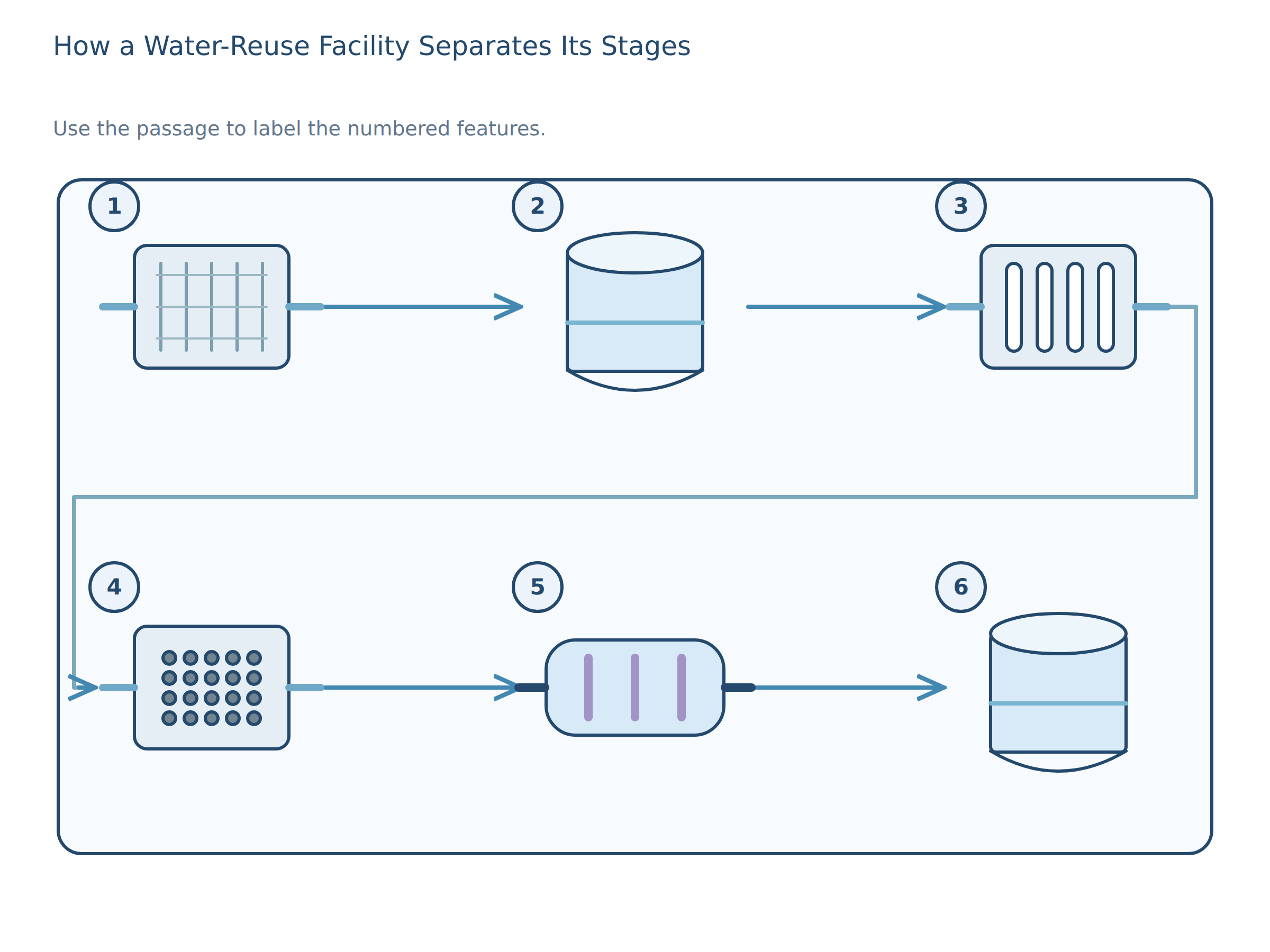
At first glance, the Greybridge water-reuse facility looks as if it ought to work like a single large filter, but that is not how its engineers describe it. They prefer the verb separate, because the plant is built to divide the task into stages, each of which solves a different problem. One stage removes bulky debris, another smooths out sudden surges, a third breaks down dissolved waste biologically, and later stages polish the water before it is stored. The final product is reclaimed water for irrigation, toilet flushing, and some industrial cooling. It is not drinking water, and that distinction shapes the whole design. The site receives a mixture of lightly contaminated wash water, staff kitchen water, and runoff from nearby workshops. On normal days the inflow is manageable, but after a public event it can become unexpectedly dirty, and after rain it may arrive in awkward bursts. This variation is why the plant behaves less like a straight pipe than like a sequence of checks. Some contaminants are visible and bulky, some are dissolved, and some are biological or chemical residues that need more delicate treatment. If those categories are confused, the system either wastes energy or leaves too much behind. From the upper left to the lower right, the arrangement is deliberate. In the upper left, a coarse screen catches rags, plastic fragments, and leaves before the water reaches anything delicate. The upper centre holds the equalisation tank, which evens out surges so the rest of the line does not lurch from calm to overload. In the upper right stands the membrane bioreactor, where oxygen-fed microbes digest dissolved waste while a fine membrane keeps the biomass from passing onward. Lower left, the activated carbon filter adsorbs traces of odour, colour, and stubborn organic compounds. The lower centre is a narrow ultraviolet chamber, and the lower right is the covered reclaimed-water reservoir that stores the finished supply until demand appears. The screen is a blunt instrument, and that is precisely why it sits first. Engineers do not ask it to remove smell or colour; they want it to stop pumps from choking on things that should never have entered the flow. Because the basket can be lifted out and cleaned quickly, unstable material is dealt with before it reaches more fragile equipment. The equalisation tank is less dramatic but more strategic. Its mixers keep the inflow moving gently, which means one sudden surge does not force the rest of the facility into an expensive scramble. The membrane bioreactor is more demanding. It combines biology and separation in a way that looks almost deceptively neat from outside. Oxygen feeds the microbes; the microbes digest dissolved waste; the membrane stops suspended solids from escaping. If the earlier stages fail, the biology struggles. If they succeed, the liquid leaving this section is already far cleaner than many visitors expect. Yet the plant still refuses to treat this as the end of the story, because a technically sound stage is not the same thing as a finished product. Further on, the activated carbon filter deals with what remains after the obvious pollution has been removed. It is not there to do the heavy lifting. Instead, its porous granules adsorb small traces of smell, colour, and some organic compounds that the biological stage has not fully resolved. Carbon is expensive to regenerate, so the plant saves it for later, when the load is lighter and the polishing task is more efficient. The UV chamber follows as a final barrier against microbes. It adds no taste and no chemical residue, but it does require clarity; if the water were still murky, the light would be less effective. At the lower right, the reservoir holds the finished water until sensors detect demand. From there, pumps send it to gardens, cleaning lines, or other non-potable uses. The reservoir may look like a storage tank, yet its role is broader than storage alone: it helps the plant match supply to fluctuating demand and gives operators time to respond if one upstream unit needs cleaning. It also acts as a buffer between treatment and distribution, so the facility can keep working even when the timing of reuse is irregular. Seen from a distance, the facility appears to be a collection of separate boxes. In practice, that separation is the whole point. The process can be controlled, paused, cleaned, or expanded without shutting the entire system down, which is one reason reuse is more resilient than many people imagine. The site does not promise to turn wastewater into drinking water, and it does not need to make that promise in order to serve a city responsibly. Its value lies in precision: each component does one limited task well, and the sequence as a whole creates a dependable supply for uses that do not require potable quality.
-
Question 1 · Label the image
Match the labels to the marked regions of the image.
Read the passage and match each numbered part of the diagram to the correct label.
Return to the passage, recording or visualImage labels
sludge digester · coarse screen · equalisation tank · membrane bioreactor · activated carbon filter · ultraviolet chamber · reclaimed-water reservoir · chemical dosing tank
Label regions region-1, region-2, region-3, region-4, region-5, region-6 marked on the image above.
Check answers and explanations
- Region region-1
- coarse screen
- Region region-2
- equalisation tank
- Region region-3
- membrane bioreactor
- Region region-4
- activated carbon filter
- Region region-5
- ultraviolet chamber
- Region region-6
- reclaimed-water reservoir
Label 1: coarse screen — the upper-left stage catches “rags, plastic fragments, and leaves.” Label 2: equalisation tank — the upper-centre tank “evens out surges.” Label 3: membrane bioreactor — the upper-right unit uses microbes to digest dissolved waste while a membrane retains biomass. Label 4: activated carbon filter — the lower-left filter adsorbs “traces of odour, colour, and stubborn organic compounds.” Label 5: ultraviolet chamber — the lower-centre chamber provides a final barrier against microbes. Label 6: reclaimed-water reservoir — the lower-right reservoir stores the finished water until demand appears. The other labels are not assigned to any diagram position in the passage.
From the upper left to the lower right, the arrangement is deliberate. In the upper left, a coarse screen catches rags, plastic fragments, and leaves before the water reaches anything delicate. The upper centre holds the equalisation tank, which evens out surges so the rest of the line does not lurch from calm to overload. In the upper right stands the membrane bioreactor, where oxygen-fed microbes digest dissolved waste while a fine membrane keeps the biomass from passing onward. Lower left, the activated carbon filter adsorbs traces of odour, colour, and stubborn organic compounds. The lower centre is a narrow ultraviolet chamber, and the lower right is the covered reclaimed-water reservoir that stores the finished supply until demand appears
At the lower right, the reservoir holds the finished water until sensors detect demand. From there, pumps send it to gardens, cleaning lines, or other non-potable uses
What to review next
Find the words that support each answer. For a mistake, compare the question with the evidence and identify the detail or inference you missed.
A focused practice result shows how you did on these tasks. Use several activities across skills to decide what to study next; one practice score does not certify an overall CEFR level.
Before you practise: a worked example
Look for evidence in the text. Separate what the writer says from what you already know about the topic.
The library normally closes at six, but on Fridays it stays open until eight. When does it close on Friday?
The answer is eight. But introduces an exception to the normal closing time, so the first time mentioned is not the answer.
This teaching example is separate from the scored questions. After your test, compare any mistakes with the explanation and revisit the topic before trying again.