
A Heat-Recovery Network and Its Control Points
About this practice test
Read an explanation of a factory heat-recovery network and identify six components from their positions and functions.
What you’ll practice
Finding detail
Locate specific information and evidence.
Interpreting ideas
Connect main points and inferences.
Evaluating arguments
Assess claims, evidence, and limitations.
What to expect:
1 question with explanations to review after submission.
Study the questions and tasks
Work through the material below, or start the interactive practice above to complete an attempt. Try the exercises before opening any answer or transcript sections, then use them to review your work.
- Practice level
- C1. Try this level if you can follow the instructions and understand most of the language; choose an earlier level if you need more support.
- Question formats
- Label the image
How to approach this practice
Read the passage for its main idea, then return to the relevant sentence or paragraph for each question. Base answers on the passage.
A Heat-Recovery Network and Its Control Points
 region-1
region-2
region-3
region-4
region-5
region-6
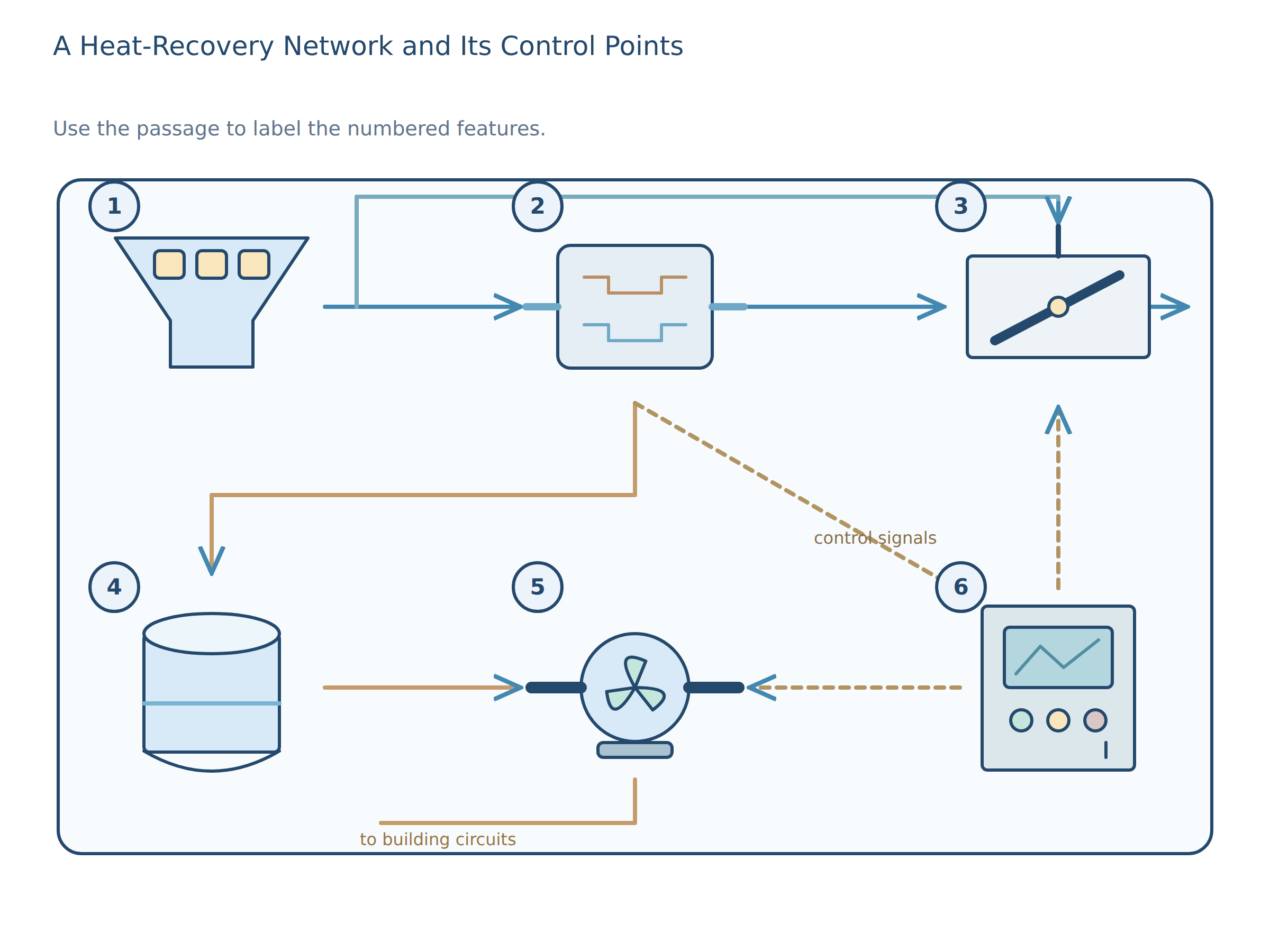
When the first cold week arrived at Northgate Foods, the maintenance team did not promise a miracle. They had installed a heat-recovery network because the factory was spending money twice: once to warm the rooms, and again to throw away air that still carried useful heat. The new system was designed to capture some of that warmth, move it through water, and return it where it could do the most good. Yet the engineer, Mara, kept repeating that recovery is only valuable when the building actually needs the heat. If the line is dirty, poorly balanced, or operating at the wrong time of day, the gains shrink quickly. The main route begins at the upper left, where the exhaust hood sits above the warm process line and catches air that would otherwise drift out of the room. In this factory the air comes from packing tables and a drying tunnel, so it is warmer than the outdoor supply even on a mild day. The hood is not meant to seal the space completely; it is meant to collect a steady stream and guide it toward the rest of the network. That matters, because the whole system depends on predictable flow rather than on a desperate attempt to trap every last degree. From there the air reaches the upper centre, where the heat exchanger core lets outgoing air warm the incoming stream without allowing the two to mix. This is the heart of the scheme, and also the place where expectations need to stay realistic. The exchanger can transfer a good share of heat when the temperature difference is healthy, but it cannot create warmth from nothing, and it cannot ignore moisture, grease, or dust. In other words, it improves efficiency best when the operators keep the filters clean and the airflow even. If they neglect those basics, the headline savings look more impressive than the actual ones. The upper right contains the bypass damper, which gives the team a way to avoid over-heating the supply air. On bright afternoons, or during a production lull, the recovered heat can become excessive for the rooms downstream. The damper opens and sends part of the stream around the core, so that the network can remain useful rather than simply hot. Mara preferred this feature because it made the system adaptable. She said a good recovery scheme should be selective: eager enough to save energy, but cautious enough not to force comfort into a corner. Beneath the exchanger, at the lower left, sits the buffer tank. Its job is not glamorous, but it is important because the demand for heat rarely matches the moment when the exhaust air is richest. The tank stores warmed water for short periods of demand, smoothing the difference between a sudden start-up and a quieter hour later in the shift. Without that reserve, the network would have to switch repeatedly between excess and shortage, which would waste energy and wear the components. The buffer makes the system less dramatic and, paradoxically, more effective. In the lower centre, the circulation pump keeps the water moving. It pushes the recovered heat from the exchanger toward the tank and then onward toward the building circuits that need it. A pump sounds like an ordinary piece of hardware, but in a network like this it decides whether the recovered energy travels far enough to matter. If the flow is too weak, the useful heat lingers in the wrong place; if it is too strong, the electricity used to drive the pump begins to eat into the savings. That is why the engineers matched it carefully to the expected load instead of simply choosing the most powerful model. At the lower right, the control cabinet watches the temperature difference and decides when the network should recover heat and when it should pass through. It receives signals from the main sensors, compares them with the target range, and adjusts the valves and dampers accordingly. This is where the system becomes more than a collection of parts. The cabinet does not make the air warmer by itself, but it determines whether the available warmth is worth collecting. In practice, that judgment is shaped by weather, shift patterns, and maintenance alerts, which is why the cabinet must be set up by someone who understands the building, not just the hardware. Seen as a whole, the network is less a heroic invention than a disciplined way of refusing waste. It works best in a building that has steady exhaust air, a real need for heating, and staff willing to treat calibration as part of the job. That is also why Mara resisted the language of total transformation. She liked the system, but she did not exaggerate it. It recovers heat, it does not abolish winter; it trims losses, it does not eliminate them. In technical terms, that honesty is not a weakness. It is the reason the network survives long after the first enthusiastic visitor has left the plant.
-
Question 1 · Label the image
Match the labels to the marked regions of the image.
Read the passage and choose labels for the six positions in the diagram.
Return to the passage, recording or visualImage labels
buffer tank · circulation pump · control cabinet · solar collector · dehumidifier · exhaust hood · heat exchanger core · bypass damper
Label regions region-1, region-2, region-3, region-4, region-5, region-6 marked on the image above.
Check answers and explanations
- Region region-1
- exhaust hood
- Region region-2
- heat exchanger core
- Region region-3
- bypass damper
- Region region-4
- buffer tank
- Region region-5
- circulation pump
- Region region-6
- control cabinet
Label 1: exhaust hood — it is at the upper left and catches warm air above the process line. Label 2: heat exchanger core — it is at the upper centre and transfers heat between outgoing and incoming air without mixing them. Label 3: bypass damper — it is at the upper right and sends part of the air around the core when recovered heat is excessive. Label 4: buffer tank — it is at the lower left and stores warmed water for later demand. Label 5: circulation pump — it is at the lower centre and moves water from the exchanger towards the tank and building circuits. Label 6: control cabinet — it is at the lower right and uses sensor signals to adjust valves and dampers. The extra labels, solar collector and dehumidifier, are not mentioned in the network description.
The main route begins at the upper left, where the exhaust hood sits above the warm process line and catches air that would otherwise drift out of the room
From there the air reaches the upper centre, where the heat exchanger core lets outgoing air warm the incoming stream without allowing the two to mix
At the lower right, the control cabinet watches the temperature difference and decides when the network should recover heat and when it should pass through
What to review next
Find the words that support each answer. For a mistake, compare the question with the evidence and identify the detail or inference you missed.
A focused practice result shows how you did on these tasks. Use several activities across skills to decide what to study next; one practice score does not certify an overall CEFR level.
Before you practise: a worked example
Look for evidence in the text. Separate what the writer says from what you already know about the topic.
The library normally closes at six, but on Fridays it stays open until eight. When does it close on Friday?
The answer is eight. But introduces an exception to the normal closing time, so the first time mentioned is not the answer.
This teaching example is separate from the scored questions. After your test, compare any mistakes with the explanation and revisit the topic before trying again.