
The Stages of a Materials-Recovery Facility
About this practice test
An explanation of the six stages used to separate, sort, and prepare household recycling at a materials-recovery facility.
What you’ll practice
Finding detail
Locate specific information and evidence.
Interpreting ideas
Connect main points and inferences.
Evaluating arguments
Assess claims, evidence, and limitations.
What to expect:
1 question with explanations to review after submission.
Study the questions and tasks
Work through the material below, or start the interactive practice above to complete an attempt. Try the exercises before opening any answer or transcript sections, then use them to review your work.
- Practice level
- B2. Try this level if you can follow the instructions and understand most of the language; choose an earlier level if you need more support.
- Question formats
- Label the image
How to approach this practice
Read the passage for its main idea, then return to the relevant sentence or paragraph for each question. Base answers on the passage.
The Stages of a Materials-Recovery Facility
 region-1
region-2
region-3
region-4
region-5
region-6
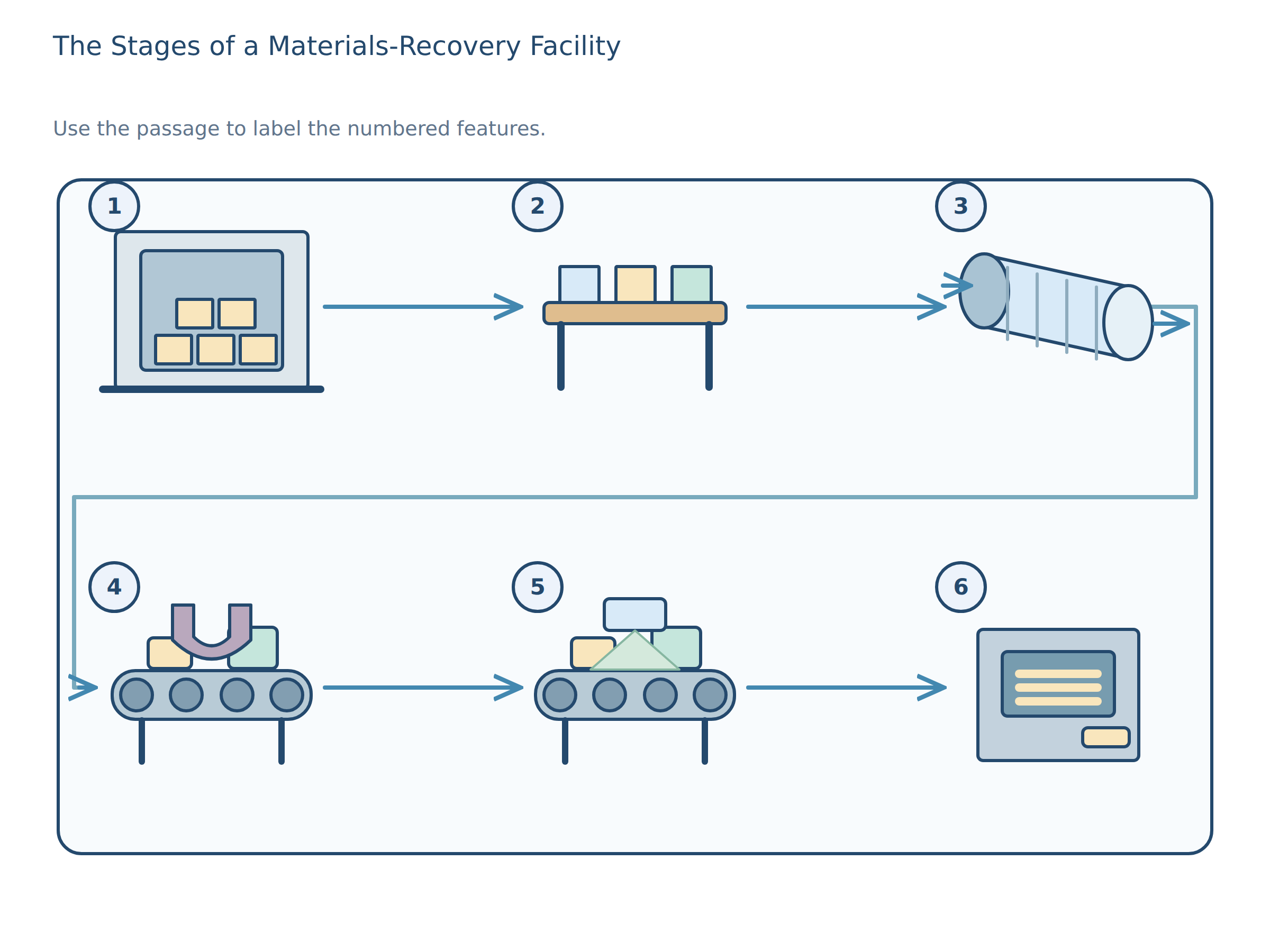
At a materials-recovery facility, mixed household recycling arrives in no tidy order: paper, bottles, food trays, cans, and the occasional object that never belonged in the bin at all. The plant’s task is not to make the waste disappear, but to separate it quickly enough that useful material can be sold again. For that reason, the building is arranged as a chain of stages. A load enters at one end, changes shape and direction several times, and leaves as cleaner streams with less contamination. The sequence matters because one bad object can interfere with later machines, and every delay costs time. The first stage is in the upper left of the plant, where trucks tip their loads onto a receiving bay. From there, a wide conveyor carries the pile to the first checks. Workers stand above the moving belt and pull out things that can damage the system, such as ropes, garden hoses, or sealed containers. The aim here is simple: remove the obvious trouble before it reaches the machines. If a long plastic sheet wraps around a roller, the whole line can slow down. This early removal does not make the material clean; it just keeps the rest of the line safe and moving. Next, in the upper centre, the material reaches the pre-sort platform, where it is still mixed but easier to handle. This stage is less about precision than about judgement. People remove bags, paper cups with liquid inside them, and other items that are too dirty for recycling. These rejects are sent away early, because a clean stream is worth more than a larger one. The facility therefore accepts a small loss at this point in order to protect the rest of the process. By this stage, the workers are not trying to make every decision perfectly; they are trying to prevent contamination from spreading. In the upper right, a rotating trommel screen does a different kind of sorting. It is basically a long drum with holes in it. As the drum turns, small fragments and broken glass fall through, while larger containers continue onward. The machine does not care whether something is plastic or aluminium; it only cares about size. That is useful because mixed loads often contain both heavy and light items, and size is the fastest clue when shape is irregular. In other words, the machine solves a problem that people would find slow and tiring to do by hand. After that, the stream drops to the lower left magnetic separator. Here, a powerful drum pulls steel cans and other iron-based pieces away from the rest. The magnet is selective, but not perfect, so crushed cans or dirty pieces can slip through. Next, in the lower centre, an optical sorter uses lights, cameras, and bursts of air to recognise certain plastics by their colour and surface pattern. It pushes chosen items into a new lane while the remainder keeps moving. The two machines work for different reasons: one responds to metal, while the other responds to visual features that cameras can measure quickly. Because the two stages depend on different clues, they complement one another rather than compete. At the lower right, the sorted materials meet the baler. Cardboard, plastic film, and other recovered items are squeezed into dense blocks so they take less room on a truck. These bales are tied and sent to paper mills, plastics plants, or metal processors, depending on what they contain. Even after all these steps, some residue still leaves the site for disposal, because not every object can be rescued. The plant succeeds by recovering enough good material to make the long chain worthwhile. It is a practical system: each stage removes a different kind of problem, and no single stage could do the whole job alone.
-
Question 1 · Label the image
Match the labels to the marked regions of the image.
Read the passage and label the six parts of the materials-recovery facility diagram.
Return to the passage, recording or visualImage labels
trommel screen · magnetic separator · optical sorter · baler · inspection desk · drain channel · receiving bay · pre-sort platform
Label regions region-1, region-2, region-3, region-4, region-5, region-6 marked on the image above.
Check answers and explanations
- Region region-1
- receiving bay
- Region region-2
- pre-sort platform
- Region region-3
- trommel screen
- Region region-4
- magnetic separator
- Region region-5
- optical sorter
- Region region-6
- baler
Label 1: receiving bay—the passage places it in the upper left, where trucks unload their loads. Label 2: pre-sort platform—the upper centre stage where workers remove bags and dirty items. Label 3: trommel screen—the upper right machine that separates smaller pieces from larger containers. Label 4: magnetic separator—the lower left stage where a drum pulls steel and iron-based pieces away. Label 5: optical sorter—the lower centre machine that uses cameras, lights, and air to identify plastics. Label 6: baler—the lower right stage where recovered materials are compressed into dense blocks. The other labels are not among the six named stages in the passage.
The first stage is in the upper left of the plant, where trucks tip their loads onto a receiving bay
Next, in the upper centre, the material reaches the pre-sort platform, where it is still mixed but easier to handle
In the upper right, a rotating trommel screen does a different kind of sorting. It is basically a long drum with holes in it
What to review next
Find the words that support each answer. For a mistake, compare the question with the evidence and identify the detail or inference you missed.
A focused practice result shows how you did on these tasks. Use several activities across skills to decide what to study next; one practice score does not certify an overall CEFR level.
Before you practise: a worked example
Look for evidence in the text. Separate what the writer says from what you already know about the topic.
The library normally closes at six, but on Fridays it stays open until eight. When does it close on Friday?
The answer is eight. But introduces an exception to the normal closing time, so the first time mentioned is not the answer.
This teaching example is separate from the scored questions. After your test, compare any mistakes with the explanation and revisit the topic before trying again.