
How a Floodable Urban Park Functions
About this practice test
A reading explaining how a floodable urban park captures, filters, stores, and releases stormwater.
What you’ll practice
Finding detail
Locate specific information and evidence.
Interpreting ideas
Connect main points and inferences.
Evaluating arguments
Assess claims, evidence, and limitations.
What to expect:
1 question with explanations to review after submission.
Study the questions and tasks
Work through the material below, or start the interactive practice above to complete an attempt. Try the exercises before opening any answer or transcript sections, then use them to review your work.
- Practice level
- B2. Try this level if you can follow the instructions and understand most of the language; choose an earlier level if you need more support.
- Question formats
- Label the image
How to approach this practice
Read the passage for its main idea, then return to the relevant sentence or paragraph for each question. Base answers on the passage.
How a Floodable Urban Park Functions
 region-1
region-2
region-3
region-4
region-5
region-6
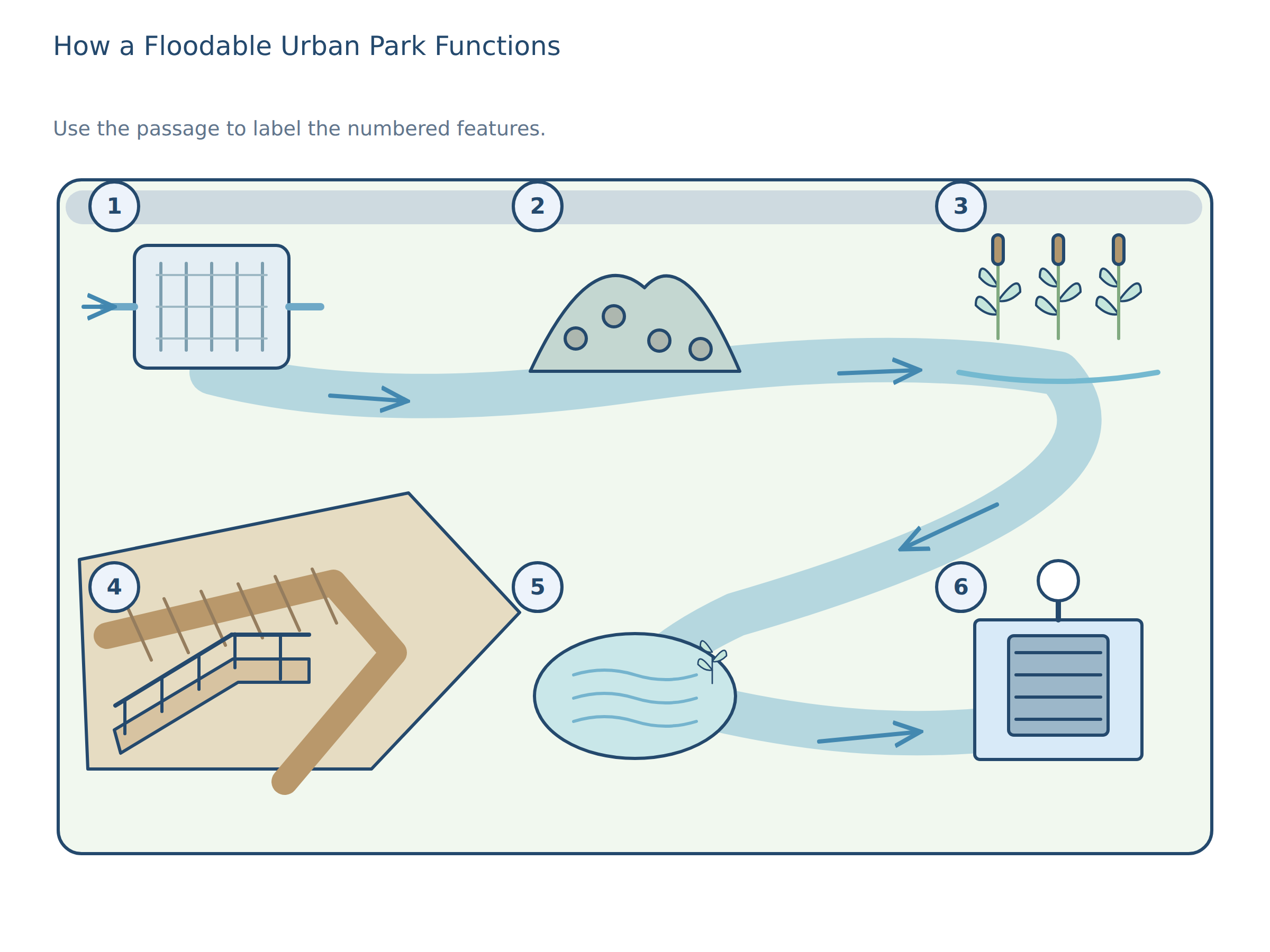
A floodable urban park is designed for two jobs at once: it gives a neighbourhood a place to walk, sit, and play, and it also gives heavy rain somewhere safe to go. This one sits in a low block between apartment buildings and a river. On dry days, people may not notice how carefully it works. The lawns look ordinary, the paths look simple, and the planting seems decorative. Yet the park is shaped like a shallow bowl, so water can move through it in a planned order instead of racing across the streets. At the upper left edge, a street inlet catches runoff from the road and nearby roofs. The opening is low enough for water to enter easily, but narrow enough to stop larger rubbish from washing straight through. Just beyond it, in the upper centre, a gravel forebay slows the first rush and drops heavier grit before the water moves on. This matters because sand, leaves, and cigarette ends would otherwise clog the rest of the park. In a normal storm, the forebay fills first and is cleaned out later by maintenance staff. From there, the flow reaches the upper right, where a reed filter bed strips out fine dirt and some nutrients. The reeds are not there simply for appearance. Their stems create resistance, which reduces speed, and their roots help trap particles. The bed also gives the water a little more time before it enters the lower part of the site. On the lower left, a raised boardwalk keeps people moving above ground that may be wet. It is the least dramatic element, but it matters on days when one half of the park is soft or partly submerged. The main storage area lies in the lower centre. It is the flood basin lawn, an open bowl that can hold a deep layer of water for a short time without damage. The grass there is chosen because it can recover after being covered, and the ground underneath drains more slowly than normal soil. During a heavy shower, the basin accepts water that would otherwise overflow into basements or traffic lanes. In this sense, the lawn is not wasted space at all; it is temporary flood insurance. Finally, the lower right holds an outlet gate, which releases the stored water slowly after the storm has passed. If the river outside is already high, the gate closes longer so the park does not push extra water out too soon. If the river level drops, the gate opens a little and drains the basin in stages. That timing is important. Emptying the park too fast would send a new surge downstream, while emptying it too slowly would leave the ground unusable for too long. The park therefore works by combining storage, filtering, and controlled release. It does not try to defeat rain, only to guide it. The result is a space that remains useful in ordinary weather and becomes protective in extreme weather. The same design that makes a weekend picnic pleasant also helps the city absorb a storm with less damage.
-
Question 1 · Label the image
Match the labels to the marked regions of the image.
Read the passage and label the six numbered parts of the diagram with the correct names.
Return to the passage, recording or visualImage labels
street inlet · gravel forebay · reed filter bed · raised boardwalk · flood basin lawn · outlet gate · picnic terrace · storage pond
Label regions region-1, region-2, region-3, region-4, region-5, region-6 marked on the image above.
Check answers and explanations
- Region region-1
- street inlet
- Region region-2
- gravel forebay
- Region region-3
- reed filter bed
- Region region-4
- raised boardwalk
- Region region-5
- flood basin lawn
- Region region-6
- outlet gate
Label 1: Street inlet is at the upper left, where runoff enters. Label 2: Gravel forebay is in the upper centre, where the first rush slows. Label 3: Reed filter bed is in the upper right, where fine dirt and nutrients are removed. Label 4: Raised boardwalk is in the lower left. Label 5: Flood basin lawn is in the lower centre, where water is stored. Label 6: Outlet gate is in the lower right, where stored water is released slowly. The other labels are not identified as components.
At the upper left edge, a street inlet catches runoff from the road and nearby roofs
Just beyond it, in the upper centre, a gravel forebay slows the first rush and drops heavier grit before the water moves on
The main storage area lies in the lower centre. It is the flood basin lawn, an open bowl that can hold a deep layer of water for a short time without damage
What to review next
Find the words that support each answer. For a mistake, compare the question with the evidence and identify the detail or inference you missed.
A focused practice result shows how you did on these tasks. Use several activities across skills to decide what to study next; one practice score does not certify an overall CEFR level.
Before you practise: a worked example
Look for evidence in the text. Separate what the writer says from what you already know about the topic.
The library normally closes at six, but on Fridays it stays open until eight. When does it close on Friday?
The answer is eight. But introduces an exception to the normal closing time, so the first time mentioned is not the answer.
This teaching example is separate from the scored questions. After your test, compare any mistakes with the explanation and revisit the topic before trying again.