
The Route through a Community Recycling Centre
About this practice test
A reading about the stations and one-way route through a community recycling centre.
What you’ll practice
Finding detail
Locate specific information and evidence.
Interpreting ideas
Connect main points and inferences.
Evaluating arguments
Assess claims, evidence, and limitations.
What to expect:
1 question with explanations to review after submission.
Study the questions and tasks
Work through the material below, or start the interactive practice above to complete an attempt. Try the exercises before opening any answer or transcript sections, then use them to review your work.
- Practice level
- B1. Try this level if you can follow the instructions and understand most of the language; choose an earlier level if you need more support.
- Question formats
- Label the image
How to approach this practice
Read the passage for its main idea, then return to the relevant sentence or paragraph for each question. Base answers on the passage.
The Route through a Community Recycling Centre
 region-1
region-2
region-3
region-4
region-5
region-6
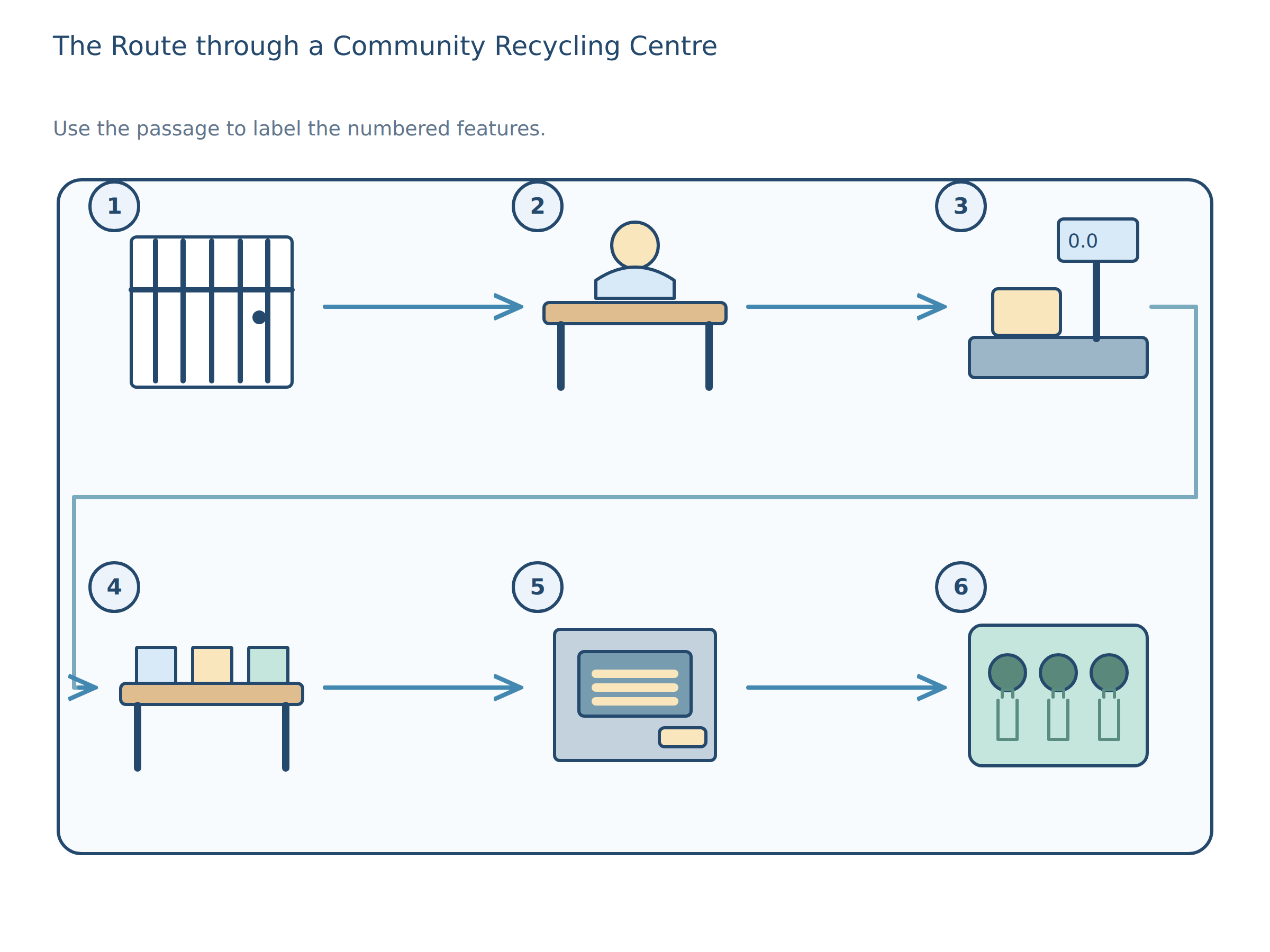
On Saturday mornings, the community recycling centre opens like a simple one-way path. Visitors park on the street and follow painted arrows to the upper left, where the route begins at the entry gate. The gate is not just a door; it helps staff count arrivals and keeps the line moving in a calm order. On busy days, a second volunteer reminds people to keep their bags closed so the path does not get cluttered. After the gate, people step to the upper centre, where the welcome desk stands beside a notice board. A volunteer there hands out labels for mixed loads and tells new visitors which bins are full. From there, the route bends to the upper right, where the weighing scale waits under a roof. Heavy bags are lifted onto it so the centre can record how much material is brought in each day. This matters because the council uses the figures to plan collections. People wait beside a yellow line while the scale is being used, so the entrance to the next station stays clear. Next, visitors continue to the lower left, where the sorting table takes the next share of the work. Clean paper, cans, and plastic are separated there, and anything dirty is sent back for another round at home. The table is also where volunteers remove unwanted items before they cause trouble farther along. At the lower centre stands the paper baler, which presses cardboard and newspapers into tight blocks. That saves space and makes transport cheaper for the recycling truck. The last stop is in the lower right, where the glass bank holds jars and bottles until a lorry collects them. People usually finish the route there and leave by the side path. The volunteers say the system works because each station has one clear job; when visitors follow the path in order, the centre stays tidy, and nobody has to turn back.
-
Question 1 · Label the image
Match the labels to the marked regions of the image.
Read the passage and choose the correct labels for the six marked positions in the diagram of the recycling centre.
Return to the passage, recording or visualImage labels
weighing scale · sorting table · paper baler · glass bank · repair shelf · tool cupboard · entry gate · welcome desk
Label regions region-1, region-2, region-3, region-4, region-5, region-6 marked on the image above.
Check answers and explanations
- Region region-1
- entry gate
- Region region-2
- welcome desk
- Region region-3
- weighing scale
- Region region-4
- sorting table
- Region region-5
- paper baler
- Region region-6
- glass bank
Label 1: Entry gate is in the upper left, where the route begins. Label 2: Welcome desk is in the upper centre, after the gate. Label 3: Weighing scale is in the upper right. Label 4: Sorting table is in the lower left. Label 5: Paper baler is in the lower centre. Label 6: Glass bank is in the lower right, the final stop. The other labels are not described as stations.
Visitors park on the street and follow painted arrows to the upper left, where the route begins at the entry gate. The gate is not just a door; it helps staff count arrivals and keeps the line moving in a calm order
After the gate, people step to the upper centre, where the welcome desk stands beside a notice board
From there, the route bends to the upper right, where the weighing scale waits under a roof. Heavy bags are lifted onto it so the centre can record how much material is brought in each day. This matters because the council uses the figures to plan collections. People wait beside a yellow line while the scale is being used, so the entrance to the next station stays clear. Next, visitors continue to the lower left, where the sorting table takes the next share of the work. Clean paper, cans, and plastic are separated there, and anything dirty is sent back for another round at home. The table is also where volunteers remove unwanted items before they cause trouble farther along. At the lower centre stands the paper baler, which presses cardboard and newspapers into tight blocks. That saves space and makes transport cheaper for the recycling truck. The last stop is in the lower right, where the glass bank holds jars and bottles until a lorry collects them
What to review next
Find the words that support each answer. For a mistake, compare the question with the evidence and identify the detail or inference you missed.
A focused practice result shows how you did on these tasks. Use several activities across skills to decide what to study next; one practice score does not certify an overall CEFR level.
Before you practise: a worked example
Look for evidence in the text. Separate what the writer says from what you already know about the topic.
The library normally closes at six, but on Fridays it stays open until eight. When does it close on Friday?
The answer is eight. But introduces an exception to the normal closing time, so the first time mentioned is not the answer.
This teaching example is separate from the scored questions. After your test, compare any mistakes with the explanation and revisit the topic before trying again.