
Inside a Shared Bicycle Workshop
About this practice test
Read a description of a shared bicycle workshop and identify the positions of its desks, tools, repair equipment, storage, and cleaning areas.
What you’ll practice
Finding detail
Locate specific information and evidence.
Interpreting ideas
Connect main points and inferences.
Evaluating arguments
Assess claims, evidence, and limitations.
What to expect:
1 question with explanations to review after submission.
Study the questions and tasks
Work through the material below, or start the interactive practice above to complete an attempt. Try the exercises before opening any answer or transcript sections, then use them to review your work.
- Practice level
- B1. Try this level if you can follow the instructions and understand most of the language; choose an earlier level if you need more support.
- Question formats
- Label the image
How to approach this practice
Read the passage for its main idea, then return to the relevant sentence or paragraph for each question. Base answers on the passage.
Inside a Shared Bicycle Workshop
 region-1
region-2
region-3
region-4
region-5
region-6
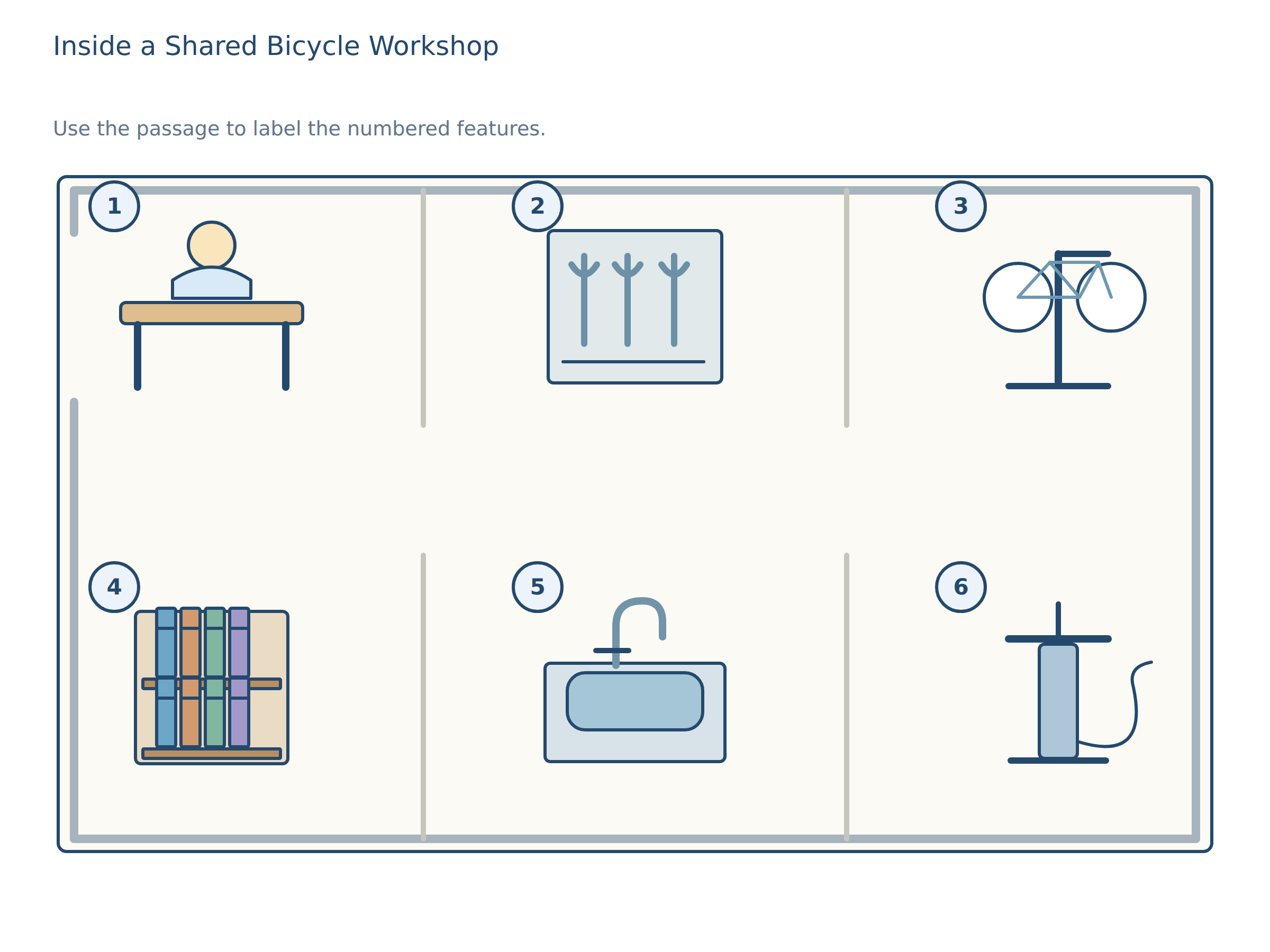
The shared bicycle workshop sits in an old warehouse near the river. Riders enter through a wide door and first see the welcome desk in the upper left corner. A volunteer sits there with a notebook and a card reader, signs people in, and gives them a short safety sheet. On busy days, the desk also keeps spare maps for riders who want to find the nearest cycle path. In the upper centre is the tool wall, a long board with hooks for keys, hex wrenches, and screwdrivers. Members return borrowed tools there after a repair, so nothing disappears for long. A small bench stands beside it, and members often wait there while they check the day’s repair list. The wall also has clear labels, so new people can put each item back quickly. The upper right corner holds the repair stand, a strong metal frame that lifts a bike off the floor. Marta says this is the busiest place because people can reach the chain and brakes without crouching. A small tray below the stand catches screws, and a volunteer checks the bolts after each job. Below it, in the lower right corner, stands the tyre pump. It has two hoses, one for narrow city tyres and one for wider cargo bikes. People use it when a tyre looks soft, and the pressure gauge helps them stop at the right level. People usually step back when a chain comes loose, because the frame keeps the bike steady. A short line on the wall tells riders which hose to choose, so they do not waste time. On the lower left side is the parts shelf, where boxes of inner tubes, bell parts, and reflective clips are kept in size order. The lower centre is the wash station, with a bucket, sponge, and drain. Volunteers clean muddy wheels there before a final check. A sign on the wall reminds everyone to rinse mud off the sponge after use. Nearby, a tall window lets in light, so workers can see dirt on the frames before they miss a scratch. The team likes the clear layout because newcomers can find each station quickly, and the workshop feels calm even when it is busy. At the end of a long afternoon, they sweep the floor, return the tools, and close the wide door.
-
Question 1 · Label the image
Match the labels to the marked regions of the image.
Read the passage and choose the correct labels for the six workshop positions in the diagram.
Return to the passage, recording or visualImage labels
parts shelf · wash station · tyre pump · bike rack · coffee counter · welcome desk · tool wall · repair stand
Label regions region-1, region-2, region-3, region-4, region-5, region-6 marked on the image above.
Check answers and explanations
- Region region-1
- welcome desk
- Region region-2
- tool wall
- Region region-3
- repair stand
- Region region-4
- parts shelf
- Region region-5
- wash station
- Region region-6
- tyre pump
Label 1: The upper-left region is the welcome desk, where riders sign in and receive safety information. Label 2: The upper-centre region is the tool wall, which holds hooks for repair tools. Label 3: The upper-right region is the repair stand, which lifts a bike off the floor. Label 4: The lower-left region is the parts shelf, where repair parts are stored in size order. Label 5: The lower-centre region is the wash station, with a bucket, sponge, and drain. Label 6: The lower-right region is the tyre pump, which has hoses for different kinds of tyres. The other labels are not supported by the workshop layout described in the passage.
Riders enter through a wide door and first see the welcome desk in the upper left corner
In the upper centre is the tool wall, a long board with hooks for keys, hex wrenches, and screwdrivers
The upper right corner holds the repair stand
What to review next
Find the words that support each answer. For a mistake, compare the question with the evidence and identify the detail or inference you missed.
A focused practice result shows how you did on these tasks. Use several activities across skills to decide what to study next; one practice score does not certify an overall CEFR level.
Before you practise: a worked example
Look for evidence in the text. Separate what the writer says from what you already know about the topic.
The library normally closes at six, but on Fridays it stays open until eight. When does it close on Friday?
The answer is eight. But introduces an exception to the normal closing time, so the first time mentioned is not the answer.
This teaching example is separate from the scored questions. After your test, compare any mistakes with the explanation and revisit the topic before trying again.