
Improving a Neighbourhood Green Space
About this practice test
Read three connected texts about residents planning, testing, and sharing small neighbourhood green spaces. Complete statements, short answers, dropdowns, image labels, and multiple-choice questions based on practical details, opinions, and reasons in the texts.
What you’ll practice
Finding detail
Locate specific information and evidence.
Interpreting ideas
Connect main points and inferences.
Evaluating arguments
Assess claims, evidence, and limitations.
What to expect:
18 questions with explanations to review after submission.
Study the questions and tasks
Work through the material below, or start the interactive practice above to complete an attempt. Try the exercises before opening any answer or transcript sections, then use them to review your work.
- Practice level
- B1. Try this level if you can follow the instructions and understand most of the language; choose an earlier level if you need more support.
- Question formats
- Yes / No / Not Given, Single choice, Fill in the blank (text), Fill in the blank (dropdown), Label the image
How to approach this practice
Read the passage for its main idea, then return to the relevant sentence or paragraph for each question. Base answers on the passage.
A Quiet Green Corner
Every Saturday morning, Mara Nguyen walks along Birch Street with her dog, Pip. The street is busy, and the small patch of grass near the bus stop is mostly used as a shortcut. When it rains, the ground turns muddy in a few hours. Mara does not want the neighbourhood to become a perfect garden. She only wants a greener place where people can slow down, breathe, and talk without traffic noise. She believes even a few trees and benches can change the mood of a street. Last month, Mara joined a community meeting. She said the plan should start with the empty corner beside the library, because it already has shade and is easy to reach. In her view, the best design would keep one path for cyclists, add flowers along the edge, and leave the middle open for quiet sitting. She does not support a playground there, since children already have one behind the school. What the area needs most, she said, is a place that helps older residents rest and gives office workers a calm walk home. Mara also thinks people misunderstand green space. It is not only decoration, and it is not the same as a large park on the edge of town. A small local space can be more useful because it is close enough for daily visits. She hopes the council will choose plants that need little water, and at the meeting she was told that several drought-tolerant plants had already been chosen for the corner. To her, the real test is not how many photos visitors take, but whether neighbours come back the next day.
Pocket Park on Briar Close
On a wet Thursday evening, the Riverside Ward team met residents beside Briar Close Pocket Park. The space was small, but people used it to cut across the estate and to sit after school. Anna Patel, who chaired the meeting, said the council wanted to make the park safer and easier to enjoy without closing it for weeks. Several neighbours had already sent short notes about muddy paths, dark corners, and bins that overflowed on Sunday evenings. A children’s football group and two dog walkers also came to speak. After listening, the team agreed to try three changes for six weeks. Workers laid a narrow strip of gravel along the worst path, trimmed one hedge near the play area, and moved a lamp so the entrance was brighter. The council also placed a feedback box in the library, because not everyone could stay for the meeting. Anna explained that the trial would matter only if people used it and reported what changed in daily life. Mei, a local shop assistant, promised to watch the park on her way home. By the end of the trial, the path stayed drier, and the area near the lamp felt less empty after sunset. Not every idea helped. A flower bed near the gate looked cheerful, but it took too much water, so it was not kept. At the final meeting, Tom Reed said the park had become “a little place that works better now.” Anna said the next step was to copy the useful parts and ask volunteers to help with litter once a month.
Mill Lane Garden Plan
 region-1
region-2
region-3
region-4
region-5
region-6
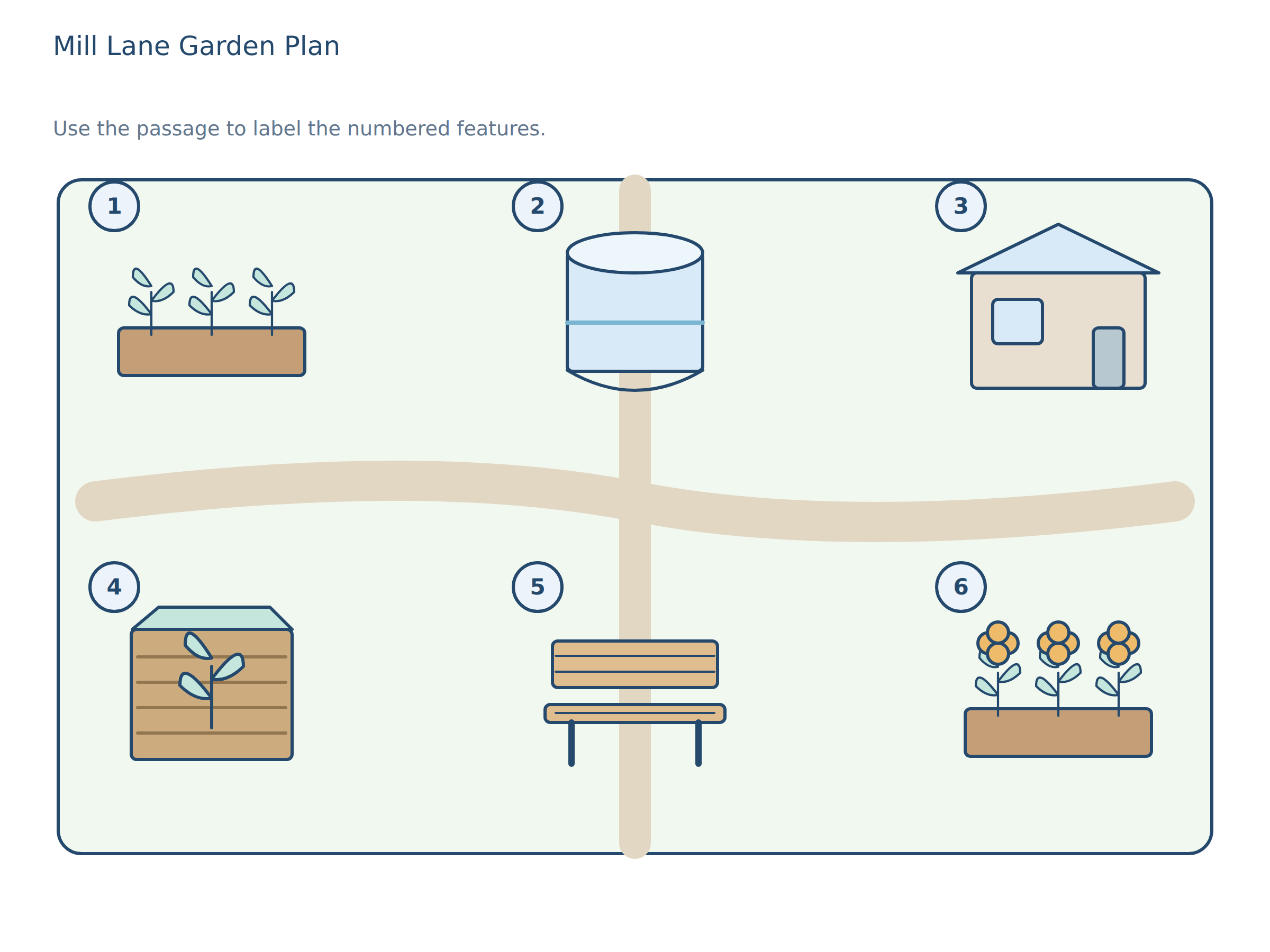
On a damp Saturday, ten neighbours met beside the old Mill Lane fence to decide how to improve the shared garden. The ground was uneven, and people had been stepping around puddles for years. Sam, who led the meeting, wanted a plan that was practical first and pretty second. He asked the group to keep a clear path through the middle so children, wheelchairs, and wheelbarrows could all move easily. In the upper left, they put a raised herb bed with mint, parsley, and rosemary. The upper centre holds a narrow rain barrel beside the fence, so watering cans can be filled after storms. On the upper right, there is a small tool shed for gloves, spades, and seed packets. Along the lower left edge, a compost bin turns leaves and grass into soil. The lower centre has a wooden bench under a young apple tree, because people asked for a quiet seat. In the lower right, a wildflower patch attracts bees and gives the corner more colour. Nina, who runs the local bookshop, liked the plan most because it used the whole space without making it crowded. She said the garden would be easier to share if every corner had a clear job. Sam agreed, but he also hoped the bench would make strangers stop and talk. For the first month, the group will water the beds together and check that the path stays clear.
-
Question 1 · Yes / No / Not Given
Decide whether the statement agrees with the writer’s or speaker’s view. Choose Not Given when the view is not stated.
Does Mara believe visitors should mainly judge the space by how many photos they take?
Return to the passage, recording or visual- Yes
- No
- Not Given
Check answers and explanations
- Answer
- No
No. Mara says, "the real test is not how many photos visitors take, but whether neighbours come back the next day." She clearly rejects photos as the main measure of success.
the real test is not how many photos visitors take, but whether neighbours come back the next day
Yes: This is the opposite of the writer's opinion.
No: Correct: the writer says photos are not the real test.
Not Given: The passage directly discusses how to judge the space.
-
Question 2 · Yes / No / Not Given
Decide whether the statement agrees with the writer’s or speaker’s view. Choose Not Given when the view is not stated.
Does Mara think a small local space can be more useful than a large park on the edge of town?
Return to the passage, recording or visual- Yes
- No
- Not Given
Check answers and explanations
- Answer
- Yes
Yes. Mara says, "A small local space can be more useful because it is close enough for daily visits." She also contrasts it with a large park on the edge of town, so the statement matches her view.
A small local space can be more useful because it is close enough for daily visits
it is not the same as a large park on the edge of town
Yes: Correct: the writer clearly prefers the small local space for daily use.
No: This contradicts the writer's opinion.
Not Given: The passage gives this opinion directly.
-
Question 3 · Yes / No / Not Given
Decide whether the statement agrees with the writer’s or speaker’s view. Choose Not Given when the view is not stated.
Does Mara prefer plants that need little water?
Return to the passage, recording or visual- Yes
- No
- Not Given
Check answers and explanations
- Answer
- Yes
Yes. Mara says, "She hopes the council will choose plants that need little water," which shows that she prefers low-water plants for the corner. The statement matches her recommendation, so it is supported.
She hopes the council will choose plants that need little water
Yes: Correct: the writer shows a preference for low-water plants.
No: This is opposite to the writer's preference.
Not Given: The passage states this preference directly.
-
Question 4 · Yes / No / Not Given
Decide whether the statement agrees with the writer’s or speaker’s view. Choose Not Given when the view is not stated.
Does Mara believe the neighbourhood should become a perfect garden?
Return to the passage, recording or visual- Yes
- No
- Not Given
Check answers and explanations
- Answer
- No
No. Mara says, "Mara does not want the neighbourhood to become a perfect garden." She wants a greener place, but not that kind of idealised garden. So the statement is directly rejected.
Mara does not want the neighbourhood to become a perfect garden
Yes: This is contradicted by the passage.
No: Correct: the writer rejects the idea of a perfect garden.
Not Given: The passage clearly states the opposite.
-
Question 5 · Yes / No / Not Given
Decide whether the statement agrees with the writer’s or speaker’s view. Choose Not Given when the view is not stated.
Does Mara believe the new space should replace the bus stop on Birch Street?
Return to the passage, recording or visual- Yes
- No
- Not Given
Check answers and explanations
- Answer
- Not Given
Not Given. The passage mentions the bus stop only as part of the current street scene: "The street is busy, and the small patch of grass near the bus stop is mostly used as a shortcut." It never says Mara wants to remove or replace the bus stop.
The street is busy, and the small patch of grass near the bus stop is mostly used as a shortcut
Yes: The passage does not say this.
No: The passage does not contradict this directly; it simply does not mention it.
Not Given: Correct: the writer never states that the bus stop should be replaced.
-
Question 6 · Single choice
Choose one answer.
What is the main purpose of the green space Mara wants to create?
Return to the passage, recording or visual- To provide a calm, easy-to-reach place for daily use
- To give cyclists a faster route through the neighbourhood
- To offer children a second place for outdoor play
- To make the street look more attractive for visitors
Check answers and explanations
- Answer
- To provide a calm, easy-to-reach place for daily use
The correct answer combines Mara’s main aims: a quiet place that is close enough for regular visits. The other choices focus on cyclists, children, or appearance, although Mara gives these lower importance or rejects them.
She only wants a greener place where people can slow down, breathe, and talk without traffic noise
A small local space can be more useful because it is close enough for daily visits
-
Question 7 · Fill in the blank (text)
Complete each blank with the missing word or phrase.
Write NO MORE THAN THREE WORDS AND/OR A NUMBER from the passage. The meeting took place beside Briar Close ___.
Return to the passage, recording or visualCheck answers and explanations
- Blank 1
- Pocket Park
The correct phrase is 'Pocket Park' because the passage says the team met residents beside Briar Close Pocket Park. 'Park' alone is too general, and 'estate' is where people lived, not where the meeting took place.
met residents beside Briar Close Pocket Park
the Riverside Ward team met residents
-
Question 8 · Fill in the blank (text)
Complete each blank with the missing word or phrase.
Write NO MORE THAN THREE WORDS AND/OR A NUMBER from the passage. Several neighbours complained that the bins ___ on Sunday evenings.
Return to the passage, recording or visualCheck answers and explanations
- Blank 1
- overflowed
The passage says the bins 'overflowed' on Sunday evenings, so that is the missing word. 'Filled up' is not used in the text, and 'broke' is not mentioned.
bins that overflowed on Sunday evenings
Several neighbours had already sent short notes
-
Question 9 · Fill in the blank (text)
Complete each blank with the missing word or phrase.
Write NO MORE THAN ONE WORD AND/OR A NUMBER from the passage. Anna said the six-week ___ would matter only if people used the park and reported what changed.
Return to the passage, recording or visualCheck answers and explanations
- Blank 1
- trial
The missing word is 'trial'. The phrase 'six-week' makes the reference clear, so the blank cannot mean the park itself. A different word would not fit the sentence or the passage meaning.
After listening, the team agreed to try three changes for six weeks
Anna explained that the trial would matter only if people used it
-
Question 10 · Fill in the blank (dropdown)
Choose the correct option for each blank.
The council placed a feedback box in the ___.
Return to the passage, recording or visualChoices for blank 1
- bus stop
- library
- play area
- park entrance
Check answers and explanations
- Blank 1
- library
The correct answer is 'library' because the passage says the council placed the feedback box there. The other places are not mentioned for this action.
placed a feedback box in the library
because not everyone could stay for the meeting
-
Question 11 · Fill in the blank (dropdown)
Choose the correct option for each blank.
The flower bed was not kept because it ___.
Return to the passage, recording or visualChoices for blank 1
- took too much water
- needed more signs
- was too small
- looked cheerful
Check answers and explanations
- Blank 1
- took too much water
The correct choice is 'took too much water' because the passage says it looked cheerful, but it took too much water, so it was not kept. The other options may sound possible, but they are not stated in the text.
it took too much water, so it was not kept
A flower bed near the gate looked cheerful
-
Question 12 · Fill in the blank (dropdown)
Choose the correct option for each blank.
At the final meeting, Tom Reed said the park had become ___.
Return to the passage, recording or visualChoices for blank 1
- a little place that works better now
- a safer place that stays open longer
- a greener place that needs less care
- a quieter place that has more space
Check answers and explanations
- Blank 1
- a little place that works better now
The correct answer is 'a little place that works better now' because that is Tom Reed's exact comment. The negative options contradict the passage, and 'too noisy for children' is not mentioned.
Tom Reed said the park had become “a little place that works better now
copy the useful parts
-
Question 13 · Label the image
Match the labels to the marked regions of the image.
Read the passage and label the six parts of the garden diagram.
Return to the passage, recording or visualImage labels
Pond · Picnic table · Herb bed · Rain barrel · Tool shed · Compost bin · Bench · Wildflower patch
Label regions region-1, region-2, region-3, region-4, region-5, region-6 marked on the image above.
Check answers and explanations
- Region region-1
- Herb bed
- Region region-2
- Rain barrel
- Region region-3
- Tool shed
- Region region-4
- Compost bin
- Region region-5
- Bench
- Region region-6
- Wildflower patch
Label 1: Herb bed — the upper-left area contains a raised bed with mint, parsley, and rosemary. Label 2: Rain barrel — the upper-centre area has a rain barrel beside the fence for filling watering cans. Label 3: Tool shed — the upper-right area contains a shed for gloves, spades, and seed packets. Label 4: Compost bin — the lower-left edge has a bin that turns leaves and grass into soil. Label 5: Bench — the lower-centre area has a wooden bench under a young apple tree for quiet sitting. Label 6: Wildflower patch — the lower-right area has flowers that attract bees and add colour.
In the upper left, they put a raised herb bed with mint, parsley, and rosemary
The upper centre holds a narrow rain barrel beside the fence, so watering cans can be filled after storms. On the upper right, there is a small tool shed for gloves, spades, and seed packets. Along the lower left edge, a compost bin turns leaves and grass into soil. The lower centre has a wooden bench under a young apple tree, because people asked for a quiet seat. In the lower right, a wildflower patch attracts bees and gives the corner more colour
-
Question 14 · Single choice
Choose one answer.
What is the passage mainly about?
Return to the passage, recording or visual- How neighbours planned the layout of a shared garden.
- Why a garden path became difficult to use after heavy rain.
- How a bookshop owner chose plants for a garden.
- Why local residents decided to replace an old fence.
Check answers and explanations
- Answer
- How neighbours planned the layout of a shared garden.
The passage mainly describes how neighbours planned the layout and future use of a shared garden. The details about particular plants and the first month’s work support this overall purpose.
ten neighbours met beside the old Mill Lane fence to decide how to improve the shared garden
the garden would be easier to share if every corner had a clear job
-
Question 15 · Single choice
Choose one answer.
Why did the group keep a clear path through the middle?
Return to the passage, recording or visual- Because the middle was the sunniest part of the garden.
- Because it would let different users cross the garden easily.
- Because it would give the neighbours more room for flowers.
- Because the group planned to place the bench there.
Check answers and explanations
- Answer
- Because it would let different users cross the garden easily.
They wanted the middle to stay easy to cross for different people and for a wheelbarrow. The other choices are not supported by the passage.
He asked the group to keep a clear path through the middle so children, wheelchairs, and wheelbarrows could all move easily
-
Question 16 · Single choice
Choose one answer.
In the sentence 'She said the garden would be easier to share if every corner had a clear job,' who does 'She' refer to?
Return to the passage, recording or visual- Nina
- Sam
- the local bookshop
- the young apple tree
Check answers and explanations
- Answer
- Nina
'She' refers to Nina, the person who gave the opinion in the next paragraph. Sam is a different character, and the apple tree and bookshop are things, not people.
Nina, who runs the local bookshop, liked the plan most because it used the whole space without making it crowded
-
Question 17 · Single choice
Choose one answer.
What can we infer about Sam from the passage?
Return to the passage, recording or visual- He wants the garden to encourage conversation.
- He wants the garden to be used mainly for growing food.
- He wants visitors to keep away from the quiet seating area.
- He thinks practical paths are less important than decoration.
Check answers and explanations
- Answer
- He wants the garden to encourage conversation.
Sam seems to care about the garden helping people meet and talk. The passage does not suggest that he wants the space to stay empty or that he dislikes the bench.
Sam agreed, but he also hoped the bench would make strangers stop and talk
-
Question 18 · Single choice
Choose one answer.
How does Nina feel about the new plan?
Return to the passage, recording or visual- She thinks the plan uses the space well without overcrowding it.
- She thinks the plan leaves too little room for visitors.
- She thinks the plan gives too much space to the herb bed.
- She thinks the plan should focus only on making the garden attractive.
Check answers and explanations
- Answer
- She thinks the plan uses the space well without overcrowding it.
Nina feels positive about the plan. She says it uses the whole space without making it crowded, so the other choices do not fit.
Nina, who runs the local bookshop, liked the plan most because it used the whole space without making it crowded
What to review next
Find the words that support each answer. For a mistake, compare the question with the evidence and identify the detail or inference you missed.
A focused practice result shows how you did on these tasks. Use several activities across skills to decide what to study next; one practice score does not certify an overall CEFR level.
Before you practise: a worked example
Look for evidence in the text. Separate what the writer says from what you already know about the topic.
The library normally closes at six, but on Fridays it stays open until eight. When does it close on Friday?
The answer is eight. But introduces an exception to the normal closing time, so the first time mentioned is not the answer.
This teaching example is separate from the scored questions. After your test, compare any mistakes with the explanation and revisit the topic before trying again.