
How a Rainwater Collection System Works
About this practice test
Read an explanation of how a household rainwater system catches, cleans, stores, and releases water for garden and household use.
What you’ll practice
Finding detail
Locate specific information and evidence.
Interpreting ideas
Connect main points and inferences.
Evaluating arguments
Assess claims, evidence, and limitations.
What to expect:
1 question with explanations to review after submission.
Study the questions and tasks
Work through the material below, or start the interactive practice above to complete an attempt. Try the exercises before opening any answer or transcript sections, then use them to review your work.
- Practice level
- B1. Try this level if you can follow the instructions and understand most of the language; choose an earlier level if you need more support.
- Question formats
- Label the image
How to approach this practice
Read the passage for its main idea, then return to the relevant sentence or paragraph for each question. Base answers on the passage.
How a Rainwater Collection System Works
 region-1
region-2
region-3
region-4
region-5
region-6
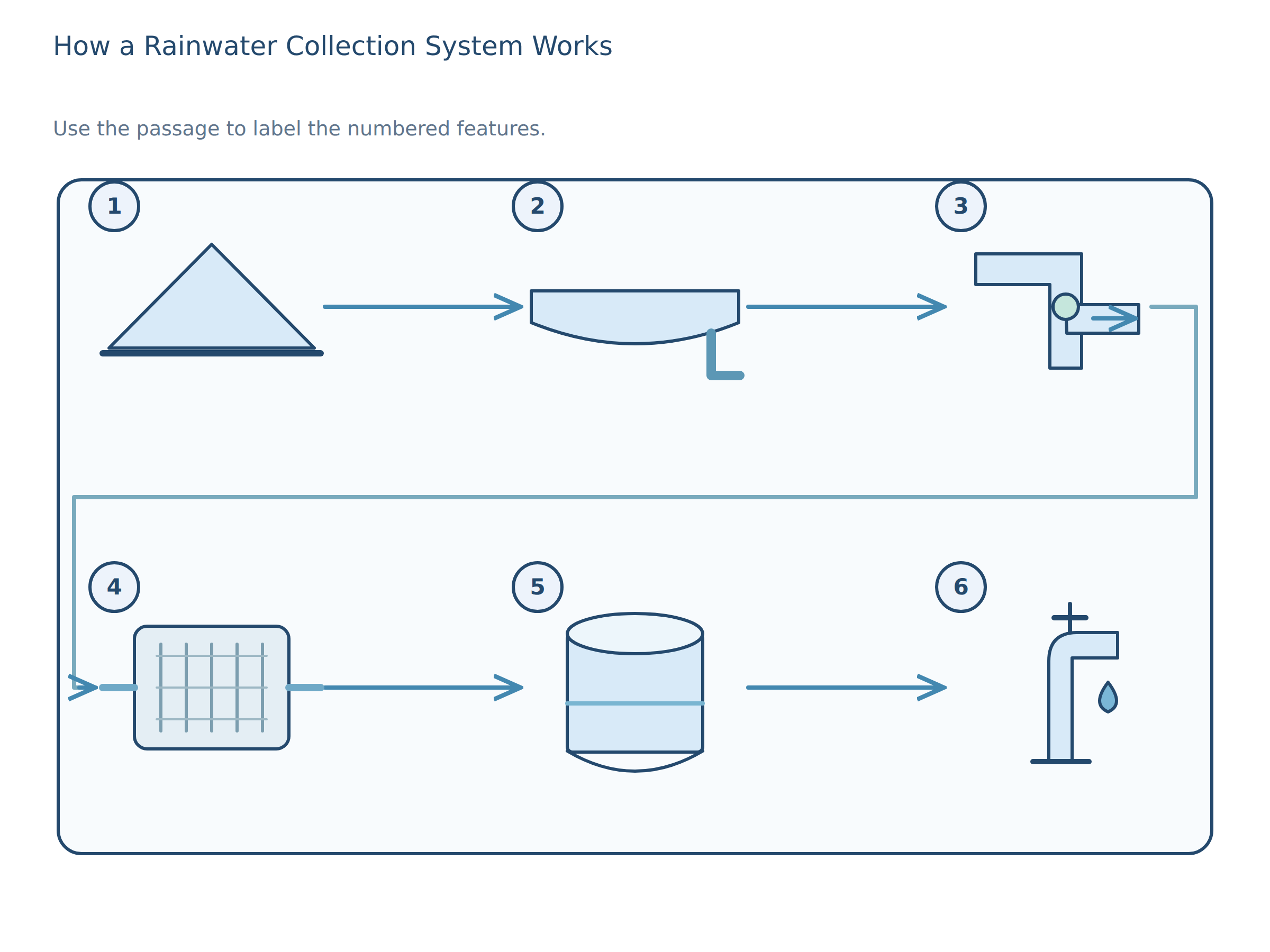
During the rainy season, a small family garden in a quiet town uses a rainwater collection system to save water. The idea is simple: instead of letting rain run off the house, the system catches it and stores it for later. At the upper left, the sloping roof works like a wide tray. Water falls onto it and moves down toward the edge. At the upper centre, the gutter runs along that edge and guides the water into a pipe. At the upper right, a first-flush diverter sends the first dirty water away, because dust and leaves usually come down first. The family watches this first stage closely, because it decides how clean the rest of the water will be. After that, the water reaches the lower left part of the system. There, a filter removes small pieces of dirt before the water enters the main tank. At the lower centre, the storage tank keeps the clean water safe until the family needs it. The tank has a lid on top so insects and rubbish stay out. A simple pipe connects the filter to the tank, and the water moves by gravity, so the system does not need a pump most of the time. This makes it useful for a small home, and it also keeps the running costs low. The family does not need special training to use it, which is another reason they like it. On the lower right, a tap lets people take the water for plants, cleaning, or washing the yard. If rain is heavy and the tank fills up, an overflow pipe carries extra water away so the tank does not spill over. The family checks the gutter and filter now and then, because dry leaves can block the flow. In a long dry spell, they still save every drop they can. They say the system is not complicated, but it works well when each part does its job. The roof catches the rain, the diverter keeps the first water out, the filter cleans it, and the tank saves it for sunny days.
-
Question 1 · Label the image
Match the labels to the marked regions of the image.
Read the passage and choose the correct labels for the six parts of the rainwater collection system.
Return to the passage, recording or visualImage labels
first-flush diverter · filter · storage tank · tap · solar panel · drain · roof · gutter
Label regions region-1, region-2, region-3, region-4, region-5, region-6 marked on the image above.
Check answers and explanations
- Region region-1
- roof
- Region region-2
- gutter
- Region region-3
- first-flush diverter
- Region region-4
- filter
- Region region-5
- storage tank
- Region region-6
- tap
Label 1: Roof — it is at the upper left and catches the rain. Label 2: Gutter — it runs along the roof edge and guides water into a pipe. Label 3: First-flush diverter — it is at the upper right and sends the first dirty water away. Label 4: Filter — it is at the lower left and removes small pieces of dirt. Label 5: Storage tank — it is at the lower centre and keeps clean water safe. Label 6: Tap — it is at the lower right and lets people take water for plants, cleaning, or washing the yard. Solar panel and drain are not described as parts in these positions.
At the upper left, the sloping roof works like a wide tray
At the upper centre, the gutter runs along that edge and guides the water into a pipe. At the upper right, a first-flush diverter sends the first dirty water away, because dust and leaves usually come down first
On the lower right, a tap lets people take the water for plants, cleaning, or washing the yard
What to review next
Find the words that support each answer. For a mistake, compare the question with the evidence and identify the detail or inference you missed.
A focused practice result shows how you did on these tasks. Use several activities across skills to decide what to study next; one practice score does not certify an overall CEFR level.
Before you practise: a worked example
Look for evidence in the text. Separate what the writer says from what you already know about the topic.
The library normally closes at six, but on Fridays it stays open until eight. When does it close on Friday?
The answer is eight. But introduces an exception to the normal closing time, so the first time mentioned is not the answer.
This teaching example is separate from the scored questions. After your test, compare any mistakes with the explanation and revisit the topic before trying again.