
A Wildlife Garden’s Different Habitats
About this practice test
A reading about a school wildlife garden and the habitats arranged across its different areas.
What you’ll practice
Finding detail
Locate specific information and evidence.
Interpreting ideas
Connect main points and inferences.
Evaluating arguments
Assess claims, evidence, and limitations.
What to expect:
1 question with explanations to review after submission.
Study the questions and tasks
Work through the material below, or start the interactive practice above to complete an attempt. Try the exercises before opening any answer or transcript sections, then use them to review your work.
- Practice level
- B1. Try this level if you can follow the instructions and understand most of the language; choose an earlier level if you need more support.
- Question formats
- Label the image
How to approach this practice
Read the passage for its main idea, then return to the relevant sentence or paragraph for each question. Base answers on the passage.
A Wildlife Garden’s Different Habitats
 region-1
region-2
region-3
region-4
region-5
region-6
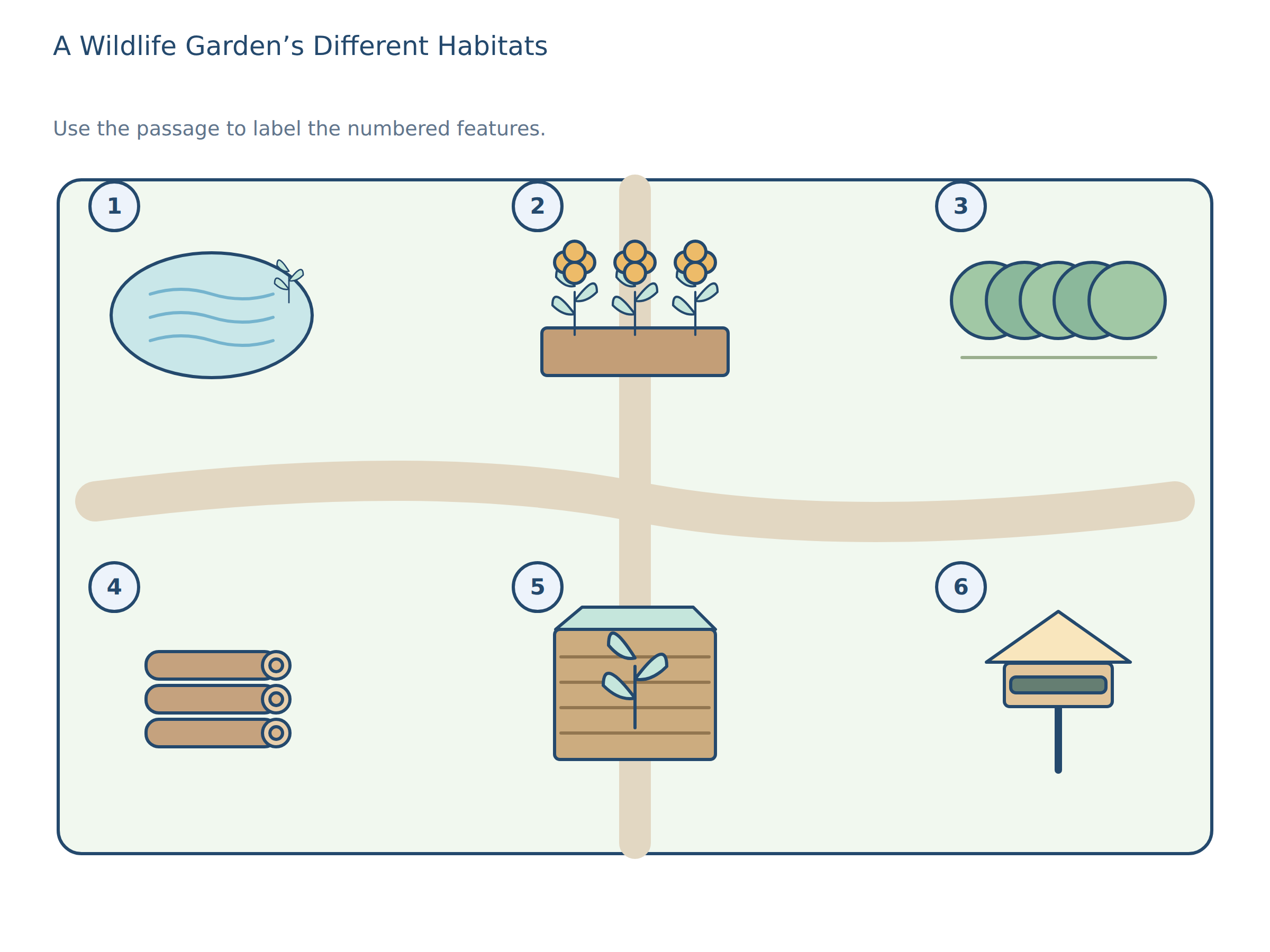
Mia designed her school garden to help local animals live, feed, and hide. She wanted one small place to offer several habitats, so she arranged each area with a different purpose. In the upper left, she built a shallow pond with a few flat stones at the edge. Frogs can rest there, drink safely, and jump away into the water if a cat appears. In the upper centre, she planted a wide border of wildflowers, including lavender, daisies, and thyme. This sunny patch brings bees and butterflies close to the flowers. In the upper right, she grew a thick hedge from native shrubs. Small birds use it as shelter when the wind is strong, and some of them also build nests inside it. She placed the taller plants at the back so the smaller creatures would still have space in front. Below that, the lower left holds a tidy log pile under a young tree. Mia left the wood damp on purpose because beetles and woodlice prefer dark, moist places, and the slow decay of the logs returns food to the soil. The lower centre has a compost heap inside a wooden box. Kitchen scraps, dead leaves, and grass cuttings break down there, and worms turn them into rich earth for the beds nearby. On the lower right, a bird feeder hangs from a slim pole beside a small dish of water. Robins and finches visit it when insects are hard to find, so the feeder helps them through colder weeks. Mia checks the garden after school and keeps chemicals out of it. She says the best thing is that each habitat supports different creatures at different times of year. On warm days the insects stay near the flowers, while on wet days frogs use the pond and birds hide in the hedge. Because the spaces are close together, the animals can move from one area to another without leaving the garden. Mia likes watching that change, because it shows how a small garden can stay lively all year. It also means the garden does not depend on only one kind of animal. Even when one place is quiet, another part is busy. In spring the wildflowers open first, and later the compost helps new plants grow strong. That balance makes the garden useful as well as pleasant.
-
Question 1 · Label the image
Match the labels to the marked regions of the image.
Read the passage and choose labels for the diagram of the wildlife garden.
Return to the passage, recording or visualImage labels
hedge · log pile · compost heap · bird feeder · stone path · sand tray · pond · wildflower border
Label regions region-1, region-2, region-3, region-4, region-5, region-6 marked on the image above.
Check answers and explanations
- Region region-1
- pond
- Region region-2
- wildflower border
- Region region-3
- hedge
- Region region-4
- log pile
- Region region-5
- compost heap
- Region region-6
- bird feeder
Label 1: Pond is in the upper left. Label 2: Wildflower border is in the upper centre. Label 3: Hedge is in the upper right. Label 4: Log pile is in the lower left. Label 5: Compost heap is in the lower centre. Label 6: Bird feeder is in the lower right. The stone path and sand tray are not described as garden habitats.
In the upper left, she built a shallow pond with a few flat stones at the edge. Frogs can rest there, drink safely, and jump away into the water if a cat appears
In the upper centre, she planted a wide border of wildflowers, including lavender, daisies, and thyme. This sunny patch brings bees and butterflies close to the flowers. In the upper right, she grew a thick hedge from native shrubs. Small birds use it as shelter when the wind is strong, and some of them also build nests inside it
Below that, the lower left holds a tidy log pile under a young tree. Mia left the wood damp on purpose because beetles and woodlice prefer dark, moist places, and the slow decay of the logs returns food to the soil. The lower centre has a compost heap inside a wooden box. Kitchen scraps, dead leaves, and grass cuttings break down there, and worms turn them into rich earth for the beds nearby. On the lower right, a bird feeder hangs from a slim pole beside a small dish of water. Robins and finches visit it when insects are hard to find, so the feeder helps them through colder weeks
What to review next
Find the words that support each answer. For a mistake, compare the question with the evidence and identify the detail or inference you missed.
A focused practice result shows how you did on these tasks. Use several activities across skills to decide what to study next; one practice score does not certify an overall CEFR level.
Before you practise: a worked example
Look for evidence in the text. Separate what the writer says from what you already know about the topic.
The library normally closes at six, but on Fridays it stays open until eight. When does it close on Friday?
The answer is eight. But introduces an exception to the normal closing time, so the first time mentioned is not the answer.
This teaching example is separate from the scored questions. After your test, compare any mistakes with the explanation and revisit the topic before trying again.