
Finding Places in the Town Square
About this practice test
Read about places in a small, busy town square and match each place to its position on a simple diagram.
What you’ll practice
Finding detail
Locate specific information and evidence.
Interpreting ideas
Connect main points and inferences.
Evaluating arguments
Assess claims, evidence, and limitations.
What to expect:
1 question with explanations to review after submission.
Study the questions and tasks
Work through the material below, or start the interactive practice above to complete an attempt. Try the exercises before opening any answer or transcript sections, then use them to review your work.
- Practice level
- A1. Try this level if you can follow the instructions and understand most of the language; choose an earlier level if you need more support.
- Question formats
- Label the image
How to approach this practice
Read the passage for its main idea, then return to the relevant sentence or paragraph for each question. Base answers on the passage.
Finding Places in the Town Square
 region-1
region-2
region-3
region-4
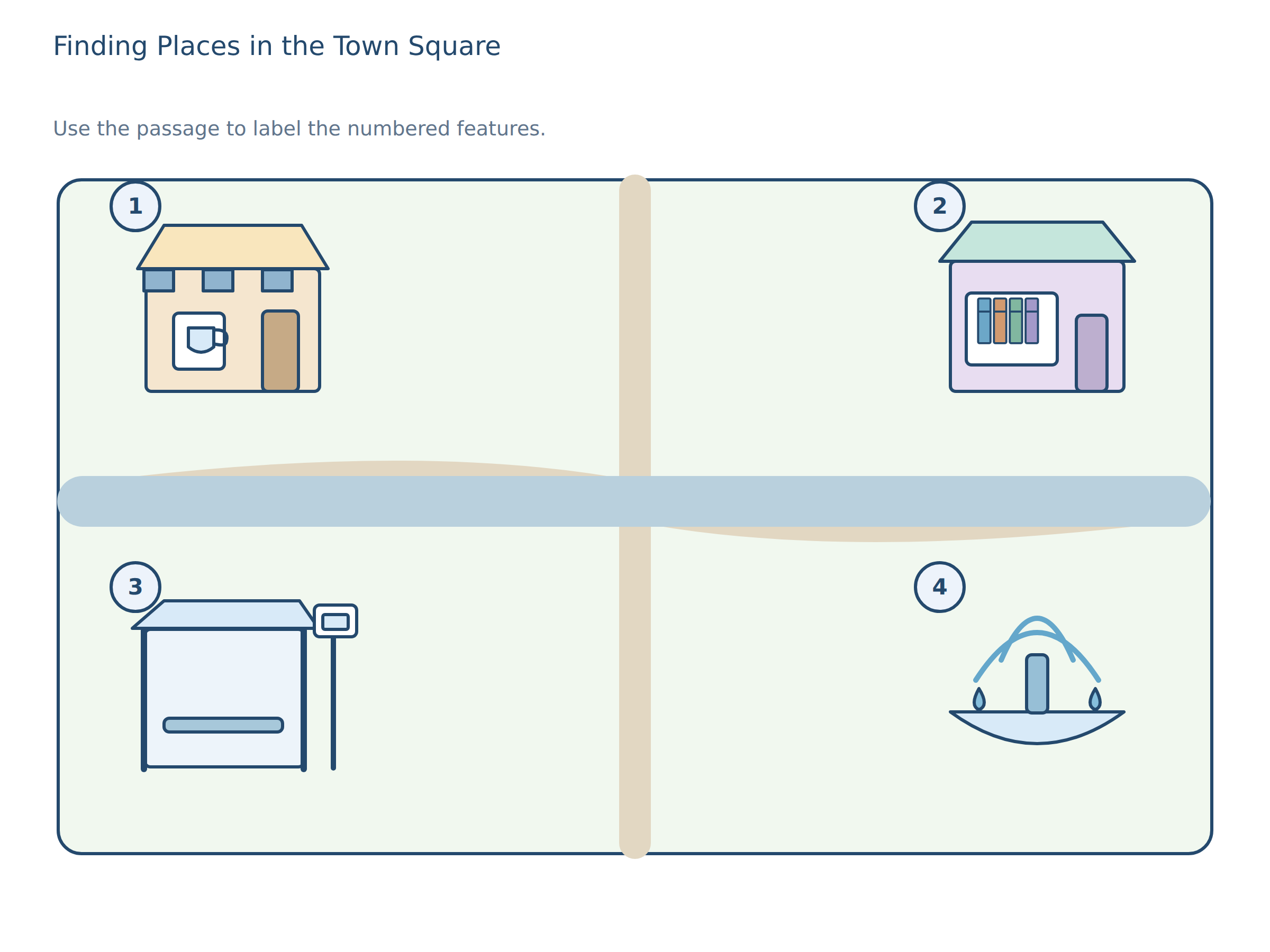
In the town square, the café is in the upper left. People buy tea and bread there, and they rest at the small tables. The bookshop is in the upper right. You can find maps and postcards there. The bus stop is in the lower left. Travelers wait there for the blue bus each afternoon. The fountain is in the lower right. Children like to sit near it and watch the water. The square is small, but it is busy and friendly.
-
Question 1 · Label the image
Match the labels to the marked regions of the image.
Read the passage and choose labels for the diagram.
Return to the passage, recording or visualImage labels
bus stop · fountain · bakery · post office · café · bookshop
Label regions region-1, region-2, region-3, region-4 marked on the image above.
Check answers and explanations
- Region region-1
- café
- Region region-2
- bookshop
- Region region-3
- bus stop
- Region region-4
- fountain
Label 1: café — it is in the upper left, where people buy tea and bread. Label 2: bookshop — it is in the upper right, with maps and postcards. Label 3: bus stop — it is in the lower left, where travelers wait for the blue bus. Label 4: fountain — it is in the lower right, where children watch the water.
the café is in the upper left
The bookshop is in the upper right. You can find maps and postcards there. The bus stop is in the lower left
The fountain is in the lower right
What to review next
Find the words that support each answer. For a mistake, compare the question with the evidence and identify the detail or inference you missed.
A focused practice result shows how you did on these tasks. Use several activities across skills to decide what to study next; one practice score does not certify an overall CEFR level.
Before you practise: a worked example
Look for evidence in the text. Separate what the writer says from what you already know about the topic.
The library normally closes at six, but on Fridays it stays open until eight. When does it close on Friday?
The answer is eight. But introduces an exception to the normal closing time, so the first time mentioned is not the answer.
This teaching example is separate from the scored questions. After your test, compare any mistakes with the explanation and revisit the topic before trying again.